What Is a Chief Medical Information Officer (CMIO)?
A Chief Medical Information Officer, commonly referred to as a CMIO, is the healthcare executive responsible for bridging clinical care and information technology within a health system. Unlike a Chief Information Officer (CIO), who oversees the broader technology infrastructure, the CMIO brings a clinical lens to health informatics decisions, ensuring that electronic medical records (EMRs), clinical information systems, and emerging technologies serve the needs of physicians, nurses, and patients alike. For industry professionals seeking to engage health system leaders on technology, data, and clinical workflow solutions, the CMIO is often the most consequential and misunderstood executive in the room.
At The Health Management Academy (THMA), we convene CMIOs from the nation's largest and most influential health systems twice a year through our Chief Medical Information Officer Forum. The insights in this guide draw on our proprietary executive priorities research, direct engagement with CMIO cohorts, and post-forum debriefs conducted with senior information officers. Whether you are new to selling into health systems or looking to refine your engagement strategy, this guide will give you a substantive understanding of who CMIOs are, what they care about, and how to earn their trust.
What Does a Chief Medical Information Officer Do?
The Chief Medical Information Officer oversees the intersection of clinical practice and healthcare technology within a healthcare organization. In practical terms, this means the CMIO is the executive accountable for ensuring that technology investments translate into measurable improvements in patient care, clinical workflows, and operational efficiency.
Core Responsibilities
On a day-to-day basis, CMIOs are responsible for a range of activities that span both the clinical and technical sides of a health system. They serve as the primary liaison between IT departments, medical staff, and executive leadership on matters of clinical information systems. They lead the evaluation, selection, and implementation of EMR platforms and related clinical applications. They govern standards for computerized physician order entry (CPOE) and clinical decision support tools. They direct clinical informatics initiatives, including the training of medical professionals on new technology and the ongoing optimization of electronic health records workflows. And they evaluate emerging technologies, including artificial intelligence and automation tools, through a lens that balances patient outcomes with financial and operational feasibility.
The Clinical Authority That Sets CMIOs Apart
A distinguishing characteristic of the CMIO is the clinical authority they carry. Most CMIOs are physicians, and their ability to speak credibly to medical staff about the practical implications of a given technology is what separates this role from its purely technical counterparts. When a health system is weighing whether to adopt a new AI-driven documentation tool, for instance, the CMIO is the executive who can evaluate both the clinical merit and the integration burden, and who will be accountable for clinician adoption.
Where the CMIO Sits in the Healthcare Organization
Understanding how the Chief Medical Information Officer fits within the organizational hierarchy of a healthcare institution is critical for anyone trying to navigate the decision-making structure of a health system.
The CMIO most commonly reports to the Chief Information Officer (CIO), though the specific reporting relationship varies considerably by system. In some organizations, the CMIO reports directly to the Chief Medical Officer (CMO) or the Chief Executive Officer (CEO). In many cases, there is a dotted line relationship between the CMIO and the CIO, the CMO, or both. Our research across leading health systems shows that CMIOs and CNIOs (Chief Nursing Information Officers) report to the CIO and the Chief Physician or Nursing Executive, respectively, and that they oversee the front-line implementation of technology while serving as liaison between the informatics interests of clinical staff and the executive leadership team.
Why the CMIO Is Not an Isolated Point of Contact
What matters for industry professionals is that the CMIO operates at a unique crossroads. While CIOs are deepening their relationships with finance leaders and CFOs, particularly around investment portfolio management and ROI attribution, CMIOs are increasingly aligning with operations executives. Our latest forum debriefs reveal a general shift of clinical informatics toward operations and revenue cycle management (RCM), as the wins from investments like ambient clinical documentation have drawn informatics leaders closer to the operational core of the enterprise. Engaging a CMIO effectively requires understanding the broader coalition of executives they work alongside, including the COO, the CIO, and clinical department leaders.
How the CIO and CMIO Roles Diverge
It is also worth noting the growing distinction between the CIO and the CMIO in terms of strategic orientation. CIOs across the market are actively shifting the cultural view of IT from a cost center to an investment and transformation center, and are moving toward agile, software-development-style operating models. The CMIO, meanwhile, is increasingly the executive who translates those structural changes into clinical reality. If the CIO is rewriting how IT is governed, the CMIO is the one ensuring that physicians, nurses, and clinical departments can actually adopt and benefit from what comes out of that new governance.
CMIO Strategic Priorities
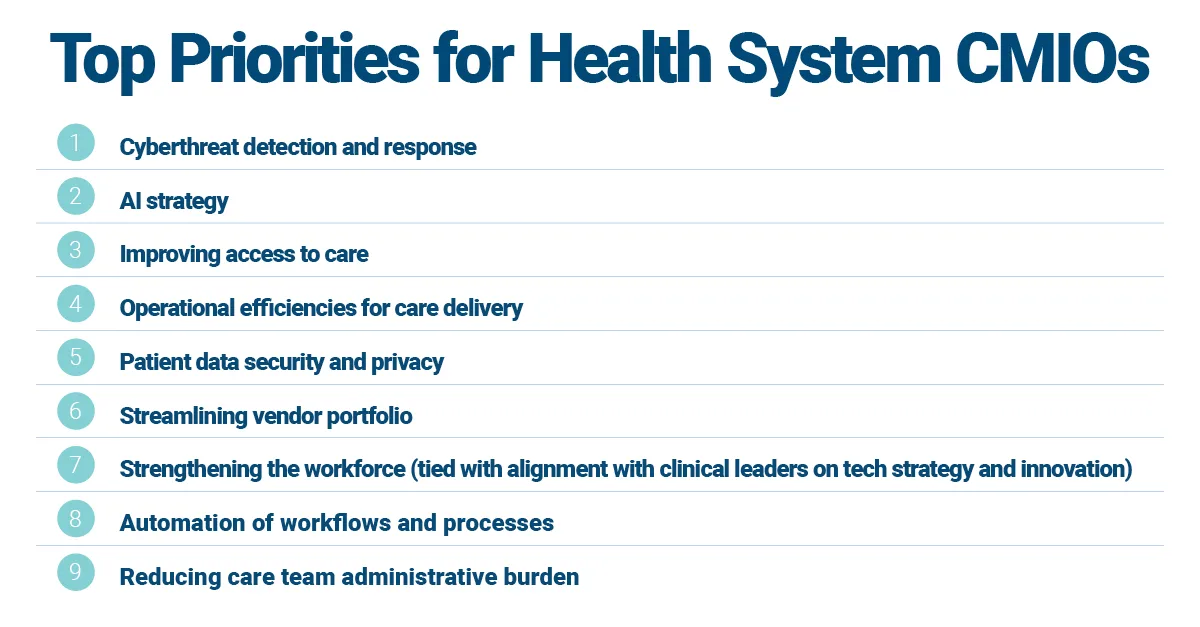
According to our executive priorities research, information officers (a cohort that includes CIOs, CMIOs, and CNIOs) rank their top strategic priorities as follows:
Cyberthreat detection and response
AI strategy
Improving access to care
Operational efficiencies for care delivery
Patient data security and privacy
Streamlining vendor portfolio
Strengthening the workforce (tied with alignment with clinical leaders on tech strategy and innovation)
Automation of workflows and processes
Reducing care team administrative burden
Year-Over-Year Priority Shifts
When assessing which priorities have become more important relative to prior years, the shifts are revealing:
75% of information officers rated AI strategy as more important than it was the year before
67% said the same about cyberthreat detection and response
58% said improving access to care had risen in importance
53% said streamlining the vendor portfolio was a growing concern
For industry partners, the takeaway is straightforward. The CMIO is operating in an environment where cybersecurity is table stakes, AI is the dominant strategic conversation, and there is mounting pressure to consolidate an unwieldy technology vendor ecosystem. Understanding where your solution fits within these priorities is the first step toward a productive engagement.
Where the Largest Gaps Remain
Our research also identifies the areas where information officers see the largest gap between current performance and desired outcomes, or the greatest improvement opportunities. The top five are: reducing care team administrative burden, consumer-centered care delivery, healthcare affordability, improving access to care, and AI strategy. That the number-one improvement opportunity (reducing administrative burden) ranks tenth in overall priority importance is itself instructive. It signals that while CMIOs recognize this as a critical unmet need, it competes for attention against more urgent imperatives like cyber defense and AI governance.
What CMIOs Care About When Evaluating Solutions
For industry sales professionals, understanding how CMIOs evaluate potential technology partners is at least as important as understanding what they are trying to solve. Based on our research into information officer decision-making, CMIOs and their peers typically evaluate solutions using a consistent set of criteria:
Business continuity planning and joint scenario planning for outages
Interoperability with existing systems (especially the EMR)
Operational efficiency impact across IT and clinical functions
Hard ROI (revenue, efficiency gains, cost reduction) plus soft ROI (reduced burden/frustration)
Compliance and security risk (data sharing, information security)
Evidence the company will be a long-term transformation partner, not a transactional vendor
The Vendor vs. Partner Distinction
That final criterion deserves particular attention. Our most recent forum debrief with CIOs and CMIOs surfaced a growing emphasis on the distinction between vendor and partner. CMIOs and CIOs increasingly view technology purchases as near-term investments made so that the health system can build its own in-house capabilities over the long term. For sellers, a pitch focused solely on the immediate use case will fall short. Instead, present a partnership roadmap that includes the current solution and future co-development opportunities, demonstrating that you are invested in the system's long-term clinical and technical maturity, not simply closing a transaction.
How Industry Partners Can Build Trust with CMIOs
Trust is the foundation of a CMIO relationship. Our forum discussions consistently reinforce that the industry partners who succeed with this audience are those who approach engagements with transparency, clinical empathy, and a willingness to share risk.
Lead with Model Visibility and Transparency
In conversations with CMIOs during our recent convenings, the number one thing information leaders say they want from technology partners is visibility into the models they are investing in. This is especially true for AI and automation solutions. CMIOs want to understand how a model was trained, what data underpins it, how performance is monitored over time, and what processes are in place to detect and correct model drift. Solutions that have gained the most traction in the market are those that have embedded health system needs and priorities into their product roadmaps, rather than simply acknowledging feedback while pursuing a predetermined internal agenda.
Demonstrate Flexibility in Deployment and Development
Health systems differ substantially in their organizational structures, cultural readiness, and clinical priorities. A rigid, one-size-fits-all deployment model will raise red flags. CMIOs and their teams want input into how solutions are configured, piloted, and scaled within their environments. The ability to co-develop with a system, rather than deliver a finished product with limited adaptation, signals a deeper commitment.
Be Prepared to Share Financial Risk
The imperative for hard ROI on technology investments, particularly AI investments, has grown considerably. Finance leaders and CIOs are becoming more aggressive on ROI accountability, and some systems are now baking projected cost mitigation claims from AI investments directly into their prospective operating budgets. We have seen examples of health systems planning anywhere from five to fifty million dollars in prospective budget reductions based on anticipated FTE savings from current-year AI deployments. In this environment, CMIOs are hearing from their CFOs that vendors need to have skin in the game. Industry partners who can offer shared-risk financial structures, performance guarantees, or outcome-based pricing models will find a more receptive audience.
Build a Coalition Beyond the CMIO
The CMIO does not make purchasing decisions in isolation. As clinical informatics continues its drift toward operations, and as CIOs build closer alignment with finance, the decision-making coalition for any major technology investment spans multiple C-suite and senior vice president roles. Engaging the CMIO is essential, but a successful engagement strategy also accounts for the COO, the CFO, the CIO, and the individual business unit leaders who are increasingly accountable for specific value levers under the agile operating structures that many health systems are adopting.
Address Workforce Readiness with Care
Workforce anxiety around AI and automation remains a genuine barrier to adoption, particularly among nurses. Our research shows that nursing sentiment toward AI trails physician sentiment across nearly every use case, and that frontline nursing staff continue to express concern about replacement, accuracy in automated workflows, and the pace of implementation. CMIOs are acutely aware of this dynamic. Partners who can demonstrate thoughtful change management frameworks, tiered training programs, and evidence of successful adoption in comparable clinical settings will differentiate themselves from those who focus only on the technology.
Where to Meet and Engage CMIOs

For industry executives seeking direct access to Chief Medical Information Officers, the venue matters as much as the message. Large trade shows offer scale, but the candid, strategic conversations that move relationships forward tend to happen in smaller, more focused settings where health system leaders feel comfortable speaking openly about their priorities and challenges.
The Chief Medical Information Officer Forum
Our Chief Medical Information Officer Forum is purpose-built for this type of engagement. The CMIO Forum brings together health technology thought leaders from the nation's leading health systems, including organizations such as Providence, Northwell Health, Mayo Clinic, Kaiser Permanente, Ochsner Health, UPMC, Mass General Brigham, and Intermountain Health, among others. The forum operates on principles of shared and experiential learning, best practice sharing, and collaborative problem solving around the most pressing challenges in clinical care, healthcare technology, and innovation.
Recent forum discussions have centered on topics that define the current CMIO agenda: the promise and reality of AI in clinical settings, the challenge of measuring and attributing ROI for technology investments, workforce evolution and the role of technology in addressing clinical burnout, the advancement of care transformation models like hospital-at-home and virtual nursing, and the imperative to build partnerships between health systems and industry that go beyond the traditional vendor-customer dynamic.
What distinguishes the forum from a typical healthcare conference is the quality and seniority of the participants. The conversations are confidential, the attendance is curated to include only senior executives, and the format is designed to facilitate two-way dialogue rather than one-directional presentations. For industry partners, participating in the CMIO Forum provides a context for relationship-building that simply does not exist in larger conference environments.