Insights
THMA's Weekly Essentials


Upcoming Events
Browse by Topics
Featured All-Access Insights

Podcasts
The Strategist in Brief: October 15, 2026
Listen to the episode on a streaming platform by clicking one of the links below:
Health system leaders at The Health Management Academy’s Fall 2026 CEO Forum discussed the policy pressures and financial realities that are forcing systems to rethink business as usual.
Affordability was a major theme. CEOs discussed how policymakers sometimes frame the debate around the price of a single service, not the total cost of care.
Limited ED and inpatient bed capacity is pushing some systems to make greater use of value-based care strategies. Mandatory CMS payment models and direct-to-employer offerings are accelerating the trend.
CEOs worry that stacking too many AI point solutions will make overall workflows less efficient, even if each individual use case has a positive return on investment.
Labor costs are pushing systems to reimagine how care is delivered, but CEOs say culture and clinician training remain major obstacles.
HRSA named ten drugmakers and 21 high-cost drugs for its reworked 340B rebate pilot, set to launch January 1. Drugs eligible for the pilot account for less than 5.5% of 340B purchases, but a successful rollout could pave the way for a broader shift away from upfront discounts.
The AHA and other provider groups have once again sued to block the pilot, arguing annual administrative costs could top $1B, nearly double HRSA’s $537M estimate.
In other 340B news, a growing number of health systems are suing CVS, alleging the company withheld nearly $300M in 340B savings.
Five Democratic governors asked HHS to delay the January 1 deadline for Medicaid work requirements, citing new frailty definitions and verification rules that states say they can’t implement in time.
Medicaid coverage losses will build gradually through 2027, with a different timeline in each state depending on the specifics of implementation.
This week’s featured graphic tracks the recovery in health system operating margins, with new data from Strata Decision Technology.
After dipping below zero early in the year, the median health system margin climbed to 0.7% in June. That’s still below the 1.0%–1.5% range seen throughout much of the second half of 2025.
How Children's Health Decides Where to Grow Next
Listen to the episode on a streaming platform by clicking one of the links below:
In this episode of The Strategy Catalyst Dispatch, Dennis Thé, Vice President of Strategy and Business Development at Children's Health System of Texas, walks us through how the leading pediatric system in North Texas decides where to grow.
Children's Health serves about one million patients a year across two campuses and is building a $5 billion campus in partnership with UT Southwestern. Dennis explains what makes pediatric growth decisions different from adult ones, why the system evaluates growth across its full portfolio rather than site by site, how that thinking led them to move their inpatient rehab unit from Dallas to Plano and convert the freed-up capacity into NICU beds, and how community need shaped the services at the Redbird Specialty Center south of Dallas.
The Strategist in Brief: October 1, 2026
Listen to the episode on a streaming platform by clicking one of the links below:
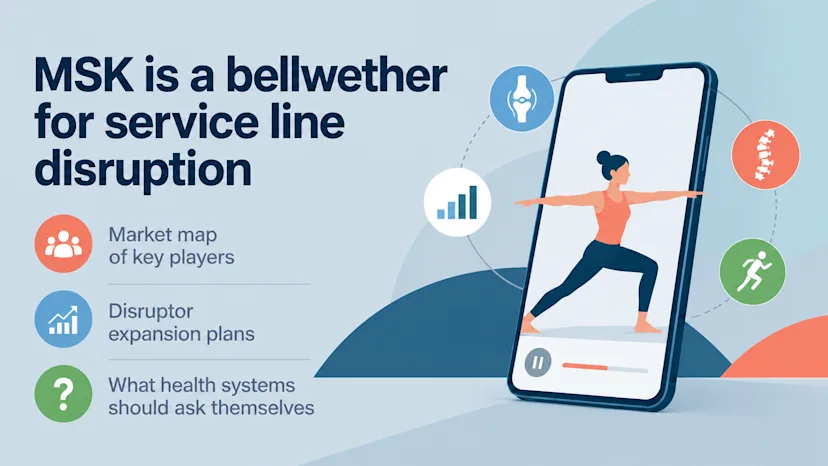
This week’s Key Market Dive looks at the landscape for musculoskeletal care, one of the largest service lines facing one of the most rapid transitions to outpatient settings.
Multiple forces are reshaping the market: digital MSK platforms and benefit networks capture and steer patients upstream, ASCs siphon off profitable routine procedures midstream, and PE-backed platforms consolidate the full orthopedic value chain.
Digital MSK leaders Hinge Health and Sword Health are expanding their platforms into GI care and behavioral health, leveraging their existing relationships with employers and health plans.
Our featured graphic showcases data from The Health Management Academy’s 2026 AI Use Case Benchmarking Survey Report, which surveyed 52 health systems.
Health systems that have deployed more than a dozen AI use cases report a positive ROI in most cases where ROI can be measured, suggesting that returns hold up even as AI portfolios grow.
Ascension is selling its ownership stake in an Arizona-based Medicaid plan called Mercy Care to Aetna for an undisclosed amount.
Mercy Care has massive revenues and dual-eligible enrollees, but also has a margin of less than one percent. Aetna has enough scale to take on that financial risk in an uncertain policy environment.
Counsel Health will join CMS's ACCESS Model with Oura as its preferred wearable partner, offering no-cost chronic care to eligible Medicare beneficiaries starting in early 2027.
ACCESS's low rates, which many digital health companies passed on, work for Counsel because its AI-first care model is cheap to run and Oura's 5 million paid members give it low-cost patient acquisition.
The Strategist in Brief: September 17, 2026
Listen to the episode on a streaming platform by clicking one of the links below:
We asked a half dozen health system strategy leaders how their teams use GenAI for strategic planning work.
Information gathering is a top use case: some strategy teams use AI to size up markets faster, build competitor and hospital profiles, and reach a point of view on acquisition targets.
Several teams use AI to create finished deliverables, but verification and cleanup work can be time intensive.
Some teams are forced to stick with organizationally sanctioned AI tools that are clunkier than popular consumer tools like ChatGPT and Claude, which slows adoption.
At a recent roundtable discussion hosted by Strategy Catalyst, health system strategy leaders discussed different approaches to physician alignment and growth.
Many health systems employ multiple alignment strategies at the same time. The right model can vary by market or service line.
Health systems are facing pressure from rising costs for hospital-based specialties and competition from private equity.
This week’s featured graphic looks at average CEO tenures across different industries, based on data from Crist Kolder Associates. Healthcare is middle-of-the-pack, with an average tenure of 6.4 years.
A separate survey of health system CEOs specifically, by the consultancy SullivanCotter, found an average tenure of just over seven years.
This week’s lead news flash: Johnson & Johnson will require 340B providers to submit claims data to receive discounts, following in the footsteps of Eli Lilly and Novo Nordisk.
Videos
Inside an AI Operating Model: Montefiore’s Approach to Governance, Portfolio Decisions, and Adoption
As health systems move from isolated AI pilots to enterprise deployment, leaders need a disciplined way to govern, evaluate and scale solutions across clinical and operational settings.
In this webinar, leaders from Montefiore Health System share their approach to establishing AI governance amid competing stakeholder priorities and growing demand for AI-enabled capabilities. Speakers discuss how Montefiore's AI journey has evolved and how AI solutions are evaluated — including capabilities from existing third-party partner platforms and when internal development makes sense. Panelists also discuss how they determine where AI agents can deliver value across the organization.
Through clinical and operational case studies, the panel outlines a repeatable governance framework by sharing the role of AI agents in redesigned workflows and learnings from deployment. Attendees will leave with practical guidance for assessing impact through hard financial measures as well as patient, clinician, and employee experience outcomes.
The Ambulatory Calculus: Competing With What You Have Now
A second outpatient migration is underway, as surgery and infusion leave the hospital outpatient department for freestanding sites that don’t earn HOPD rates. This shift is driven less by clinical advances than by who pays and who owns the site: physicians with ASC equity pull surgical cases, and payer site-of-care policies pull infusions. Health systems compete for that volume against independent physicians, payer-owned sites, and well-capitalized national platforms. Every case moved early gives up hospital revenue, and every case moved late may end up somewhere else.
In this member-led session, Strategy Catalyst leaders are joined by executives from Baptist Health, ChristianaCare, and Ochsner Health, who share how they’re competing for the surgical and infusion volume leaving the HOPD.
Member Speakers:
Phil Gaby, Executive Director of Surgical Service Lines, Baptist Health
Douglas Azar, Senior Vice President, Growth & Strategic Partnerships, ChristianaCare
Emily Lawrence, VP of Cancer Service Line and Precision Medicine, Ochsner Health
Neil Hunter, System Director of Sterile Drug Compounding Operations, Ochsner Health
Unlocking the Executive Insights Hub: Your Membership Orientation & Guided Walkthrough
The Executive Insights Hub is THMA's dedicated research and data center, built to keep industry teams current on healthcare market trends and health system CXO priorities. In this orientation, we walk through everything your membership unlocks — the specific deliverables, tools, and services at your disposal — so you and your team can get the most out of your access.
Logged-in members have access to the full orientation and can start exploring everything their membership unlocks.
Q3 2026 Healthcare Trends: Finance and Budgeting Survey
Aggregate operating margins at nonprofit health systems slid from 2.2% to 1.3% over the past three quarters. Budgets went the other direction: 56% of finance leaders told The Health Management Academy their operating budget will increase over the next 12 months, up 21 points from last year. Health systems are splitting into two groups and buying very differently. Increasers report strengthening financial health and a growth posture, and skew large and multi-state. Decreasers are contingency-oriented, single-state or regional, and planning for downside risk.
The pressure is broad and the policy risk is sharpening. Finance leaders expect negative impact from labor (88%), drugs (88%), and supplies (78%), but the fastest-rising concern is site-of-care shift — up 19 points to 69%, with Academy modeling putting $42M of near-term facility revenue at risk for a $5B system and $247M at a 2028 run rate. Medicaid reform ranks as the top financial risk, with work requirements taking effect January 2027. Spending is still moving: advanced practice providers and permanent physicians lead anticipated increases at 76% each, followed by pharmaceuticals at 75%, while 78% plan to cut travel and contract nurses.
Based on a quantitative survey of 32 CFOs and senior finance leaders at health systems with more than $750M in annual revenue, this Q3 2026 Market Pulse also shows where AI stands against the business case. Only 16% of finance leaders say AI has met their ROI expectations; a quarter say it has fallen short, citing integration gaps and difficulty measuring financial impact. Anticipated returns concentrate in revenue cycle and documentation. Finance leaders were direct about what they want from industry partners — risk-adjusted models that account for implementation cost, evidence from comparable systems, transparent total cost, and follow-through after go-live.
Whether you're in an active sales cycle or building your 2027 engagement strategy, this briefing gives you the numbers to show up informed.
Please log in to view the full recording and access downloadable materials.