How to Use Healthcare Conferences to Anticipate Health System Needs
TL;DR
Healthcare conferences can act as early signal environments when you know what to listen for.
The most useful information surfaces in peer conversations, not keynote presentations.
Repeated questions, hesitation, and unresolved debates often reveal future health system priorities before they show up in budgets or formal plans.
Leaders who listen intentionally can adjust strategy earlier and avoid reacting too late.
Why Anticipation Matters More Than Attendance
Many healthcare conferences focus on what has already happened. For leaders trying to stay ahead of health system needs, that backward view has limits.
When approached intentionally, the right conferences offer something more useful. They reveal where pressure is building and where decisions are likely to follow, often surfacing in candid peer conversations and comparisons.
The value is not in how many sessions you attend, but in how closely you listen.
Why Healthcare Conferences Reveal Needs Before They Are Formalized
Health system leaders do not wait for final strategies to talk about problems. They talk about them while they are still unresolved.
Conferences create space for executives to compare experiences with peers facing similar constraints. Budget pressure, staffing shortages, service line trade-offs, and skepticism toward new solutions surface informally long before they are written into plans.
In these moments, leaders are not presenting answers. They are testing assumptions out loud. That testing process is where future needs first become visible.
Reactive Conferences vs. Anticipatory Environments
Not every conference creates conditions for this kind of listening.
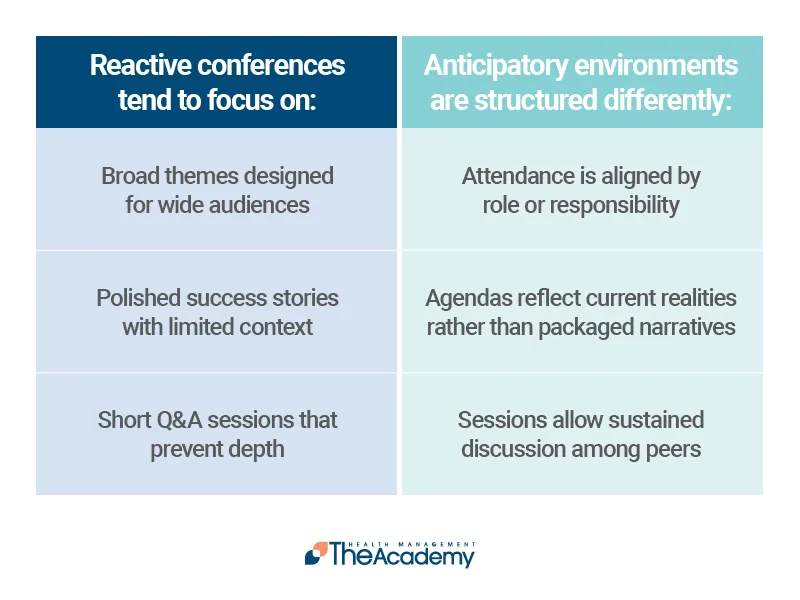
Reactive conferences tend to focus on:
Broad themes designed for wide audiences
Polished success stories with limited context
Short Q&A sessions that prevent depth
Anticipatory environments are structured differently:
Attendance is aligned by role or responsibility
Agendas reflect current realities rather than packaged narratives
Sessions allow sustained discussion among peers
The structure of the event determines whether you leave with hindsight or foresight.
Signals to Watch for at Healthcare Conferences
Anticipation does not come from a single comment. It comes from patterns throughout conversations.
What Leaders Ask Each Other
Pay attention to questions executives ask peers, not moderators. Repeated questions often signal uncertainty or urgency. When leaders seek reassurance from one another, it usually means internal alignment is still forming.
Where Conversations Slow Down
Moments where discussion stalls or circles back are often more revealing than confident statements. These pauses point to areas where existing approaches are no longer working effectively.
Language That Is Changing
Subtle shifts in language matter. When familiar terms are replaced with qualifiers or enthusiasm is paired with caution, it often reflects changing priorities that have not yet been formalized.
Peer Conversations as Early Warning Systems
Peer-level dialogue is one of the fastest ways priorities take shape in healthcare. Leaders use these conversations to compare constraints, validate instincts, and learn how others are responding to similar challenges.
When the same concern surfaces across multiple systems, it’s usually an early sign of a broader shift underway. Listening for repetition across different conversations is one of the most reliable ways to anticipate what will demand action next.
Where Cross-Functional Pressure First Appears
Many future needs emerge where roles intersect.
Clinical goals may conflict with operational capacity
Technology interest may outpace workforce readiness
Growth plans may collide with reimbursement realities
Conferences that bring together leaders across service lines and functions surface these tensions in real time. Understanding where pressure is building between roles often provides clearer insight than any single executive viewpoint.
Turning Conference Observations Into Direction
Anticipation only matters if it informs action.
From Conversations to Hypotheses
After a conference, step back and look for themes rather than quotes. Identify which topics surfaced repeatedly and which discussions generated uncertainty or debate.
These patterns should inform questions, not conclusions. Their value is in guiding where to focus next.
Pressure-Testing Internal Assumptions
Use what you heard to challenge internal thinking. Are your priorities aligned with what leaders are actively debating? Are you preparing for problems they are about to face or ones they have already solved?
The goal is adjustment, not overreaction.
Why Many Conferences Fall Short
Large, open-floor events often struggle to support this kind of awareness. When conversations feel performative, useful signals disappear.
This is why event design matters. Smaller, role-aligned, peer-driven environments consistently produce clearer signals than high-volume exposure.
Building a Conference Strategy Around Awareness
Leaders who use conferences well are selective. They prioritize environments that support relevance and depth.
Before committing, ask:
Who will be in the room?
How much openness does the format allow?
Are discussions driven by current pressure or prepared narratives?
The answers determine whether a conference informs future decisions or simply reinforces what is already known.
From Attendance to Awareness
Healthcare conferences can function as listening posts, not just calendar commitments.
Anticipation comes from hearing uncertainty early, recognizing patterns quickly, and adjusting direction before change becomes unavoidable.
This is where intentionally designed executive convening environments, such as those facilitated by The Health Management Academy, create real value. By prioritizing peer-level discussion and focused dialogue, these settings help leaders understand what is coming next, not just react to what already happened.
The leaders who listen closely today are better prepared for what health systems will need tomorrow.