Who Cares for the Caregivers? The Systemic Drain Depleting America's Nurses
Published 3/24/2026
Author: Andrew Reed, Assoc. Director, The Health Management Academy
Most Americans know what it feels like to start the day exhausted. In a recent survey of 2,000 U.S. adults conducted by The Health Management Academy, 62% reported waking up feeling half-charged or worse on most days. Over a third (34%) said they hadn't felt fully recharged for a single day in the past month.
But if everyday Americans are running on empty, consider the people tasked with caring for them. Nurses, the backbone of the U.S. healthcare system, are navigating that same exhaustion while simultaneously managing staffing shortages, mandatory overtime, rising patient acuity, and the emotional weight of clinical care. The result is a structural crisis threatening patient safety, workforce stability, and the long-term viability of the health systems that employ them.
To understand the depth of this problem, The Health Management Academy conducted a supplementary survey of 350 practicing nurses across the United States, examining how system-level conditions are draining their capacity and what organizational changes could restore it. Combined with national workforce data and our broader population research, the findings reveal a healthcare workforce that is systematically depleted, not by personal habits, but by the environments in which they work.
Key Findings
58% of nurses report severe or complete burnout, and more than half are actively considering leaving the profession.
Nearly 60% of nurses rarely or never feel fully recovered before their next shift, with ICU, ED, and long-term care worst affected.
Only 29% of nurses say their units are adequately staffed. The top capacity drains: inadequate staffing, excessive documentation, and unsupported patient acuity.
73% of nurses say their energy and capacity is lower than when they entered the profession, with the steepest declines among 11+ year veterans.
Nurses strongly agree (4.05/5) that caring for an increasingly exhausted general population compounds their demands, creating a feedback loop of depletion.
Most facilities offer limited structural recovery support. Only 30% of nurses have access to on-site mental health resources; just 12% have fatigue policies.
The Workforce Is Running on Empty
The general public's energy crisis is well-documented. Our January 2026 survey of 2,000 U.S. adults found that 63% say their energy levels are lower than they were five years ago, 80% agree that modern life makes real rest feel out of reach, and 59% report getting through most days on willpower rather than actual energy.
In our February 2026 nurses survey, the average self-reported energy level of a nurse at the start of a typical shift was just 2.99 out of 5, meaning most nurses begin their workday with barely more than half a tank. By the end of a shift, that number plummets to 1.65, with more than half of respondents reporting they finish completely drained.
The gulf between these two numbers paints a picture of workload intensity that no amount of personal wellness advice can address.
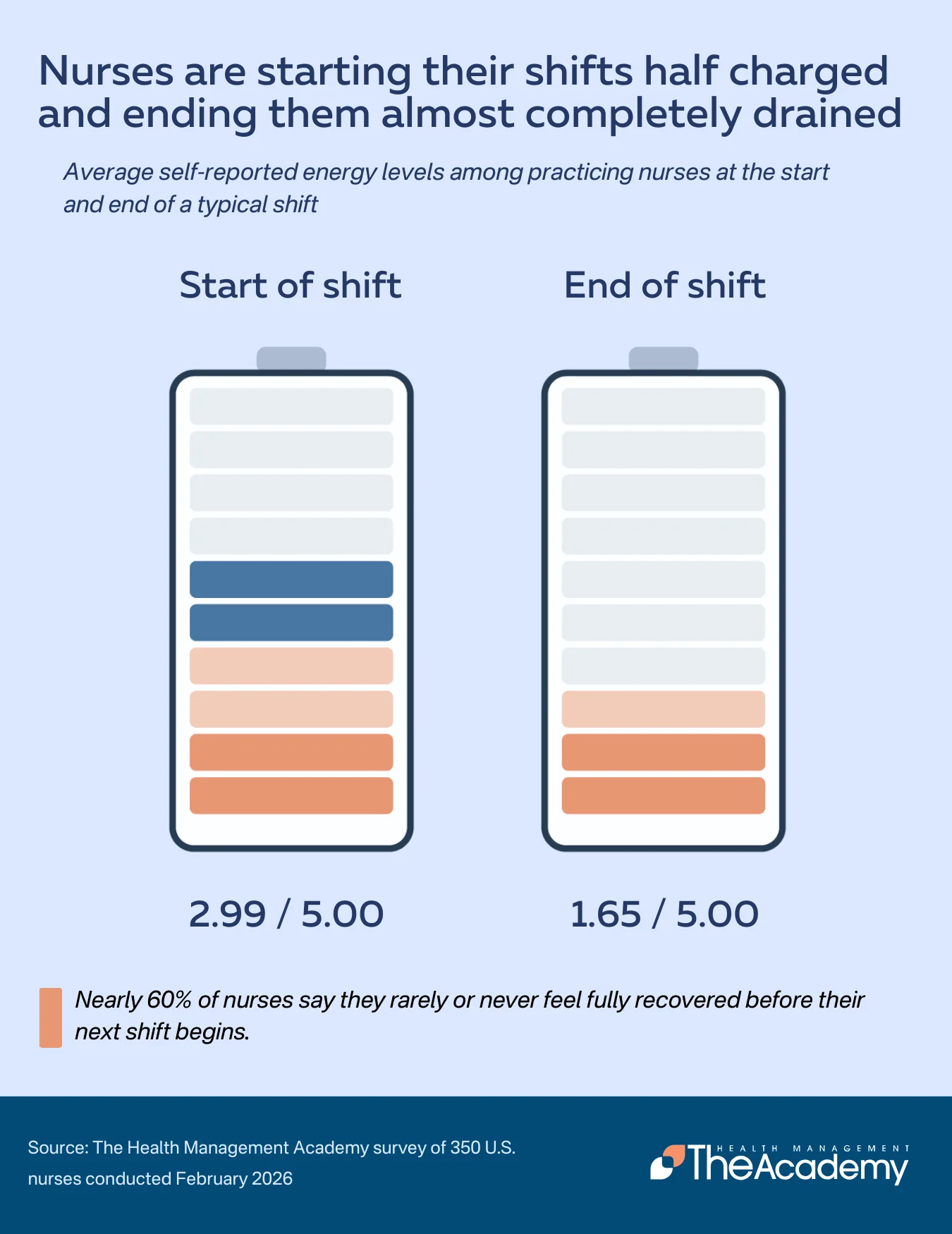
Recovery between shifts is equally concerning. Nearly 60% of nurses say they rarely or never feel fully recovered before their next shift begins. Among nurses in ICU and critical care settings, that number climbs higher still. More than one in three nurses reported starting six or more shifts in the past month while feeling too fatigued to perform at their best.
Nearly three in four nurses (73%) said their energy and capacity is lower than when they entered the profession, while just 9.1% said it was higher.
According to the NCSBN's 2024 National Nursing Workforce Study, which surveyed over 800,000 nurses, more than 138,000 left the workforce between 2022 and 2024. The top reasons cited were stress and burnout (41.5%), followed by unsustainable workloads, chronic understaffing, inadequate salary, and workplace violence. Perhaps most alarming: in the NCSBN survey, nearly 40% of all nurses surveyed said they intend to leave the profession or retire within the next five years, potentially removing 1.6 million nurses from the workforce by 2029.
The System Is the Drain
When the general public reports feeling exhausted, the causes tend to be personal: poor sleep (cited by 60% of respondents in our population survey), stress and mental overload (53%), too much screen time (49%), and doomscrolling (38%). These are real problems, but they're largely individual in nature.
The nursing workforce faces a fundamentally different set of circumstances. When asked to identify the system-level factors that drain their capacity most on a typical shift, the responses don't point to a single staffing problem; they describe an interconnected workload design failure.
Unsurprisingly, staffing tops the list, but a more granular look at the underlying data expands our understanding. When more than half of nurses also cite documentation burden, and nearly half cite unsupported acuity, the problem extends well beyond how many nurses are on the floor. Clinical time is being consumed by administrative tasks. Patient loads are rising in complexity without acuity-adjusted support models. Support roles are being absorbed into bedside nursing. The result is a care model that structurally overloads the people delivering care, even on shifts where the raw headcount looks adequate on paper.
That overload shows up in how nurses assess their own care delivery. When asked whether they agree with the statement "on most shifts, I am able to provide the standard of care I believe my patients deserve", the average response was just 2.03 on a scale of 1 (strongly disagree) to 5 (strongly agree). The majority of nurses disagree that they can deliver the care their patients need on a typical shift.
The cost of replacing a single bedside Registered Nurse (RN) now comes with an average price tag of $61,110, according to the 2025 NSI report, up 8.6% year-over-year. At the hospital level, that translates to $3.9 to $5.7 million lost annually to RN turnover alone, with an 83-day average recruitment timeline to fill one experienced position.
Where the Signal Breaks Down
The system-level factors driving nurse depletion are considerable. The organizational response to those factors tells an equally important story, though not necessarily the one numbers suggest at first glance.
We asked nurses to rate three statements about organizational support on a scale of 1 (strongly disagree) to 5 (strongly agree):
"My organization genuinely prioritizes the well-being and recovery of its nursing staff": 2.37
"My shift schedule allows adequate time for physical and mental recovery": 2.50
"Leadership at my organization understands the day-to-day realities of frontline nursing": 2.19
A 2.19 on the third statement is worth carefully examining. Most nursing executives entered leadership through the bedside and understand understaffing, documentation burden, and acuity escalation because they worked through all of it. The score likely reflects less about what system leaders actually know and more about what frontline staff believe their leaders know, a perception gap that is common in large organizations, but carries particular weight in healthcare.
The communication pathway between the floor and the executive suite runs through an increasingly strained middle layer: charge nurses pulled into direct patient assignments, nurse managers overseeing more staff than any one person can maintain real visibility into. When that layer erodes, frontline staff experience leadership as distant, even when system-level leaders are actively engaged. The gap is not fundamentally a knowledge problem, but rather a signal problem, and closing it requires sustained investment in the frontline leadership infrastructure that translates bedside realities into decisions made in the boardroom.
Burnout among nurses is widely reported, but the level of severity matters. We asked nurses to rate their current level of burnout on a scale of 1 (no burnout) to 5 (completely burned out). The results show a workforce that has moved well past the early warning signs.
Burnout at this level has direct consequences. It drives up sick leave, which feeds directly into the understaffing problem nurses already identified as their biggest drain. And sick leave is the mild outcome. The more serious one is permanent departure. We asked nurses whether they have seriously considered leaving the nursing profession in the past 12 months.
Where Exhausted Patients Meet an Exhausted Workforce
Our general population survey revealed that chronic fatigue varies significantly by state. Pennsylvania emerged as the most exhausted state, with an average self-reported energy score of 2.34, followed by Ohio (2.72), Indiana (2.76), Texas (2.78), and Wisconsin (2.81). On the other end of the spectrum, Hawaii led the nation as the most well-rested state at 3.92, followed by South Dakota, Colorado, Utah, and Minnesota.
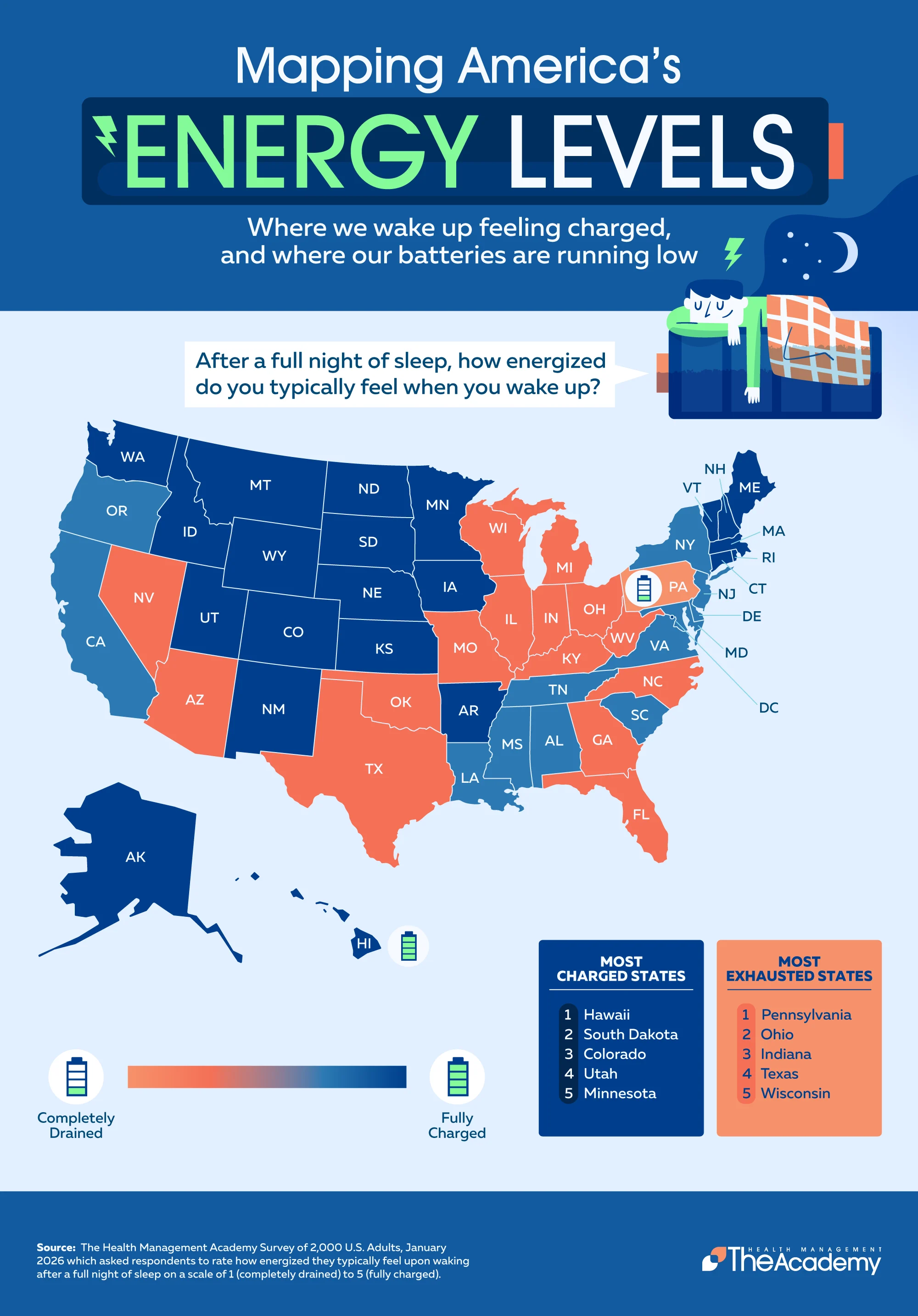
When we overlay these findings with HRSA's nursing workforce shortage projections, a more urgent picture emerges. States with some of the highest projected nursing shortages through 2036 and 2038, including Georgia (12% RN shortage projected), California (13%), Louisiana, South Carolina, and Oklahoma, are simultaneously home to populations reporting significant fatigue. In these regions, the healthcare system faces a compounding crisis: sicker, more exhausted patients being cared for by a shrinking and increasingly depleted workforce.
HRSA projects an 11% shortage of RNs in nonmetropolitan areas by 2038, compared to just 2% in metropolitan areas. Rural communities, which already face longer travel times to care, fewer specialists, and older populations with more complex health needs, will bear the brunt of workforce depletion. For health system leaders operating across multiple markets, workforce planning cannot be treated as a single national problem. It must be location-specific, accounting for the intersection of local population health needs and local workforce supply.
What Actually Recharges the Workforce
The strategies the general public says help them feel recharged are largely personal: getting enough sleep (63%), setting phone cut-off times (49%), spending time outdoors (48%), and taking breaks from screens (40%). These work for individual wellbeing, but they have almost no relevance to the structural conditions draining nurses.
The nursing workforce needs a different kind of recharge, one that happens at the organizational and policy level. We asked nurses what recovery support their facility currently offers. The results reveal how wide the gap is between what's needed and what's available.
Just 35% of nurses said their facility offers dedicated, private break spaces for staff. Thirty percent report access to on-site mental health or counseling support. Only 28% have access to flexible or self-scheduling options. Protected meal breaks, uninterrupted time to actually eat during a shift, are available to only 18%. Peer support or debriefing programs, which research consistently links to reduced burnout and improved retention, are available to just 22%.
Health system leaders are navigating these gaps under real constraints: tight margins, competitive labor markets, and regulatory demands that pull capital and attention in multiple directions simultaneously. That context matters. But the data also shows that the highest-impact interventions aren't always the most expensive ones. The absence of a protected meal break or a private space to decompress mid-shift is not primarily a budget problem; rather, it’s a design and priority problem.
Where health systems are making meaningful progress, the approach tends to share a common thread: they're redesigning the work itself, not just adding support around the edges of a broken model.
The 53% of nurses who cited excessive documentation as a top capacity drain represent one of the clearest opportunities. AI-assisted documentation and ambient clinical intelligence tools are beginning to return measurable clinical time to the bedside — not by asking nurses to work differently, but by removing the administrative accumulation that has quietly consumed hours that used to belong to patients. Early adopters are reporting reductions in per-encounter documentation time significant enough to change how a shift feels.
None of this is simple or fast. But the systems making progress share one orientation: they treat workforce sustainability as a strategic capability that requires the same rigor, investment, and senior attention as any other operational priority.
The Cost of Waiting
According to the 2025 NSI National Health Care Retention & RN Staffing Report, every nurse who leaves costs an average of $61,110 to replace and takes 83 days to backfill. At the hospital level, that translates to $3.9 to $5.7 million lost to RN turnover annually. With 52.9% of the workforce in our survey considering leaving, every month of inaction compounds the problem. Fewer nurses means heavier workloads. Heavier workloads mean faster burnout. Faster burnout means more sick leave and departures.
Nurses in this survey have identified exactly what drains them and exactly what would restore their capacity: staffing that matches patient volume, schedules that protect recovery, reduced administrative burden, fatigue policies, accessible mental health support, and leadership that closes the gap between the boardroom and the bedside.
Beginning in 2026, the Joint Commission will hold hospitals accountable for staffing adequacy as part of accreditation for the first time. The systems that act ahead of that mandate will retain more nurses, deliver safer care, and build the kind of workforce stability that compounds in the right direction.
To answer the 53.4% of nurses who cited excessive documentation as a top capacity drain, early investments in AI-assisted documentation, ambient clinical intelligence, and EHR workflow redesign are beginning to return clinical time to the bedside. Where workforce models are failing, leading systems are rethinking the scope of practice, building team-based care structures, and extending the clinical reach of experienced nurses rather than burning through them.
The health systems making progress on this aren't waiting for a workforce policy fix. They're redesigning how care is delivered by reducing non-clinical burden, investing in nursing leadership infrastructure, and treating workforce sustainability as a strategic capability, not an HR problem.
Methodology
This campaign draws on draws data from: (1) a nationally representative survey of 2,000 U.S. adults conducted by The Health Management Academy in January 2026, covering energy levels, fatigue patterns, contributing factors, and recharge strategies; (2) a survey of 350 practicing nurses across the United States, examining shift-related fatigue, system-level capacity drains, organizational support, burnout, and intent to leave; and (3) publicly available workforce data from the NCSBN 2024 National Nursing Workforce Study, HRSA workforce projections, the 2025 NSI National Health Care Retention & RN Staffing Report, the AMN Healthcare 2025 Survey of Registered Nurses, and the Nurse.org 2024 State of Nursing Survey.