Speaking at Healthcare Events: The Executive's Guide to Building Authority and Influence
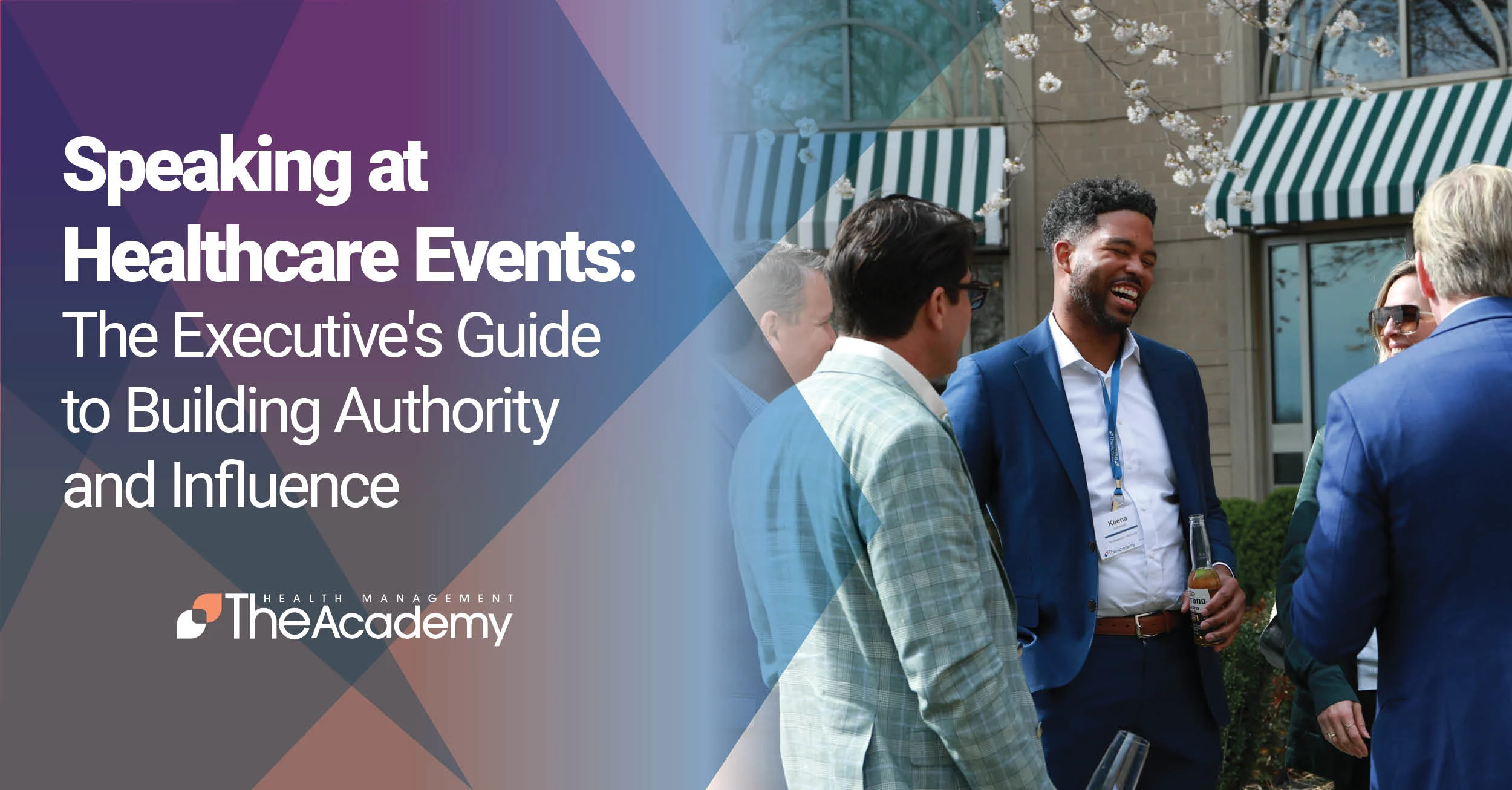
Speaking at healthcare events is one of the few non-commercial paths through which an industry executive can build a genuine relationship with a health system leader. A badge gets a commercial leader into the room. A speaking slot earns the conversation that follows.
For senior commercial leaders at pharmaceutical, health information technology, medical device, and life sciences companies, the difference matters. Health systems do not buy from organizations they have never heard reason with in public. They partner with people whose thinking they have watched, tested, and come to trust.
This guide is written for those leaders. It covers how to choose the right events, how to write a proposal that conference organizers accept, how to prepare a presentation that holds the attention of a senior healthcare audience, and how to turn a single appearance into the beginning of a durable relationship. The Health Management Academy has spent more than two decades convening health system and industry leaders in trusted, peer-driven settings, and the principles below reflect what we have observed about how authority is actually built in healthcare.
Why Speaking at Healthcare Events Matters for Industry Leaders
Presenting at a conference establishes an executive as a thought leader in a way that no marketing campaign can replicate. The act of standing in front of a room of peers and offering a point of view signals expertise that an audience can evaluate for itself. That evaluation is the point. Healthcare leaders are trained to scrutinize evidence, and a speaker who survives their scrutiny earns a kind of credibility that advertising cannot purchase.
A speaking engagement places an executive in direct contact with industry peers, clinical leaders, and the senior decision-makers who shape health system strategy. It opens the door to collaboration opportunities that rarely surface through a sales process. It keeps the speaker current, because preparing to address an informed audience forces a level of research and synthesis that passive attendance never demands. Over time, a consistent presence on the right stages reshapes how an entire market perceives an executive and the organization behind them.
There is a structural reason this works. At a traditional conference, an attendee absorbs content. A speaker creates it. The attendee leaves with notes; the speaker leaves with new contacts who sought them out. Attention is often more focused on the person at the front of the room, and for industry leaders aiming to build relationships with health system executives, that attention is a valuable asset to pursue.
Choosing the Right Healthcare Events to Target
The most important decision a prospective speaker makes happens before any proposal is written. It is the choice of which events to pursue. The right event puts an executive in front of the people whose trust they are trying to earn. The wrong one consumes preparation time and yields a room full of competitors.
Begin with the target audience. Examine the attendee and speaker lists from previous years. If a conference has historically drawn health system executives and clinical leaders rather than a hall of fellow industry representatives, it is worth the effort. If the past speakers were predominantly vendors addressing one another, the relationship value is thin regardless of the audience size.
Research the conference theme and confirm that the executive's expertise maps cleanly to the subjects the program intends to address. Reviewing organizers and their stated priorities before submitting saves the considerable work of drafting a proposal that was never a fit.
Size deserves careful thought. Large trade conferences command attention and lend a certain prestige, but they also make it easy to disappear into the crowd. Smaller, curated events frequently deliver more relational weight per hour invested, because the format encourages the kind of meaningful conversations that lead somewhere. A keynote delivered to a ballroom of thousands can matter less than a focused session in a room of forty senior leaders who will remember the speaker by name.
Understanding Conference Format Types
The format of a session shapes both how competitive the speaking slot is and what the speaker can accomplish. The common formats include:
Keynotes set the tone for an event and carry the most prestige. They are also the hardest speaking opportunities to secure and are often reserved for established names.
Panels place several speakers in conversation around a theme. They are more accessible to first-time presenters and demonstrate an executive's ability to think on their feet alongside peers.
Workshops are interactive working sessions in which the speaker leads attendees through a problem or framework. They reward practical expertise and produce strong engagement.
Fireside chats are guided conversations that suit leaders who communicate well in dialogue rather than monologue.
Case study sessions ground a presentation in a specific, documented outcome. Conference organizers favor them because they deliver evidence rather than opinion.
The Health Management Academy offers a distinct category of speaking opportunity through our Executive Convening programs. Rather than presenting to health system leaders from a stage, industry executives contribute alongside them as peers in small, retreat-style forums. This format is addressed in detail at the close of this guide, but it belongs in any honest survey of where a healthcare leader can build influence.
How to Build a Credible Speaker Profile
Conference organizers receive far more proposals than they can accept, and the speaker profile is often the first filter. A profile that reads as a list of titles tells a reviewer very little. A profile that conveys lived experience, the specific problems an executive has worked through and the outcomes they have seen, tells a reviewer everything they need to gauge whether the talk will hold up.
Credentials establish a baseline, but practical authority carries the proposal. Reviewers are looking for evidence that a speaker has done the work, not merely studied it. An executive who can point to a documented case study, a measurable result, or a hard-won lesson from a project that did not go as planned will consistently outrank one who offers credentials alone. The strongest profiles communicate a clear point of view on a focused subject rather than a broad claim of general expertise.
Non-commercial positioning is not a courtesy in healthcare; it is a requirement. Senior audiences detect commercial intent within the first minute, and conference organizers screen for it explicitly. A speaker whose profile and proposed topic read as a product pitch in disguise will be declined, and a speaker who slips past the screen and pitches from the stage will not be invited back. The discipline of speaking from genuine expertise, framed around the audience's challenges rather than the company's offerings, is what separates a thought leader from a vendor with a microphone.
Writing a Speaking Proposal That Gets Accepted
A speaking proposal is a pitch to the people who decide what fills the agenda, and it succeeds or fails on a small number of factors. The proposal must align with the conference theme, address a current healthcare issue that the audience genuinely faces, and make its case through a compelling abstract that a reviewer can read in under a minute.
Several elements determine whether a submission advances:
A clear, specific title. The title is the first thing reviewers read and often the only thing attendees see when choosing sessions. It should signal the subject and the value without resorting to a marketing slogan.
A focused abstract. Most conferences ask for a short synopsis, sometimes as brief as one hundred to two hundred words. State the problem, the approach, and what makes the perspective worth an audience's time. Reviewers reward clarity and discard padding.
Defined learning objectives. Explain what an attendee will be able to do or understand after the session. Vague promises of awareness rarely survive review; concrete key takeaways do.
A grounding case study. A proposal anchored in a real scenario with documented results consistently outperforms one built on general observation. Where a health system co-presenter is available, the proposal becomes considerably stronger, and some conference organizers require one.
Timing and process discipline matter as much as content. Most conferences seek speakers six to twelve months in advance, and many set firm submission deadlines, with December 1 a common date for events held the following year. Meeting the deadline is not optional, and a late submission is rarely read at all. Follow the formatting and word-count instructions exactly, and resist the urge to overwhelm reviewers with supplemental material they did not request. Accepted speakers typically receive complimentary registration to the conference, which is worth noting when weighing the investment of preparation against the return.
One caution belongs here. At some events, particularly those where the organization supplies a competing product or service, speaking opportunities are tied to sponsorship. There is nothing improper about a sponsored speaking slot, but an executive should recognize it for what it is and weigh it differently than an earned, peer-reviewed session. The credibility that comes from a competitive review process is the credibility most worth pursuing.
What Conference Organizers Actually Look For
Across the major healthcare conferences that publish their selection criteria, a consistent pattern emerges in what reviewers reward:
Educational framing over promotion. Sessions are evaluated on what attendees will learn, and explicit sales language is grounds for rejection at most events.
Provider and health system perspective. Proposals that include a health system co-presenter or center the health system point of view carry a clear advantage.
Evidence-based content. Reviewers favor proposals grounded in data and documented outcomes rather than opinion or projection.
Honest treatment of difficulty. The strongest sessions present real challenges and the lessons learned from what did not work, not a polished account of unbroken success.
A proposal that satisfies these criteria does more than win a speaking slot. It signals to the organizers that the speaker understands the audience, which is itself the foundation of the authority the executive is trying to build.
Preparing a Presentation for a Healthcare Audience
Acceptance is the beginning of the work, not the end of it. A presentation prepared for a senior healthcare audience must account for who is in the room. These are informed, time-poor leaders who have sat through more slide decks than they can count and who are fatigued by dense data delivered without structure. The presentation that lands is the one built around a clear narrative arc into which the data is placed, rather than a recitation of figures the audience must assemble themselves.
Storytelling is the mechanism that makes evidence memorable. A case study that follows a real situation from problem to resolution gives the audience a frame on which to hang the numbers. Human-centric narrative paired with evidence-based data outperforms either element alone. The discipline is to lead with the point, support it with the data, and return to the human stakes that make the point matter.
The mechanics of delivery deserve equal attention:
Limit the text on each slide. The 7-7-7 guideline, no more than seven lines per slide, seven words per line, and no more than seven dense slides in a row, keeps a deck readable and forces the speaker to carry the substance rather than the screen.
Avoid jargon. A healthcare audience spans clinical, operational, financial, and technical disciplines. Language that assumes one specialty's vocabulary loses the rest of the room.
Use strategic pauses. Complex information needs a moment to absorb. A deliberate pause after a key point does more for retention than another sentence.
Manage time to finish early. A presentation that ends with room for questions invites the engagement that builds relationships. Running long signals poor preparation and forecloses the most valuable part of the session.
Make resources easy to take away. If the deck includes a QR code, link it to genuinely useful material the audience can download, not a gated marketing form.
The most impactful healthcare presentations offer actionable novelty: something the audience has not already heard, framed so that they can apply it. Senior leaders are rarely in the room to be taught the basics. They are there to have their thinking challenged, to encounter a framework they can use, and to gauge whether the speaker is someone worth knowing.
Conducting Yourself on Stage and in the Room

The presentation earns the right to the conversation that follows, but it is not itself the conversation. The executives who build influence treat the session as the opening of a relationship rather than its conclusion, and they conduct themselves accordingly before, during, and after they speak.
Arrive early and meet attendees before the session begins. A speaker who has already exchanged a few words with people in the audience delivers to a warmer room and is easier to approach afterward. During the session, engage the audience directly, invite questions, and treat challenges to the argument as a gift rather than a threat. Senior leaders respect a speaker who can defend a position and concede a fair point with equal composure.
The minutes immediately after a talk are the most valuable of the entire event, and they are the ones speakers most often waste. The discipline is to remain present in the room rather than retreating to a sponsor suite or checking a phone. The hallway conversation that follows a strong session is frequently where the meaningful relationship begins. Follow up with new contacts in a way that continues the substance of the discussion rather than pivoting immediately to a commercial ask. The executive who sends a thoughtful note referencing something a leader said, with no pitch attached, is the one remembered when a real need arises.
Continuous Improvement as a Speaker
Authority on stage is built through repetition and honest review. The executives who are invited back, and invited to ever better events, are those who treat each speaking engagement as material for the next one. Review a recording when one is available, solicit candid feedback from colleagues who attended, and note what landed and what did not.
Over time, the discipline of continuous improvement produces something more durable than polish. It produces a recognized point of view. The most consistently sought speakers in healthcare are associated with a clearly defined perspective on a specific subject, not with a company or a product line. That association is the asset, and it accrues only to those who refine their thinking in public, talk after talk.
A Different Kind of Stage

The traditional conference model has real limits for the industry executive whose goal is a relationship with health system leaders. The proposal process is competitive, the audience is large and diffuse, and the structure leaves the most valuable interaction, the peer-level conversation, to chance in a crowded hallway.
The Health Management Academy designed our conference programs to remove that element of chance. Rather than positioning industry leaders on a stage in front of health system executives, Executive Convening brings the two groups together in small, retreat-style forums of roughly twenty-five to eighty leaders, organized around the roles and challenges that define the C-suite. The agendas are member-driven and built from the real strategic questions health systems are working through. Industry leaders contribute as peers in that dialogue, which means the relationship and the insight are built into the design of the event rather than left to the margins of it. For an executive who has done the work of becoming a credible voice in healthcare, it is the format in which that credibility translates most directly into trusted relationships.
Industry leaders who want to understand how Executive Convening works, and whether it fits their strategy for building relationships with health system executives can reach The Health Management Academy through our inquiry form to start the conversation.