Introduction
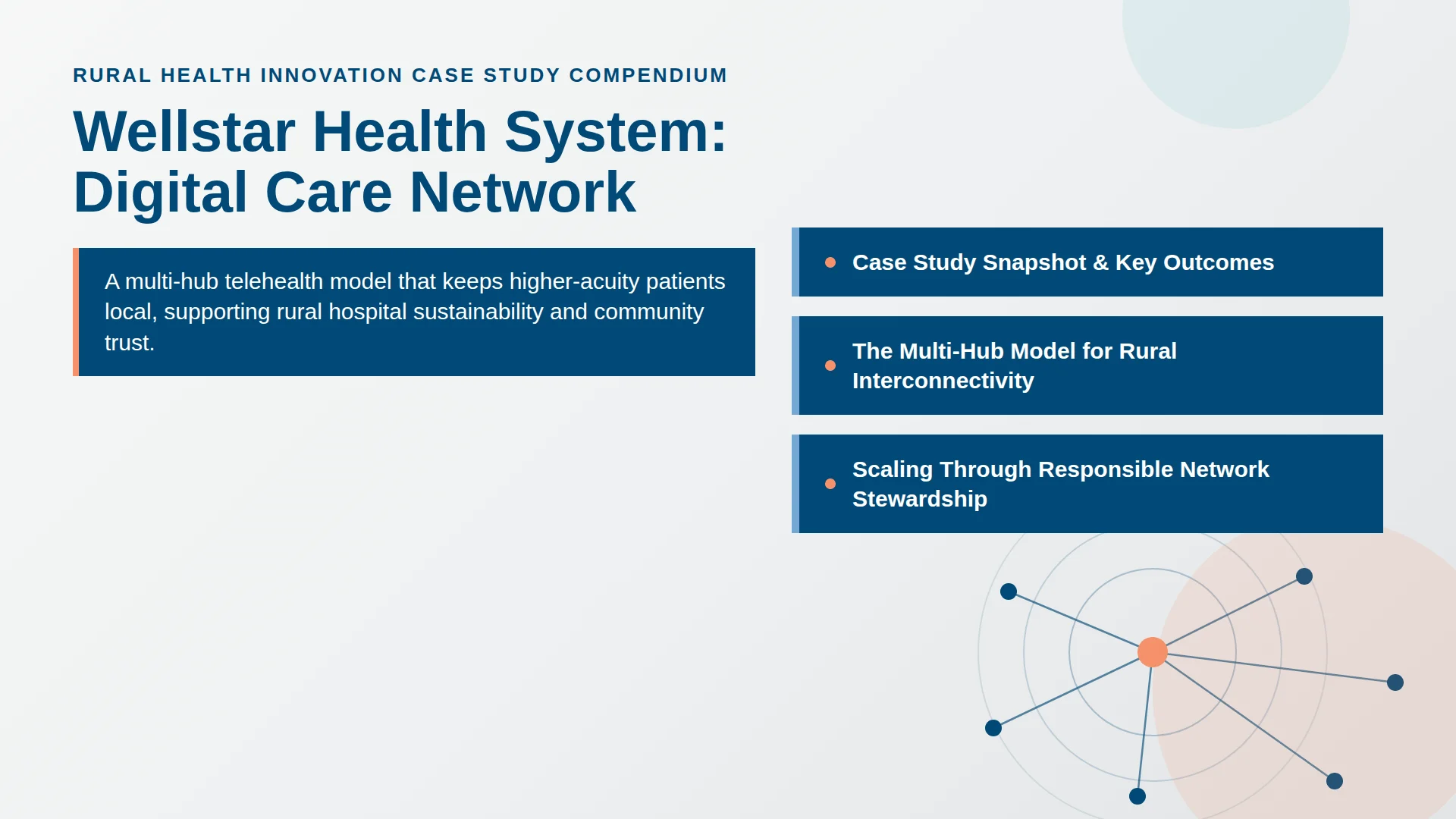
As rural hospitals transfer more patients elsewhere for higher-level care, local revenue, staffing capacity, and community trust can erode. Since 2019, Wellstar Health System’s multi-hub Digital Care Network has supported 19 independent rural hospital partners with 24/7 virtual specialist support, helping local teams treat higher-acuity patients closer to home.
Read below to learn how the network is helping reverse the rural transfer cycle and strengthen hospital sustainability across Georgia.
Case Study Snapshot
Footprint: Headquartered in Marietta, GA; 11 hospitals, 300+ outpatient sites across GA
Timeframe: 2019-Present
Challenge: Traditional approach of transferring patients away from rural hospitals created a negative feedback loop: Retaining fewer inpatients leads to less revenue & less reinvestment; increased transfers negatively impact community trust in the local hospital over time.
Solution: Multi-hub telehealth model positions rural hospitals as local acute-care hubs with 24/7 virtual specialist support, helping them treat higher-acuity patients locally & transfer to tertiary facilities only when necessary.
Key Partners:
Medical College of Georgia Center for Digital Health, Augusta University
Wellstar Health System
Independent rural hospital partners (19)
Challenges Addressed
Keeping Care Close to Home
Reduces unnecessary transfers for low-acuity conditions that do not require higher-level care, avoiding the extractive hub-and-spoke pattern, and keeps patients and revenue local to fund the staff, equipment, and capabilities needed for growth.
Rethinking Workforce Innovation
Integrates local clinical teams, including physicians, nurses, and an on-call remote specialist, within the hospital’s existing workflow, creating greater comfort and confidence in managing complex disease locally without competing for scarce rural specialists.
Key Outcomes (2021-2026)

Multi-Hub Model Creates Interconnectivity Between Rural Hospitals
Philosophy of "right place, right person, right time" provides foundation for intra-rural transfers
Wellstar positions each rural hospital as a local acute-care hub, with virtual specialty access and intra-network transfers layered around it as needs escalate.
The Multi-Hub Model

The Digital Care Network is Lowering the Adoption Burden for Rural Hospitals
Adopting new technology in independent rural facilities requires more than functionality, it requires ease of use and minimal disruption to existing workflows. Models that succeed prioritize tools clinicians can trust and rely on without added technical burden. Wellstar’s Digital Care Network was designed around the following principles to support seamless adoption:


Scale Is Achieved As An Outcome of Responsible Network Stewardship
Wellstar’s approach to determining when – and critically why – to expand their footprint over time
Approach to Scaling the Digital Care Network


Key Metrics for Network Performance
Metrics are tracked jointly by administrative and physician leads to decide when and how quickly to scale:
Operational Volume
✔️Consult volume by location
✔️Time-of-day consult patterns
✔️Average telemedicine days per patient
Transfers
✔️Transfer rate by county
✔️e-Consult transfers
Clinical Quality
✔️Length of stay
✔️Mortality rate
✔️Local end-of-life care rate
Lessons Learned for Health Systems
1. Health systems must be intentional about not letting technology be a barrier for building accessible partnerships with independent rural facilities.
Recognizing that rural hospitals enter partnerships at different starting points and capacities, the Network has built-in flexibility to adjust services to each facility’s needs and maturity level.
Decision-making around new technology add-ons or improvements is driven by the philosophy of making adoption as easy as possible for rural hospitals, regardless of their existing infrastructure.
2. A sustainable “multi-hub” network should be designed with rural hospital capacity-building in mind, driving long-term sustainability of rural care ecosystems.
Done right, telehealth can reverse the extractive cycle of rural healthcare—keeping patients local rebuilds trust, volume, and rural hospital capacity to treat complex conditions.
Internally, this involves not just redesigning clinical workflows and processes but encouraging an intentional mindset shift that centers virtual care delivery as the norm e.g., a rural hospital without a cardiologist on staff requires cardiology e-consults for all heart failure admissions.
What's Next?
Plans to expand clinical specialty care services and support models across rural Georgia
Expand educational opportunities for healthcare professionals, including on-site simulation training and enhanced tele-education pathways