Table of Contents
Virtua Health System Background & Program In-Brief
Virtua Health is an academic health system dedicated to enhancing lives and building communities of wellness through a comprehensive range of personalized health care services. They serve a diverse patient population across South Jersey and Philadelphia, a region where patients often access multiple health systems.
The combination of a highly competitive market and being a newer entrant meant that Virtua often lost patients to competitors for specialty care. Identifying a potential competitive advantage in its community-centric approach, it sought to develop consumer segments to tailor messaging to distinct patient populations. To meet this need for personalization, Virtua partnered with a national vendor that had developed a segmentation model. It then worked to apply and adapt the personas to its local context.
Virtua applies seven distinct behavioral segments across its complete patient database of nearly one million records. Segments are supported by insights from a research panel that validates the ongoing accuracy of the segments within its community and informs targeted engagement strategies.
Its approach includes modeling adjustments to ensure underrepresented patient populations receive appropriate outreach while maintaining resource efficiency across its diverse patient population.
Program Components
Behavioral segmentation
Behavioral segments that represent distinct healthcare engagement patterns with different messaging strategies and service offerings
Layered targeting combining health propensity with behavioral segments to ensure appropriate audience
Research methodology: 7 segment groups initially researched, developed, and named by Monigle, and then adjusted and applied to Virtua’s market
Voice-activated consumer research panel: 50,000+ participant panel for ongoing insights collection to better support strategy development
Research on new business opportunities, message/ad testing, patient experience, and operational improvement
Segment table
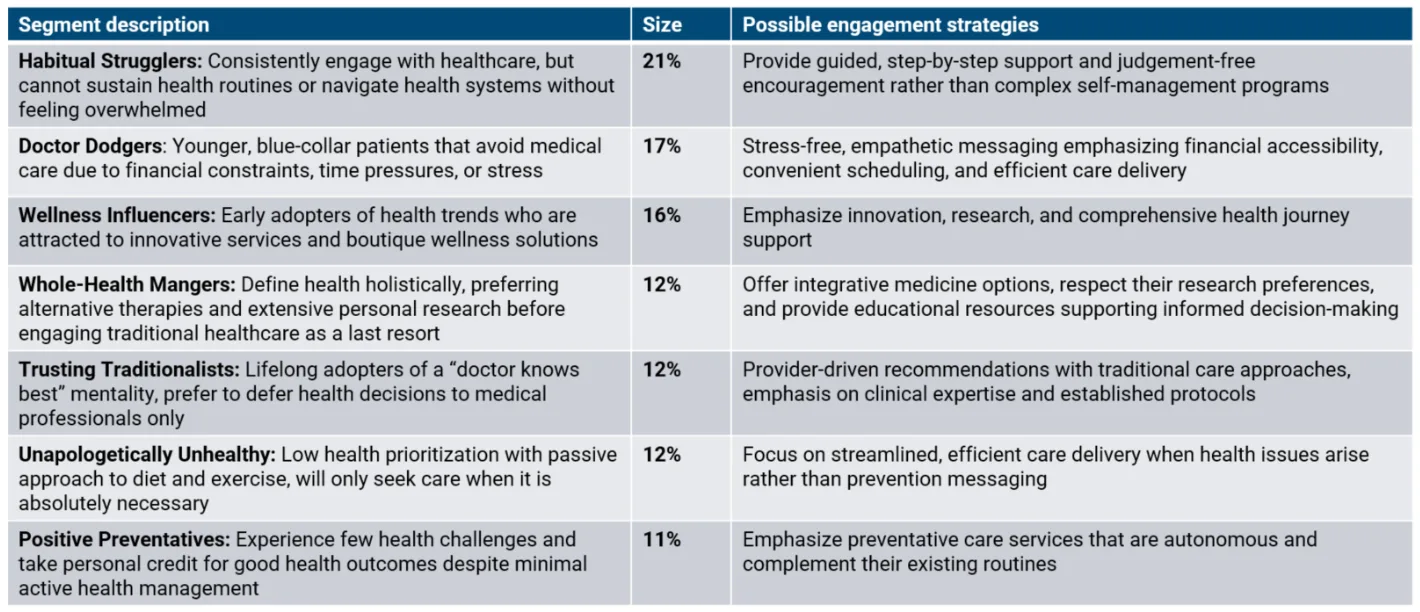
Note: Listed segment sizes are based on Monigle’s national model; Virtua, in partnership with Monigle, researched and adapted each segment to their patient database.
Segment applications
Personalized content: Segment-specific messaging adapted to lifestyle constraints (e.g., "Doctor Dodgers" segment outreach acknowledges time constraints and potential work conflicts)
Customized email subject lines and calls-to-action based on segment characteristics
Visual content: Tailored email images that reflect the target patient population
Health risk assessment (HRA) promotion for patients not quite ready to schedule appointments
Inform patients whether they are at risk for a certain health condition
Opportunity for segments that delay care to learn about their health without having to directly engage
Service recommendations by segment: Appointment type suggestions and service offerings tailored to behavioral insights and predicted healthcare needs for each segment
Framing designed to align with what motivates and resonates with each behavioral segment
Tailoring appointment suggestions to past experiences after tracking services that patients use most often over time
Appointment-ready messaging for motivated behavioral segments
Future channel expansion: Plans to incorporate text messaging as an additional outreach channel beyond current email-first approach
Results/metrics
Virtua Health's behavioral segmentation has led to the following outcomes:
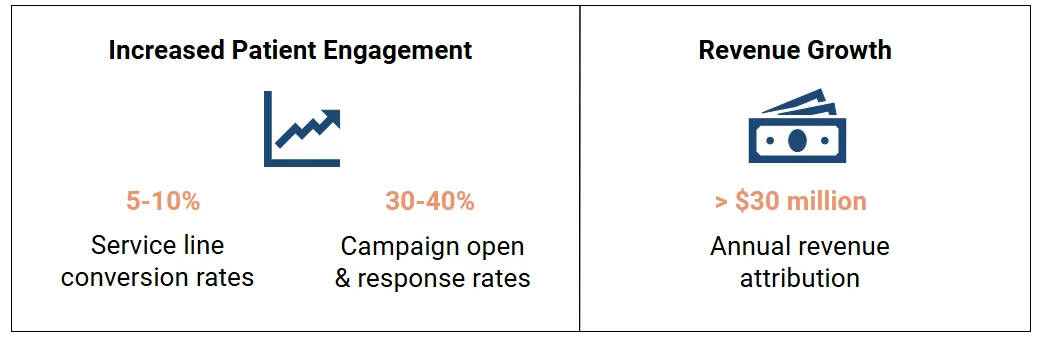
Service line conversion rates:
Tracking from initial call-to-action to specific appointments booked
Not tracked in this way before these initiatives, but overall sentiment this rate has increased
Campaign response/open rates:
Upward trend from rates prior to program implementation
Data integration sources
Epic EHR system for patient data foundation
CRM system with integrated health risk propensity modeling
Third-party demographic and health risk factor data sources
Benefits
Enhanced patient engagement:
Relevant messaging delivery reducing communication fatigue
Trust building through personalized, appropriate outreach
Breaking through message clutter in competitive market
Operational efficiency:
Resource optimization through targeted campaigns
Reduced messaging traffic from broad, untargeted communications
Strategic balance between high-value and mission-driven segments
Strategic differentiation:
Competitive advantage through sophisticated targeting
Partnering with national vendor and localizing information to fit system’s needs and populations
Brand building through human-centric approach
References
“Humanizing Brand Experience: Healthcare Edition – Volume 8,” Monigle, May 2025, https://www.monigle.com/r/humanizing-brand-experience/healthcare/
“Exploring Humanizing Brand Experience Vol 6 Findings: Consumer Segmentation,” Monigle Blog, https://www.monigle.com/blog/hbe-v6-segmentation/