1. insights
  2. Health Impact Alliance
  3. health equity
  4. executive summary rural health innovation case study compendium
Report | Health-Impact-Alliance

Executive Summary: Rural Health Innovation Case Study Compendium

Hero graphic for the Rural Health Innovation Case Study Compendium executive summary, featuring the title, a description of the compendium's focus on sustainable rural care models, two section headers ('Rural Health as a Proving Ground for the Future of Care Delivery' and '4 Key Challenges to Rural Health Sustainability'), a hub-and-spoke network illustration, and the Philips/Health Impact Alliance logo.

Executive Summary

Rural communities face unique and systemic health challenges that complicate efforts to address persistent health disparities. Although the Rural Health Transformation Program (RHTP) has injected renewed attention and funding for rural health, many rural hospital leaders are raising concerns about where and how the funds are being allocated. CMS emphasizes that these funds are not intended to support already financially strained rural hospitals who bear a disproportionate burden of forthcoming Medicaid cuts.

What's Inside

The case studies in this compendium demonstrate how health systems can harness strengths unique to the rural context to address rural health sustainability challenges:

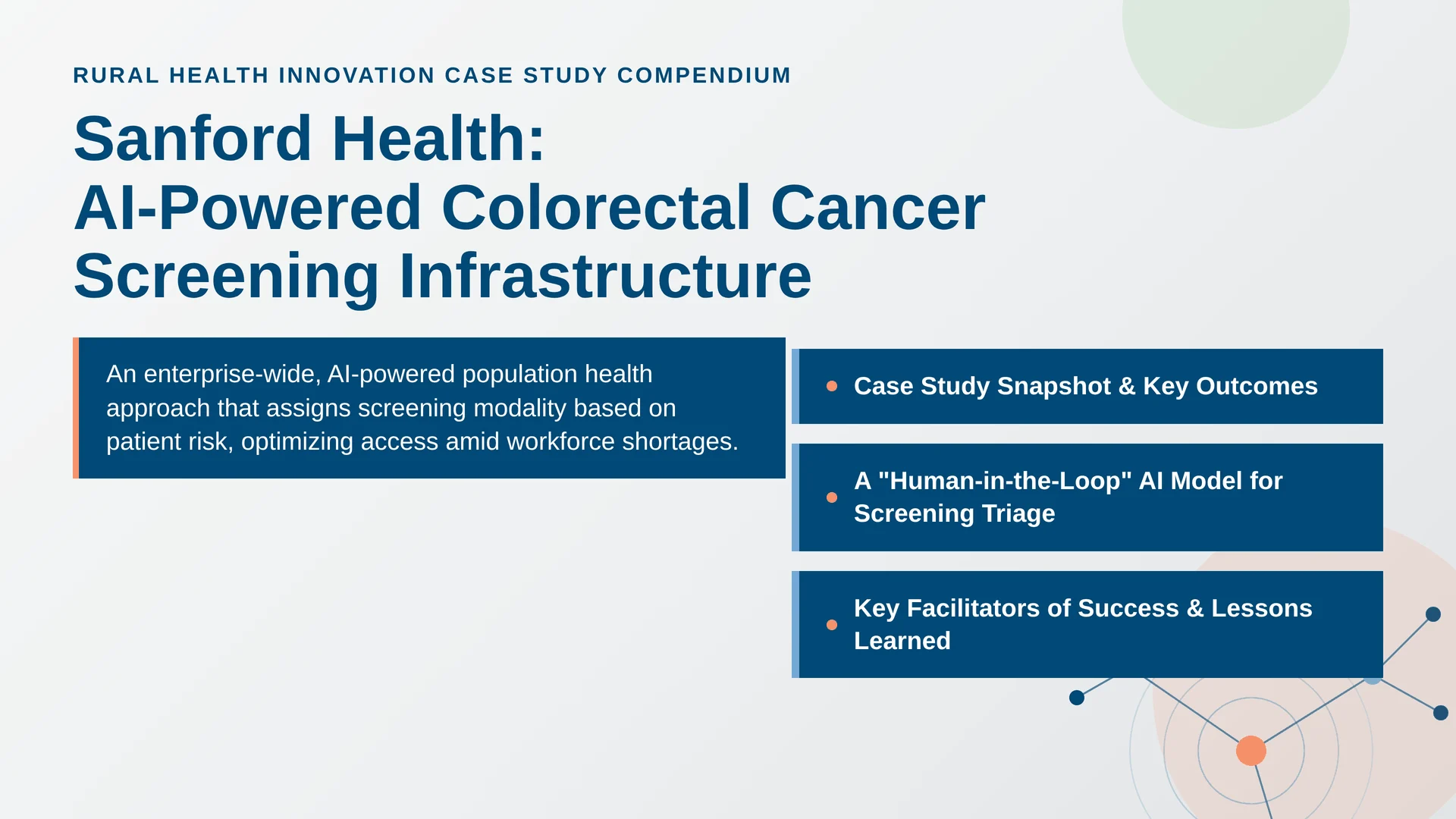
  • Expanding Screening Access Through "Human-in-the-Loop" AI: How Sanford Health built a centralized, enterprise-wide colorectal cancer (CRC) screening & outreach infrastructure driven by an AI-powered risk score that stratifies patient risk using 85 nontraditional risk factors (e.g., employment status, psychiatric conditions), ensuring that the highest risk patients have access to colonoscopies despite workforce shortages.

  • Addressing Upstream Drivers of Uncompensated Care: How Ballad Health's Appalachian Highlands Care Network (AHCN) leverages community health workers (CHWs), community navigators, and safety-net partnerships to improve outcomes for uninsured and underinsured patients in rural Appalachia, managing medical and social needs by matching care intensity to patient complexity.

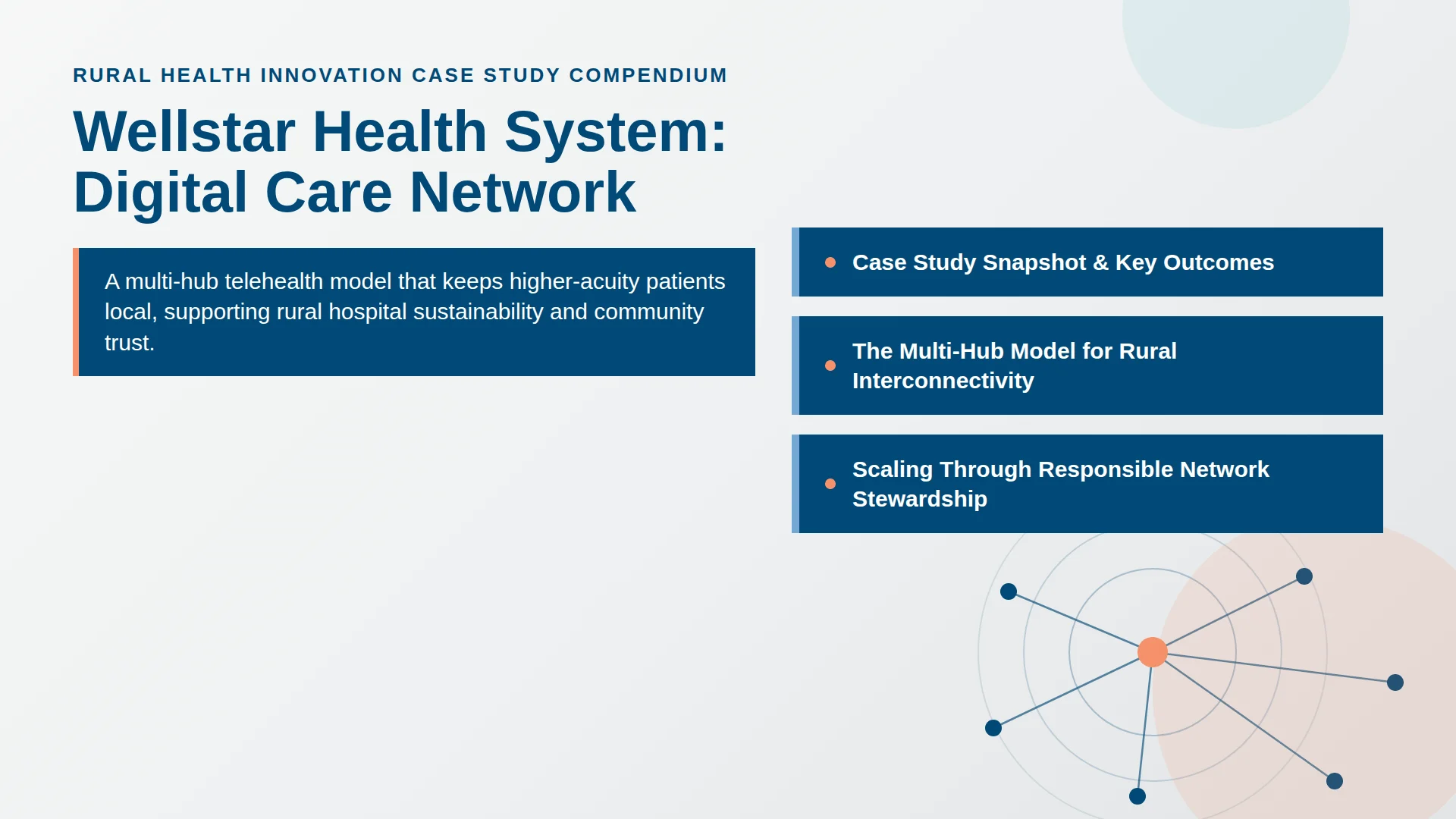
  • Supporting Long-Term Rural Hospital Sustainability: How Wellstar Health System's Digital Care Network multi-hub model subverts traditional extractive hub-and-spoke models, positioning rural hospitals as local acute-care hubs with 24/7 virtual specialist support and ensuring that transfers to tertiary facilities only happen when necessary.

While rural health care does face real sustainability challenges, rural health system leaders also highlight key strengths unique to rural contexts that position rural health innovation as a blueprint for the future of healthcare, regardless of geography:

Relational Proximity

The institutional and interpersonal trust that exists between rural facilities, providers, and the communities they serve from shared lived experience as well as prolonged relationships built over time. This proximity often affords rural care teams social capital, cultural humility, and an intimate understanding of patients’ social needs that facilities in other geographic contexts struggle to replicate.

Operational Discipline

Rural health innovation is shaped and disciplined by resource scarcity, including workforce, capital, and technology infrastructure. Rural facilities are forced to design for durability and simplicity. Because workforce shortages and tight margins are starting to materialize across all health systems, models build to succeed under rural constraints are effectively “pre-tested” for a resource-constrained future.

Community-Centered Design

Rural health status itself is associated with persistent disparities in morbidity and mortality. Any innovation in this context inherently addresses a gap in access, outcomes, or infrastructure. The unwavering focus on specific, actionable needs among rural-serving organizations directly influences organizational innovation that benefits both patients and communities.

The case studies in this compendium demonstrate how health systems can harness strengths unique to the rural context to address 3 key challenges to rural health sustainability, each shaped by the cross-cutting imperative of addressing foundational needs to stabilize rural care ecosystems.

Navy arrow banner reading 'Addressing Foundational Needs for Rural Providers in the RHTP "Era.

Icon of a house with a wireless signal above it inside a light blue circle, labeled 'Keeping Care Close to Home.

“Rural health transformation is about how we reduce total cost of care. To do that, we have to think about payment redesign…rural hospitals say I can’t think about all these complex conversations around alternative payment models and everything else. I’m just trying to stay alive.

Icon of a pyramid of people silhouettes inside a light blue circle, labeled 'Rethinking Workforce Innovation.

“CHWs do so much to alleviate our workers on the ground. They have the relationships, the trust, so they can really streamline care whenever there’s communication or language barriers. Often it comes down to a cultural barrier of trust.”

Icon of a car inside a light blue circle, labeled 'Addressing SDOH in Rural-Specific Contexts.

“I look at some of the other communities that have Instacart or Uber Health partnerships and we just don’t have these partners in our communities. It feels like it has to be more grassroots. Figuring out how to apply SDOH innovations in a rural community context can be really different.”

What We're Hearing

RHTP was built for transformation, not the starting condition of fragility that most rural hospitals are actually facing. Investment is flowing to hub-and-spokes and clinically integrated networks (CINs), but leaders say there’s still a real gap in addressing rural hospitals’ short-term, mission-critical needs just to remain viable.