OpenAI is kicking off the new year with a string of product launches that aim to establish ChatGPT as a one-stop shop for healthcare AI. The newly unveiled offerings create both risks and opportunities for health systems: it’s now easier than ever for patients to seek out AI-generated health advice without their doctor’s oversight, and a new set of enterprise tools could speed up clinical workflows at your health system (or a competitor’s).
New products for providers, health systems, and health tech
On Jan. 8, the company announced “OpenAI for Healthcare”, a suite of HIPAA-compliant AI tools with clinical and administrative use cases. The announcement featured two major products:
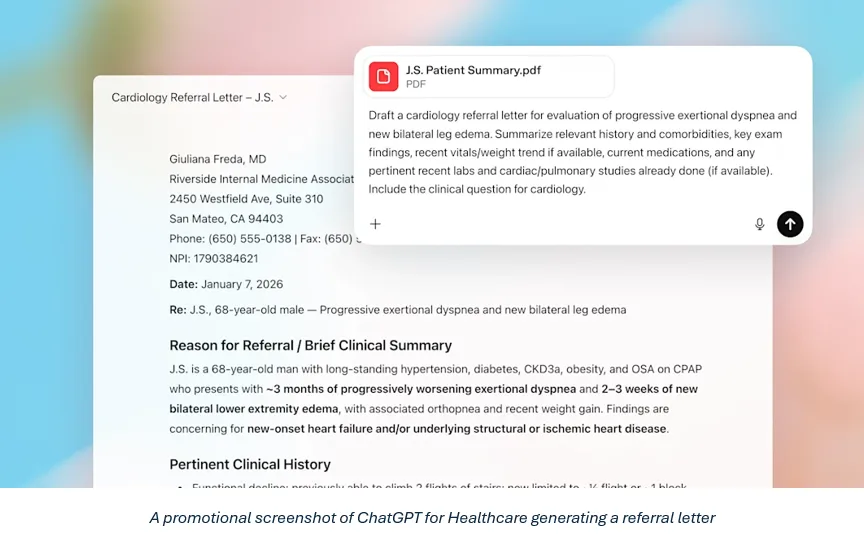
ChatGPT for Healthcare, a special enterprise version of ChatGPT with various healthcare-specific capabilities including clinical evidence search, care pathway management, and referral letter generation.
The product is already in use at AdventHealth, Baylor Scott & White Health, Boston Children’s Hospital, Cedars-Sinai Medical Center, HCA Healthcare, Memorial Sloan Kettering Cancer Center, Stanford Medicine Children’s Health, and UCSF.
OpenAI API for Healthcare, a platform that lets third parties interface with the company’s LLM models to power their own custom applications.
According to the announcement, third parties can use the API for use cases like patient chart summarization, care team coordination, and discharge workflows. The tool’s existing users include Abridge, Ambience, and EliseAI.
Together, these products position OpenAI both as a direct enterprise vendor to health systems and as an infrastructure provider for the broader healthcare AI ecosystem. This dual strategy allows the company to shape workflows directly while also powering many of the point solutions health systems already use.
Consumer-focused offering could supercharge self-directed care
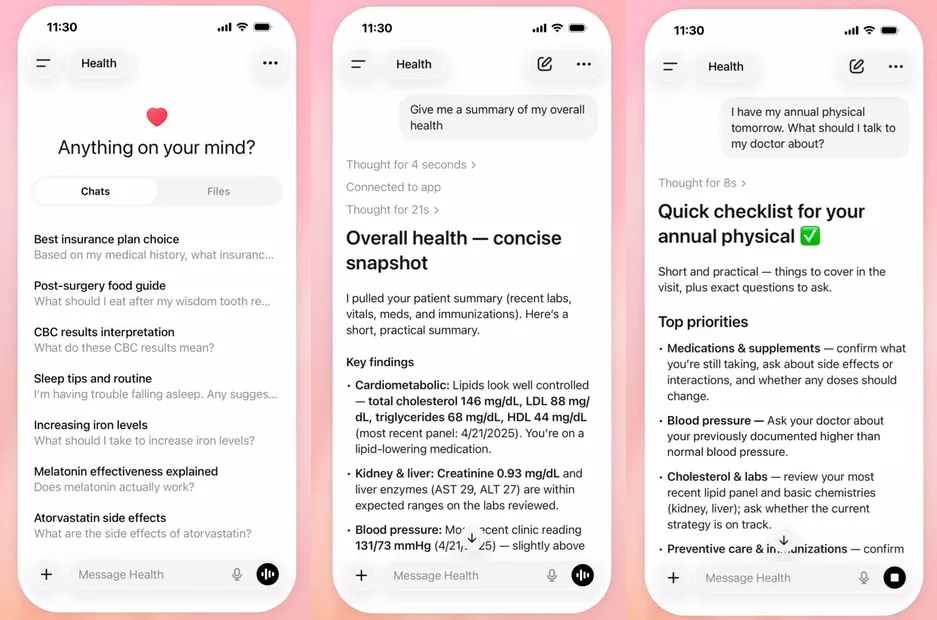
That same week, OpenAI also announced the upcoming launch of ChatGPT Health, a patient-facing app that will let users upload medical records, dietary information, and exercise routines that will enable the LLM chatbot to answer queries about healthcare and wellness.
A series of promotional videos released with the announcement show the chatbot summarizing EMRs, preparing users for an upcoming physical, suggesting workout routines, and providing diet suggestions for GLP-1 users. While the company claims the new product is “not intended for diagnosis or treatment”, some of the examples given seem awfully close to medical advice, and we wouldn’t be surprised if consumers end up testing that limit in practice.
The company has opened a waitlist for users who’d like to be part of an early test of ChatGPT Health (we’ve signed up), and OpenAI says the tab will be made available to all users in the coming weeks.
The new features will supercharge what many users are already doing with the chatbot. More than 5% of all ChatGPT messages globally are about healthcare, according to a recent report by the company. That includes nearly 2 million queries every week related to health insurance coverage and billing. ChatGPT is by far the most commonly used chatbot by consumers, with roughly 65% market share, although that number has fallen over the past year.
The company’s announcement stresses that the new healthcare tab will have special protections and controls for privacy and sensitive information. User data will be compartmentalized and not used to train the broader LLM model. The healthcare chatbot can also be connected to other healthcare and wellness apps including Apple Health, MyFitnessPal, Peloton, and Function.
So What?
We’re looking forward to testing ChatGPT Health and sharing the results once it is fully available. Likewise, we’d love to hear from any member systems that have firsthand experience with the provider-focused offerings. In the meantime, here are some of our early thoughts on the announcements and their implications for health systems:
1. OpenAI wants to be the Epic of AI, offering simplicity but also lock-in.
Many health systems have experienced AI point-solution fatigue—too many narrow tools, each solving a small problem while adding integration, governance, and workflow complexity. OpenAI’s push to sell their products to health systems through a single unified workspace (OpenAI for Healthcare) echoes the industry’s consolidation around Epic’s EMR: fewer tools, tighter integration, and a single application where work happens. The appeal isn’t best-in-class performance in any one task, but simplicity at scale.
With that said, if the market for provider-focused AI tools consolidates into just a handful of platforms (OpenAI, Microsoft, Epic), health systems may gain operational ease in the near term while facing reduced flexibility and greater pricing power concentrated in the hands of a few vendors.
2. The new ChatGPT Health tab will speed up and broaden patient adoption, but it’s not necessarily breaking new ground.
In some ways, there's less here than meets the eye. It doesn't seem like they've made significant changes to GPT-5 or fine-tuned a health-specific algorithm (although the announcement is a bit fuzzy here); it really just seems to be an easier way to get your health records into ChatGPT so you can do all the same stuff you could do previously.
With that said, many people (especially in healthcare) underestimate what the chatbot is already capable of doing. Academic research already shows that LLM models can produce accurate diagnostic information given the right context. OpenAI could take this a step further: their announcement touts a collaboration over two years with more than 260 physicians in 70 countries and dozens of specialties to give feedback on how ChatGPT Health can be improved.
Even if the product isn’t breaking new ground in a technical sense, it could still be highly disruptive in practice (especially at the scale it operates). If even a fraction of those 2 million weekly insurance and billing queries shifts from health system call centers to ChatGPT, that could radically affect both your costs and the quality of your patient relationships
3. AI startups are moving more aggressively into clinical use cases than most health systems are comfortable with.
OpenAI is taking on a great deal of legal and reputational risk by integrating its LLM so directly with medical care (in a practical sense, whatever the legal framing). Health systems have been at the forefront of AI adoption, but most patient-facing use cases involve direct clinician oversight, whereas ChatGPT Health envisions patients getting AI-generated health information and advice without a human in the loop.
While shying away from these kinds of risks was not necessarily the wrong decision for health systems with established reputations to protect, it’s increasingly clear that if they don’t move into this space, other parties will. As a case in point, rival AI developer Anthropic followed up OpenAI’s announcement with its own set of provider and consumer-focused healthcare AI tools with a similar range of features.
4. Your health system’s brand could show up in ChatGPT Health responses—unless your competitors get there first
One intriguing part of OpenAI’s promotional videos for ChatGPT Health was a moment where the chatbot pulled in branded videos and workout routines linked to the Peloton app in response to a user query about getting back in shape. Integrated partnerships with other apps and services appear to be a central part of the vision for the app, which raises the question of whether health systems can get in on the action.
Health systems with national reputations for clinical excellence in specific specialties could make a compelling pitch to have their programs or recommendations featured prominently by the chatbot. We could also imagine more local partnerships that connect patients with nearby providers based on their IP address. OpenAI has previously partnered with UTHealth Houston to test AI use cases in clinical and educational settings, which suggests the company is open to health system partnerships.
Of course, this raises competitive questions: do health systems need to fight for visibility within healthcare chatbots in much the same way that they compete to appear at the top of Google search results? And will there be a first-mover advantage for health systems that partner with OpenAI early on?
For now, the chatbot’s partner capabilities appear limited—the app doesn’t appear to be able to pull in data from partners (like a history of past Peloton rides). And health systems might justifiably feel a bit wary about associating their brand with a consumer-facing product that is likely to be a work-in-progress.
The suite of tools offered through ChatGPT for Healthcare are a safer bet because they’re not patient facing. Early adopting systems might be able to burnish their credentials as technology-forward organizations while also offering their providers real convenience. As with any AI deployment in a healthcare context, training and buy-in are key.