Table of Contents
Strategic Rationale
Access to care often breaks down before a scheduling failure or missed appointment. It begins when a patient struggles scheduling online, grows frustrated on hold, or loses clarity about next steps. Intermountain Health recognized that improving access to care required more than having the right services or the right providers; it demanded an understanding of how consumers actually navigated the system. Traditional metrics like Likelihood to Recommend or NPS captured loyalty but failed to explain where and why patients struggled to access services.
Intermountain undertook a systemwide initiative to unify and redesign its consumer experience measurement strategy. In order to use experience as a strategic differentiator, the organization needed to be able to measure and manage it at a system level. Intermountain found variability in whether and how experience was considered, measured, and managed across the enterprise. The strategic imperative was to build near-real-time situational awareness of when a consumer interfaces with the system and enable predictive and action-oriented experience management that align with the system’s broader transformation toward holistic consumer engagement.
“NPS is a fine, global measure for loyalty. We want people to return for health and for our bottom line. But it’s not a measure of experience. People want to find, get, or do something; they want to do it easily; and they want to feel good about their experience. Those form the basis of our core measurement strategy.”
— Director, Consumer Experience, Intermountain Health
Overview
Intermountain partnered with Qualtrics to unify its approach to consumer, patient, and caregiver experience across the enterprise. The collaboration evolved from traditional survey measurement into a near-real-time, experience management system that helps identify and remove access barriers while fostering trust and engagement. It positions experience data as a strategic asset for improving how patients find, get, and receive care across the system.
Key Components
Unified Measurement Platform: Replaced multiple legacy survey systems with a single Qualtrics experience platform covering digital, phone, and clinical channels.
Real-Time Feedback and Service Recovery: Enabled near-real-time data collection and service recovery versus traditional multi-week survey lags.
AI-Assisted Analytics:
Layered in dashboard assistants and sentiment analysis to help managers interpret data and act faster: Frontline managers can ask questions such as, “Where do consumers get stuck?” or “What should I focus on to improve a specific metric?” in addition to other traditional review and analytics.
Piloting an in-survey agent that can act and surface appointment availability in real time if the survey response indicates the consumer was having trouble finding a provider.
The system is currently laying the groundwork to proactively use web-behavior analytics to detect when users are beginning to encounter issues without relying on survey responses. For example, an AI chat agent could intervene and offer one-click appointment scheduling when it detects navigation difficulties.
Experience Index: Developed a composite measure—encompassing accomplishment, ease, and emotion—to consistently measure whether consumers achieved their goals, how easily, and how they felt.
Intermountain conceptualizes the consumer experience journey as the full continuum of interactions that individuals have with the health system, not limited to clinical care episodes. It reflects the end-to-end process of seeking, obtaining, and engaging in care, with emphasis on what consumers are trying to “find, get, or do.” Each touchpoint is an experience opportunity and an opportunity to improve access to care. The “moments that matter” view guides where Intermountain works with operational owners in each area to improve the consumer experience.
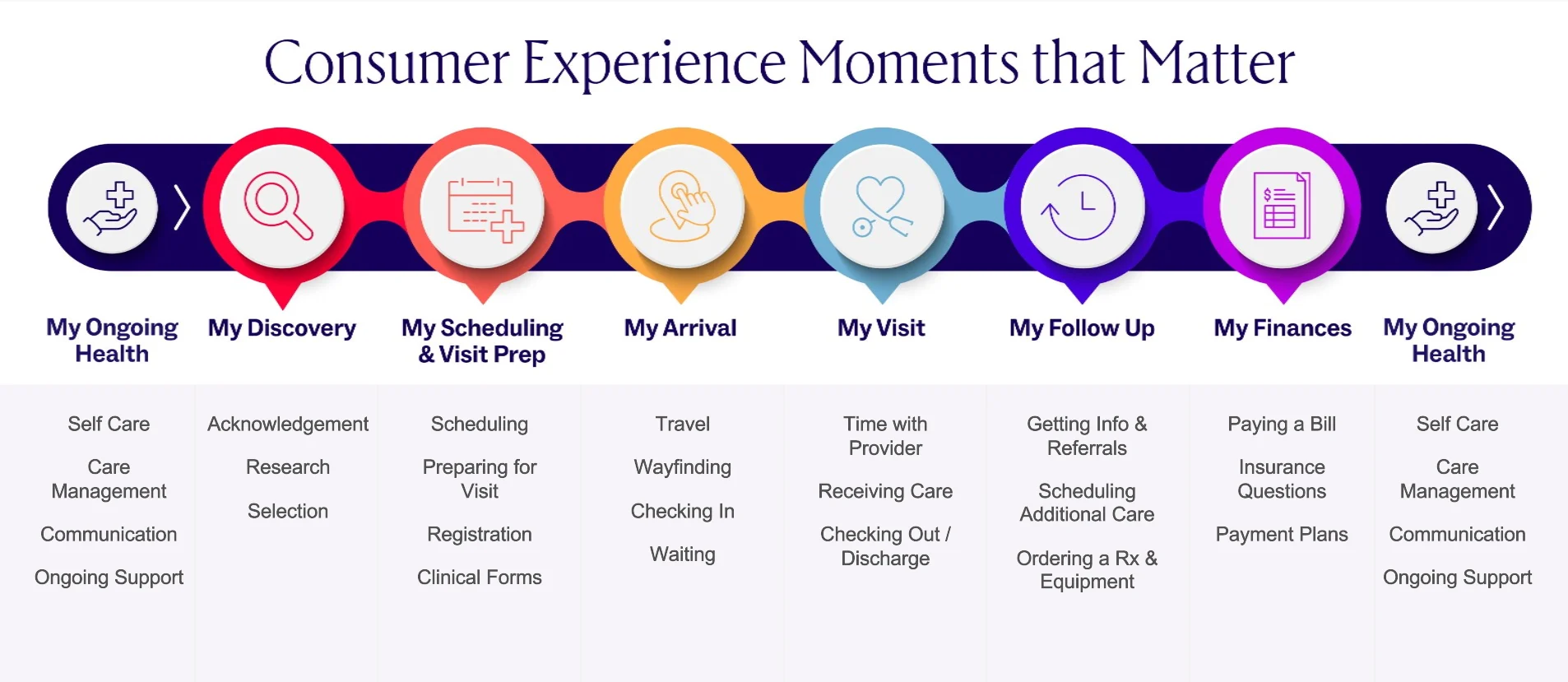
How Intermountain creates end to end access through continual consumer experience moments that matter.
Time Frame
2023-present
Pilot Scale
2023: Implemented Qualtrics XM Platform enterprise wide to connect consumer, patient, and caregiver feedback to workflows in real-time.
2024-2025: Integration with Epic and introduction of AI-driven dashboards, sentiment analysis, and testing of in-survey agents to solve for consumers’ reported problems.
Results
Reduced lag from weeks to near real-time for service recovery actions
Improved trust emerged as the strongest predictor of loyalty (likelihood to recommend)
The Experience Index (the average top-box score across Accomplishment, Ease, Emotion ) proved the best predictor of trust, outperforming operational measures such as staff courtesy or wait times.
Experience Index: Year-over-year improvement to date of 5% to 81%.
Created a closed-loop service recovery program that empowers teams to resolve issues quickly and proactively
Aiming to conduct fewer surveys while surfacing more insights
Level of Investment
Altogether, setting up the tech stack and human resources for the CX function was a substantial investment for a large, integrated system.
Lessons Learned
Access success = experience success: The consumer’s ability to “find, get, or do” emerged as the most direct indicator of access fulfillment. The traditional “likelihood to recommend” does not actually measure experience quality.
Reducing patient effort is a measurable access outcome: Intermountain is beginning to quantify “patient hours saved” (how much patient effort they streamline or eliminate) through these improvements.
Trust is the central driver of patient loyalty and the top predictor of whether patients will return and recommend your health system.
Near-real-time responsiveness is key: Weeks-delayed survey data limit impact. Static survey data won’t fix dynamic access problems. Intermountain is building the necessary foundations now to prepare for a future where predictive data closes the access gap, and early digital signals (e.g., real-time call analysis) reveal barriers long before traditional metrics do.
AI is assistive, not autonomous: Intermountain positions their AI dashboard tool as "assistive intelligence" rather than artificial. Managers remain accountable for interpreting data context and deciding which insights warrant action for their specific unit, while AI eliminates hours of manual content analysis.