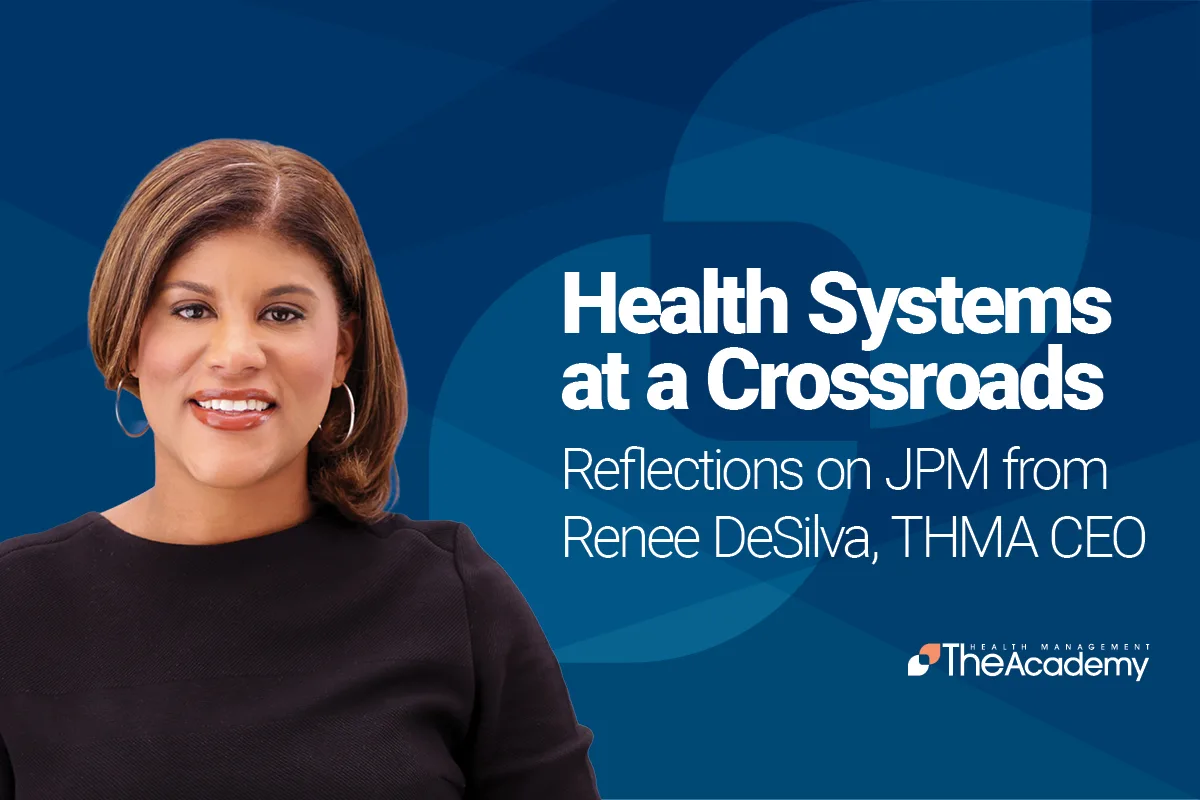
Every January, the J.P. Morgan Healthcare Conference brings health system executives to San Francisco to share their powerful stories, priorities, and performance for an audience of bond investors and strategic partners. For me, it’s one of the clearest windows into how leaders are thinking about the future of our industry.
For years, the narrative at JPM centered on expansion: more facilities, more services, and broader geographic reach. Across presentations, there was a notable shift toward discipline, divestitures, and simplification.
Importantly, that shift didn’t feel defensive. If anything, I walked away with a renewed sense of confidence in our community’s ability to adapt and meet the moment. As one CFO member put it so clearly: “We are built to absorb pressure, and we are confident that we can execute.”
As I listened across the conversations, six themes stood out to me.
1. Healthcare is decisively moving from episodic care to proactive, longitudinal models.
Health systems are accelerating their shift toward prevention, population health, and value-based care as stabilizers of both outcomes and financial performance.
Leaders highlighted care companion models that pair digital tools with human support—enabling earlier intervention, better engagement, lower costs, and more efficient use of clinical capacity. For example, a major academic system discussed how they leverage partnerships to provide extra support for patients with headaches, heart issues, or mental health needs.
While this evolution has been underway for years, today’s technologies are materially increasing both speed and scale of impact.
2. Operational rigor has become inseparable from leadership credibility and mission delivery.
In an environment defined by market disruption and policy uncertainty, leaders are prioritizing execution over aspiration.
Across JPM, there was a clear move away from “growth at all costs” toward disciplined, sustainable smart growth. Many systems have made explicit commitments to sustaining positive operating margins, with heavy emphasis on cost structure, productivity, and overhead reduction. Several shared quantified performance improvement targets ranging from $500M to more than $2B.
That same discipline is extending beyond the balance sheet. Community partnerships are increasingly framed as strategic investments aligned to long-term outcomes—not simply philanthropic efforts. One system noted that 25% of their revenue now comes from JV partnerships.
3. Simplification is emerging as a strategic advantage—not just a cost lever.
Reducing complexity is increasingly viewed as a way to differentiate, not merely to cut expenses.
Health systems are moving away from sprawling conglomerate models toward more coherent, strategically aligned portfolios. Many are divesting non-core hospitals and assets, exercising greater discipline around M&A, and, in some cases, choosing not to pursue deals. As systems raise capital to support transformation—particularly the shift to outpatient care—portfolio rationalization is proving essential to maintaining investor confidence.
Internally, leaders are focused on streamlining workflows, reducing handoffs, consolidating vendors, and eliminating duplicative corporate and “shadow” functions that add cost without clear value. Vendor ecosystems are narrowing, with greater emphasis on fewer, deeper partnerships that truly extend clinical capability.
4. Workforce culture is being treated as a core execution lever, not a “soft” issue.
Leaders are increasingly explicit that performance depends on how effectively human capacity is deployed.
Across presentations, there was strong focus on eliminating wasted work and better utilizing talent across the enterprise. Leadership development is being positioned as an antidote to uncertainty and volatility. Culture, belonging, and accountability are no longer framed as abstract values, but as drivers of results.
Five years after the pandemic, in-person collaboration and return-to-office expectations are being reframed—not as preferences, but as mechanisms to improve execution and outcomes. A system on the West Coast highlighted the impact of remote work on younger employees who need early-career coaching, framing the in-person office as a multiplier for both culture and innovation.
5. Access is a primary engine for both growth and patient loyalty.
Health systems are making significant investments in ambulatory, primary care, and urgent care as demand shifts toward lower-cost, more convenient settings.
These investments are often paired with facility renovations and broader outpatient expansion strategies that fundamentally change where care is delivered and what it costs. Digital scheduling and access tools are seen as growth multipliers that complement capital investments. Ambulatory care, in particular, is consistently framed as both a revenue driver and a pressure-release valve for inpatient capacity.
6. Technology investments are shifting from innovation theater to core infrastructure.
Health system leaders are increasingly pragmatic about where technology truly adds value.
Three years into the GenAI revolution, flashy novelties and half-built point solutions are widely viewed as operational distractions. Instead, systems are prioritizing core infrastructure investments with measurable returns – such as EHR tools that reduce clicks and administrative burden, and consumer-facing platforms that enable digital-first access
Leaders repeatedly pointed to the link between digital engagement, patient experience, and satisfaction scores—reinforcing the importance of getting the fundamentals right.
My final reflections
One of the most striking moments for me came at the opening THMA reception that was—quite literally—over capacity with health system leaders. It was a powerful reminder of the strength of this community and the shared commitment that brings it together.
Across systems, leaders are converging on similar priorities: disciplined execution, strategic simplification, and missions grounded in reality. The shared confidence we heard reflects not only individual strategies, but the strength of a network facing hard problems together.
As we take on healthcare’s most pressing challenges in the year ahead, thank you for your continued engagement and leadership. We’re honored that you choose to invest your time and insight in THMA, and we look forward to continuing this work together as a trusted forum for learning, sharing, and progress.
Warmly,

Renee DeSilva
CEO, THMA