
The four largest publicly traded hospital companies—HCA, Tenet, UHS, and Community Health Systems—reported Q1 earnings in late April. The headline was soft Q1 acute care volume, but the deeper story was ongoing massive capital spending (particularly in the outpatient space) that’s moving faster and farther than most not-for-profits systems can match.
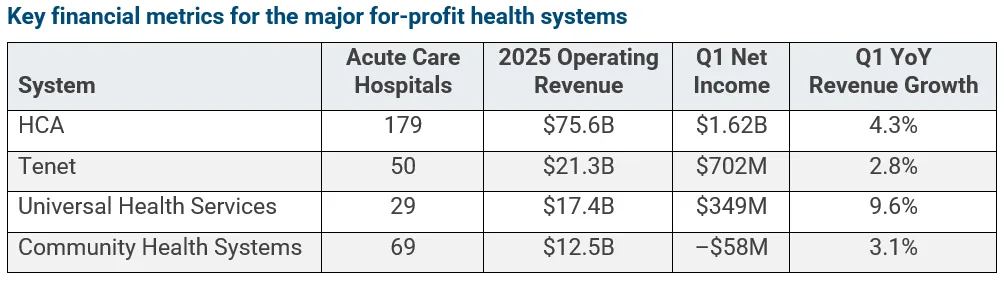
Collectively, these four systems operate 327 acute care facilities and generated approximately $126.7 billion in revenue in 2025. Their earnings calls and quarterly filings provide a window into how health systems’ major operating variables are moving.
So What?
Four observations from the Q1 calls are worth flagging for chief strategy officers calibrating their read on the rest of the year:
1. Q1 softness was a confluence of one-offs and the predicted Exchange decline.
Headline volume across the four operators was soft. Looking at same facility metrics, HCA equivalent acute admissions were up 1.3%. Tenet’s were up 0.6%. UHS saw flat adjusted admissions, while CHS adjusted admissions were down 0.5%. The interpretive challenge is decomposing this into cyclical noise and structural change.
The drop was conditioned by two one-off factors: a shorter-than-normal flu season affected all four, driving down respiratory-related admissions by 42% at HCA and by 40% at Tenet, and severe winter storms also affected all four of the major operators.
Complicating the picture, the expiration of the enhanced premium tax credits for the ACA exchanges arrived in the same quarter. HCA same-facility adjusted admissions for exchange patients declined 15%. At Tenet the drop was 10%. At UHS and CHS the drop was relatively moderate at 5% and 3.9%, respectively. All four operators expect a significant revenue hit from the decline in exchange coverage. HCA’s broad forecast of a $600M to $900M impact to adjusted EBITDA is an indicator of how uncertain the total financial hit from exchange losses is. All operators are expecting the situation to worsen throughout the year.
Forecasting the remainder of 2026 is difficult given the complexities of Q1. The respiratory and weather factors were temporary in nature, although much of the lost volume is not expected to return. The exchange-driven payer mix erosion will be permanent, but the scale varies substantially by operator, and the total financial impact is uncertain.
2. High-acuity outpatient migration is now the dominant capital story.
USPI, Tenet's outpatient surgery subsidiary with ownership stakes in 533 ASCs and 26 surgical hospitals, delivered a 36.7% adjusted EBITDA margin on 5.6% growth in net revenue per case, driven by what Tenet described as double-digit same-store growth in total joint replacements in ASCs "off of a pretty high base." Tenet has further deployed $125M (half its annual M&A target) to acquire seven other ASCs and have commenced patient care at three de novos in Q1 alone. Even while it is divesting other assets, CHS is purchasing a majority interest in an ASC operator in Anchorage, opening two de novo ASCs in Alabama, in addition to acquiring the Surgical Institute of Alabama, with 8,000+ annual cases, its largest acquisition since 2016. HCA also cited continued outpatient acquisitions in urgent care, ASC, and freestanding ED platforms.
The future is here: high-acuity surgical work—total joints, robotics-enabled general surgery, urology—is migrating outpatient at scale, and multispecialty ASCs in growth markets are the highest-margin growth vehicle available. For NFP systems planning service-line reconfiguration around the same migration, the question isn't whether the trend is real, but whether their capital position supports moving at the speed the market is now setting.
3. AI is everywhere. Savings are disclosed nowhere.
All four operators discussed AI deployment, although they were silent on the total capital investment. UHS has deployed eight enterprise AI use cases in revenue cycle alone and is also focusing on AI use in clinical operations through a Hippocratic AI partnership. Tenet described increasing AI-driven back-office automation, doubling the productivity of its Conifer analytics team. HCA named ambient documentation, patient safety, and nurse engagement initiatives. CHS is deploying ambient listening to reduce administrative burden on physicians.
Furthermore, no operator quantified savings or EBITDA contribution from AI deployment. UHS described "significant benefit on a go-forward basis." Tenet referenced productivity gains. HCA framed AI as embedded within its broader $400M savings program. But none disclosed dollar impact, headcount avoidance, or gains in specific revenue cycle metrics. There is no reason to doubt that the investment commitments are real and accelerating, but not-for-profit systems struggling with their own AI deployments may find some solace in the for-profits not yet having much to brag about.
4. Capital deployment continues despite the policy backdrop.
The implications of the One Big Beautiful Bill Act (OBBBA) on provider economics are well known. On the Medicaid side, community engagement requirements and more frequent redeterminations are expected to drive up the number of uninsured, likely leading both to lower volumes and elevated uncompensated care costs. Changes to provider taxes and to state-directed payments are expected to result in significant downward pressure on Medicaid rates themselves. Although the biggest impacts won’t begin to be felt until late 2027 or early 2028, many not-for-profit health systems are actively modeling OBBBA’s financial impacts and even preparing for difficult cuts.
The for-profits are aware of the financial threat and have at least mentioned it as a forward risk in their 10-Q filings. (UHS was unique among the for-profits in quantifying the impact of the state-directed payments and provider tax provisions, estimating that their annual Medicaid revenues would be reduced by between $432M and $480M by 2032.) But the Q1 earnings calls were near-silent on the policy. At most OBBBA was mentioned in passing. What investors heard instead was capital deployment: HCA's $5.5–$6B project pipeline, Tenet's ASC acquisitions, UHS's behavioral expansion, CHS's ambulatory investments.
The contrast with the NFP sector is striking. Many not-for-profit boards and industry forums have made OBBBA a dominant frame for 2026 strategy. The for-profits, facing the same policy environment, are running a growth posture. Regardless of tax status, market position, commercial mix, and balance sheet strength can make Medicaid policy impact less existential. In some cases a growth bet through the uncertainty may be the right call.