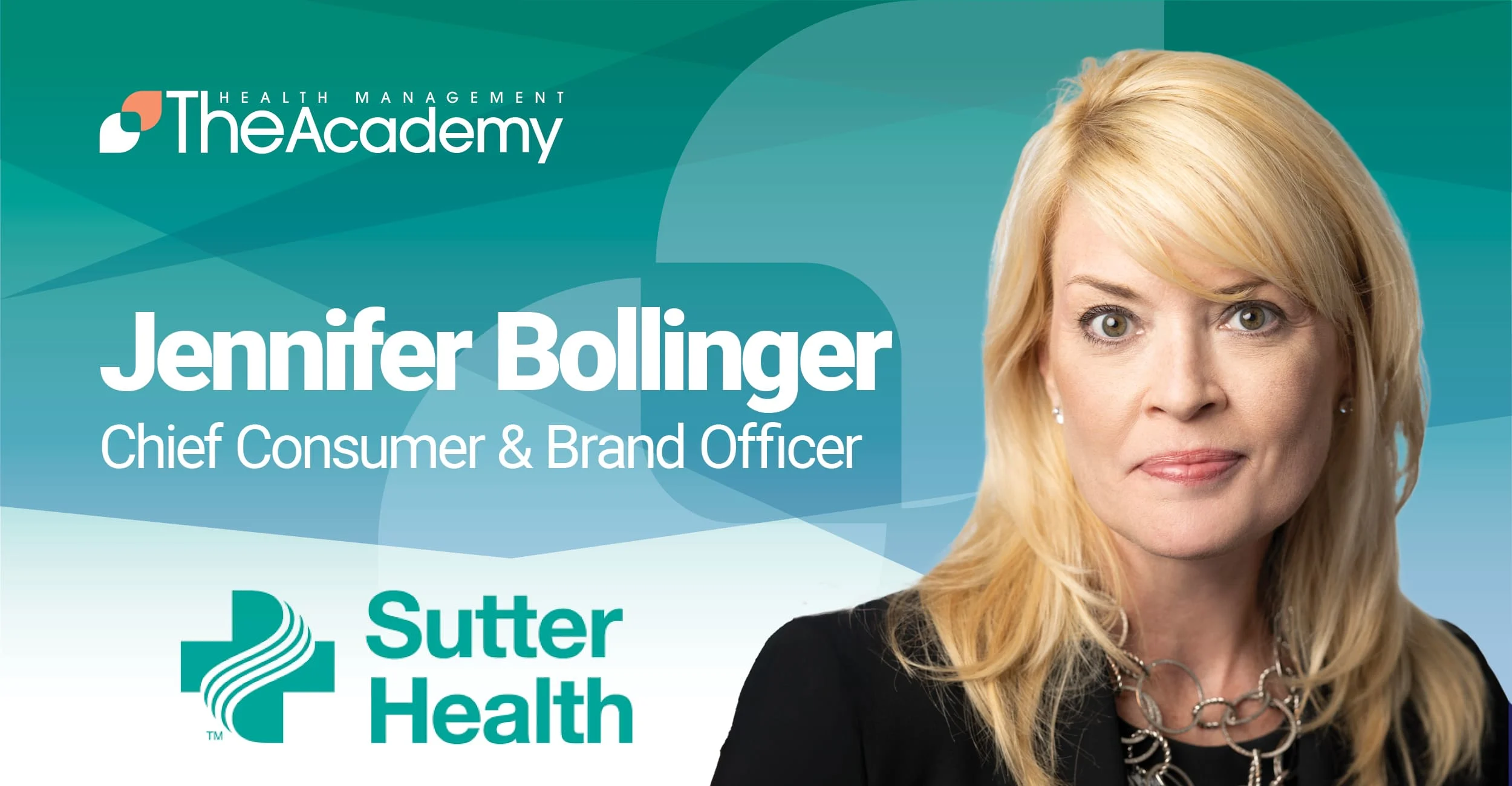
Reframing the Healthcare Experience
When Jennifer Bollinger joined Sutter Health in early 2023 as Senior Vice President and Chief Consumer and Brand Officer, she stepped into a role that was intentionally broad—and intentionally different. Her portfolio spans not only brand, marketing, and communications but also patient experience, enterprise access (including the contact center), and a dedicated consumer strategy team. It was a big remit, but also a deliberate one.
Bringing those capabilities together under one umbrella was not about consolidation for its own sake. It was a recognition that modern healthcare experiences are shaped in the in-between spaces—before, after, and across encounters—and that those moments don’t sit neatly in a single function.
"Having all of these teams aligned around both the organization’s priorities and patient expectations changes how fast we can move," Bollinger said. "It’s allowed us to drive real results—not just activity."
That alignment matters more than ever as consumer expectations in healthcare continue to be shaped almost entirely outside the industry.
Conversation Takeaways
Align the In-Between Spaces: Patient experience is shaped before, after, and across encounters. Integrating brand, access, and experience under one leader changes how fast you can move.
Expectations Are Set Elsewhere: Patients don't become different consumers in healthcare. Their expectations for ease and self-service are shaped by every other industry first.
Digital and Human, Not Either/Or: The best experiences come when digital and in-person care reinforce each other. Technology should support human connection, not replace it.
Brand as a Signal of Change: Refreshing mission, vision, values, and brand together works when intent is unmistakable and leaders are aligned. It's strategy, not a campaign.
Translate Intention into Action: "Consumer-obsessed" needs to be operationalized. Sutter uses three principles—eliminate friction, get the whole job done, anticipate needs—to guide real trade-offs.
Consumer Expectations Set Elsewhere
Bollinger is quick to point out that healthcare doesn’t exist in a vacuum. “People don’t become different consumers just because they’re interacting with healthcare,” she said. “Their expectations are shaped everywhere else first.”
The pandemic only accelerated that reality. In a short window, digital fluency increased dramatically, and with it, expectations for self-service, reliability, and ease. Patients increasingly want to handle routine tasks digitally—scheduling, messaging, follow-up—as long as those tools actually work and meaningfully reduce friction.
At the same time, Bollinger sees a growing need to design for households, not just individuals. “Women are still managing care for multiple family members,” she noted. “That has implications for how we think about access, communication, and continuity.”
Digital and Human—Not Either/Or
At Sutter, much of the work has focused on better connecting digital and in-person care. Bollinger is clear that this isn’t about replacing one with the other.
“For a long time, digital tools in healthcare were built in isolation,” she said. “But the best experiences come when digital and in-person care reinforce each other—what we think of as a truly ‘phygital’ ecosystem.”
The organization’s digital front door is an important part of that equation, but it’s only one piece. “Healthcare is still deeply human,” Bollinger said. “Technology has to support compassionate connection, not compete with it.”
Refreshing Brand as a Signal of Change
One of Bollinger’s earliest—and most visible—efforts at Sutter were helping lead a refresh of the system’s mission, vision, values, and brand. Doing all of that at once isn’t typically recommended, she acknowledged.
“I wouldn’t normally plan it that way,” she said with a laugh. “But in this case, it worked because it signaled real change—internally and externally.”
Doing all four at once only worked because the intent was unmistakable: “You can’t treat this like a branding exercise,” Bollinger said. “It only works if leaders are genuinely aligned, the organization sees itself reflected in the work, and people understand what it’s actually meant to support.” So, they made leadership commitments visible, grounded in Sutter's unique culture and history, and made sure the future direction was explicit enough to guide real decisions.
“You need a long-range view,” Bollinger said. “This kind of work isn’t about a campaign. It’s about supporting a multi-year strategy and cultural transformation.”
What ‘Consumer-Obsessed’ Really Means
Becoming consumer-obsessed, Bollinger believes, starts with shared language and clear priorities.
“At Sutter, our mission begins with ‘Patients First,’ and that’s not just a slogan,” she said. “At the same time, we balance that with ‘People Always’—taking care of the workforce who make the experience possible.”
From there, the organization aligned around three practical principles:
Relentlessly eliminate friction every day
Get the whole job done every time
Anticipate future needs
“These principles help translate intention into action,” Bollinger said. “They give teams a way to make decisions when trade-offs are real.”
Listening Beyond the Survey
Patient surveys remain important, but Bollinger emphasized that they’re only one input. Sutter has invested in dedicated insight teams, ongoing research, and user testing to better understand where experience breaks down—and why.
“We treat patient insights as a gift,” she said. “Not every issue can be solved immediately, but every signal gets documented and considered as we iterate.”
Crucially, the organization works to connect those insights directly to success metrics. “If insights inform the work, the outcomes should reflect that,” Bollinger noted.
Measuring What Matters
When it comes to steering transformation, Bollinger looks beyond traditional clinical and financial metrics. Among the indicators she pays closest attention to are brand Net Promoter Score, consumer effort across key touchpoints, patient experience scores tied to access and navigation, and loyalty—defined as the extent to which patients choose Sutter for all of their care.
“These measures help us understand whether the experience we’re designing actually matches what people need,” she said. “And we pair them with testing and leading indicators so we’re not flying blind.”
For Bollinger, the goal isn’t perfection—it’s progress grounded in real human experience. “If we stay curious, listen well, and connect the dots,” she said, “we can keep moving in the right direction.”
A Leadership Lesson: Courage
Reflecting on her career—from agency leadership to Ochsner Health to Sutter—Bollinger comes back to one theme she shares often with emerging leaders: courage.
“Say yes to the new and the unknown,” she said. “Then do the work—learn from others, start where you can create momentum, and build from there.”
At a moment when healthcare is being reshaped as much by expectations as by economics, Bollinger’s approach underscores a broader shift underway in healthcare—one where patient experience is no longer peripheral to healthcare, but foundational.