How Leading Health Systems Are Redesigning Cardiovascular Access Through Hub-And-Spoke Models

Health systems are redesigning cardiovascular access by organizing care into hub-and-spoke networks, centralizing advanced procedures at flagship medical centers while pushing outpatient care, diagnostics, and telecardiology into community and rural spokes. The shift is a direct response to a widening gap between cardiovascular disease volume and the physical and clinical capacity of any single hospital to absorb it.
Why Cardiovascular Access Is Under Pressure
Cardiovascular disease could affect up to 15 percent of the U.S. population within the next 25 years, according to the American Heart Association, and the traditional hospital-centered model, built around acute and interventional care, has not kept pace with that trajectory. THMA's own reporting on cardiovascular medicine trends has tracked the same pressure building from the demand side as AI adoption, new therapies, and outpatient care models all expand at once.
Capacity constraints show up everywhere, not only in rural markets. THMA's reporting on cardiovascular medicine trends has found that staffing shortages in catheterization labs and electrophysiology, longer scheduling lead times, and workflow inefficiencies are restricting patient throughput in highly saturated urban markets as much as in underserved ones.
In rural regions specifically, limited access to specialists has been linked directly to preventable hospitalizations and mortality, which is why regionalized cardiovascular networks have become a policy and operational priority across U.S. health systems rather than a nice-to-have.
What a Hub-And-Spoke Cardiovascular Model Actually Looks Like
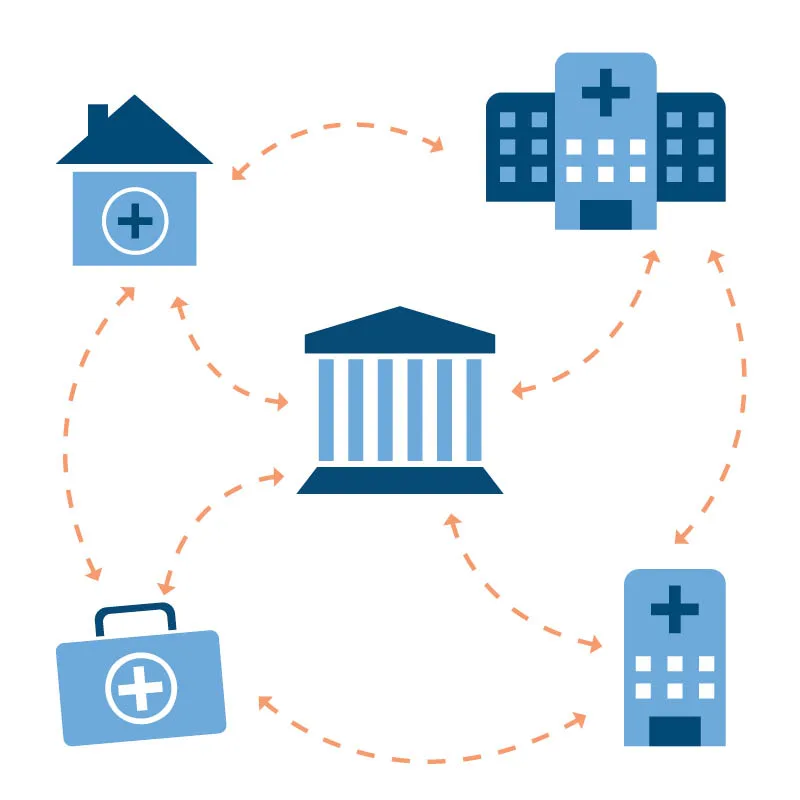
In a hub-and-spoke cardiovascular network, the hub, typically a tertiary or academic medical center, provides 24/7 interventional cardiology, electrophysiology, and advanced imaging. Spokes, community hospitals and outpatient clinics, handle routine cardiology, diagnostics, and chronic disease follow-up closer to where patients live.
Inova Heart and Vascular Institute in Falls Church, Virginia, built one of the clearest examples of this model for a time-sensitive condition. Inova Fairfax Medical Campus serves as the regional hub for cardiogenic shock, backed by a standardized, multidisciplinary shock protocol shared with more than 30 spoke hospitals across the region since 2017. More than half of the patients Inova treats for cardiogenic shock first present at a spoke hospital before being transferred in. Since standardizing the protocol across the network, 30-day survival has risen from just under 50 percent to more than 70 percent, even as patient volume has tripled. The approach was influential enough that the 2022 ACC/AHA heart failure guidelines now carry a Class IIa recommendation for multidisciplinary shock teams built on this hub-and-spoke structure.
The relationship runs in both directions. Spokes send time-sensitive cases, such as ST-elevation myocardial infarction or cardiogenic shock, to the hub for rapid intervention, and the hub sends stabilized patients back to the spoke for follow-up, chronic disease management, and routine diagnostics. The Veterans Health Administration applies the same logic to non-emergency care through its National Cardiology Hub and Spoke Network, which routes rural veterans to high-complexity VA medical centers for invasive procedures while spoke sites and community-based outpatient clinics handle pre- and post-procedural visits closer to home. This bidirectional flow, rather than a one-way referral funnel, is what distinguishes a functioning network from a simple transfer arrangement.
Digital Tools and Telecardiology Are What Make the Model Work at Scale
A hub-and-spoke structure only holds together at scale when digital tools connect the two ends in real time, and telecardiology has become the primary way U.S. health systems do that.
The Veterans Health Administration's Clinical Resource Hub program is a direct test case. Launched in July 2021 with the Palo Alto VA serving as the cardiology hub for Nevada and Northern California spoke sites, the program grew to 804 patients and 4,315 ambulatory cardiology encounters within its first 20 months, 1,961 of them delivered through the hub. Female veterans and rural veterans used the program at meaningfully higher rates than conventional VA cardiology care, evidence that a telehealth hub can reach exactly the populations a physical hub cannot (Tisdale et al., 2024).
The reporting-speed gains from remote monitoring are well established in U.S. data. The TRUST trial, a multicenter study of 1,450 patients across 102 U.S. sites, found that automatic remote monitoring of implantable defibrillators cut total healthcare utilization by roughly 50 percent compared to conventional in-office follow-up, while detecting arrhythmia events in a median of one day, versus more than a month under the conventional schedule, without any difference in safety outcomes.
The same logic extends to emergency care. In a rural hub-and-spoke network without emergency medicine physicians at every spoke site, adding tele-emergency medicine was associated with a 31 percent reduction in total annual emergency department costs.
Smaller health systems are applying the same model directly to community hospitals. Cardiovascular Institute of the South, based in Louisiana and Mississippi, operates a 24/7 Virtual Care Center in Lafayette that extends telecardiology, including remote exams with a digital stethoscope, to partner hospitals such as Hardtner Medical Center in the small town of Olla, giving patients access to subspecialty cardiology without leaving their local hospital.
Redesigning the Outpatient Network Around Subspecialty Access
The modern spoke is not a single general cardiology clinic. It is a structured outpatient network organized around subspecialty pathways, with services at each spoke matched to that community's specific needs rather than replicated uniformly across every site.
The VA's Clinical Resource Hub program builds this in by design. Which subspecialty clinics a given spoke site offers, whether that is a heart failure clinic or a women's heart health clinic, depends on that site's service gaps and patient population, with the hub supplying the specialist capacity behind it. Cardiovascular Institute of the South follows a similar logic at a greater scale, running 21 locations and 11 telemedicine programs across Louisiana and Mississippi, with services ranging from in-clinic vein treatment to at-home cardiac rhythm management, all tied back to its central Virtual Care Center.
Outpatient intravenous therapies, including iron repletion for iron-deficient heart failure patients, are increasingly used to stabilize patients outside the hospital and prevent a full admission, a shift that keeps higher-acuity capacity at the hub free for the cases that require it.
The investment case is backed by THMA's own service line research. Health systems have broadly aligned on the strategic importance of ambulatory care, yet many leaders count delayed ambulatory investment among their biggest regrets, and cardiology is one of the service lines named most vulnerable to near-term market share loss and most prioritized for ambulatory expansion over the next two to three years (Service Line Portfolio Strategy in 2026).
Why Governance, Not Technology, Is the Hard Part
The bottleneck in most hub-and-spoke cardiovascular buildouts is not the telecardiology platform. It is decision rights, referral design, and trust between sites, and those take longer to build than any technology deployment.
In conversations with cardiovascular service line leaders at our Cardiovascular Forum, a few patterns recur. Cross-site integration tends to succeed when relationship-building between the hub and each spoke precedes any push for standardized protocols, not the reverse. Leaders who try to impose shared templates before establishing trust across sites report resistance that stalls the network indefinitely, while those who invest a year or more in relationship-building before raising standardization find the conversation goes much further.
Adding hub capacity for a growing spoke referral base rarely comes from hiring alone. Leaders describe redesigning visit templates, adjusting incentive structures for additional clinic shifts, and shifting cardiology toward a consultative model with primary care and referring physicians, so that a hub visit resolves the question and returns the patient to their local physician rather than absorbing them into long-term follow-up.
Referral pathway design functions as infrastructure, not paperwork. When a highly specialized service, such as transplant evaluation or advanced heart failure management, is folded into a general clinic rather than given its own dedicated, consistently scheduled pathway, referring physicians lose confidence in where their patients are actually being seen. A dedicated pathway, marketed directly to referring partners and backed by reliable follow-through on every commitment made to them, tends to be what separates a network that earns volume from one that does not.
Even in networks with mature clinical footprints, governance authority, who controls budget, staffing, and space decisions, tends to lag behind clinical maturity. Leaders describe relying on informal escalation to unblock stalled decisions rather than a formal decision-rights structure, a workaround that holds at small scale but does not scale with the network.
What This Means for a Health System Evaluating Its Own Network
A hub-and-spoke redesign is a sequencing decision before it is a technology purchase. Four steps tend to separate networks that scale from those that stall.
Audit referral pathways before buying a platform. Map where patients currently enter and exit the system, and identify which subspecialty referrals lack a dedicated, clearly marketed pathway.
Choose a telecardiology platform that is interoperable with the existing electronic health record, not a standalone tool that creates a second system of record for referring physicians to check.
Redesign hub capacity through visit templates, incentives, and consultative care models before adding headcount, since most of the documented capacity gains in these networks come from operational redesign rather than new hires.
Build governance authority in parallel with the clinical footprint. A network that outgrows its decision-rights structure will hit a ceiling no amount of additional capacity or technology can fix.
These are the exact trade-offs that convene at THMA's Cardiovascular Forum, where cardiovascular service line leaders and heads of function from leading health systems meet select industry partners in a closed-door, peer-level setting to work through access, capacity, and growth strategy in detail.