What Is a Chief Physician Executive (CPE)?

A Chief Physician Executive is the senior-most physician leader within a health system, responsible for setting clinical strategy, improving care quality, and aligning the physician enterprise with the organization's broader operational and financial goals. The role is also commonly known as the Chief Medical Officer (CMO). In organizations where both titles exist, the CMO often focuses on medical affairs and quality, while the Chief Physician Executive carries broader enterprise responsibility across strategy, physician alignment, and system performance.
For industry professionals selling into health systems, the Chief Physician Executive is frequently the executive who determines whether a new solution, partnership, or clinical investment moves forward or stalls at the committee level.
At The Health Management Academy (THMA), we convene Chief Physician Executives from both the nation's largest health systems and independent regional systems through dedicated forums and peer circles. The insights in this guide draw on our proprietary executive priorities research, post-forum debriefs with CPE cohorts, and direct engagement with physician leaders across the market. Whether you are building relationships with large integrated delivery networks or smaller independent systems, this guide will provide a substantive foundation for understanding who CPEs are, what occupies their attention, and how to position yourself as a credible partner.
What Does a Chief Physician Executive Do?
The Chief Physician Executive holds accountability for the clinical direction of a healthcare organization. Where a Chief Operating Officer manages throughput and a Chief Financial Officer manages the balance sheet, the CPE is the executive charged with ensuring that clinical care delivery, physician performance, and medical strategy advance in concert with the system's financial and operational imperatives.
Core Responsibilities
In practice, the Chief Physician Executive leads across a wide range of domains:
Clinical strategy and quality: setting enterprise direction and overseeing quality improvement
Physician alignment: shaping compensation models, employment structures, and joint ventures that tie physicians to system goals
Clinical standardization: reducing unwarranted variation across sites to improve outcomes at scale
Clinical technology governance: guiding adoption of tools such as AI-enabled diagnostics and ambient documentation
Service line strategy: determining which services to grow, redesign, or exit based on market dynamics, reimbursement pressure, and community need
The CPE also serves as the primary voice of the physician workforce within the executive suite. When decisions about care delivery models, workforce deployment, or technology adoption require clinical credibility, it is the Chief Physician Executive who provides the translation between operational ambition and clinical reality.
The Dual Identity: Clinician and Executive
What distinguishes the CPE from other members of the C-suite is the requirement to function simultaneously as a physician leader and a business executive. Many Chief Physician Executives are practicing physicians or were until recently, and their clinical experience is what gives them standing with fellow physicians and medical staff. At the same time, the role demands financial acumen, strategic planning capability, and change management skills that extend well beyond the boundaries of clinical practice. This dual identity is the CPE's greatest asset and also the source of persistent tension in the role. They are expected to advocate for clinicians while also driving the operational decisions, cost discipline, and organizational restructuring that clinicians often resist.
Our forum discussions consistently surface this tension. Chief Physician Executives describe themselves as translators — turning the language of the boardroom into something that resonates on the clinical floor and bringing clinical reality back into executive decision-making. For industry partners, understanding this dual identity is essential. A pitch that speaks only to clinical value will miss the CPE's operational obligations. A pitch that speaks only to financial return will miss their clinical sensibility.
Where the CPE Sits in the Healthcare Organization
The Chief Physician Executive typically reports directly to the Chief Executive Officer, though some systems position the role under a president of clinical operations or a similar senior management title. Regardless of the formal reporting line, the CPE operates at the center of the executive team, collaborating closely with the CFO on financial sustainability, the COO on care delivery and throughput, the CIO on healthcare technology implementation, and the Chief Nursing Executive on workforce and clinical operations.
Reporting Lines and Executive Relationships
In most healthcare organizations, the CPE holds a seat on the executive leadership team and participates in board-level discussions on clinical strategy, quality, and physician enterprise performance. They are the executive most likely to be involved in decisions that span both the clinical and business side of the organization, from service line investment to physician compensation redesign to the governance of AI tools in clinical settings.
Their relationship with the CFO has become particularly important. As health systems face tightening margins and increased policy volatility, CPEs and CFOs are increasingly working in tandem on revenue capture strategy, cost management, and the financial modeling of service line viability. Understanding this alignment is important for industry professionals because a CPE who is enthusiastic about a clinical solution will still need to pass it through a financial lens shared with the CFO.
How the Role Varies by System Size
One of the most significant and least discussed variables in the CPE role is how it differs between leading health systems (those with $2 billion or more in annual operating revenue) and independent or regional health systems that operate below that threshold.
In leading health systems, the Chief Physician Executive typically has a larger leadership infrastructure beneath them, including medical directors, associate CMOs, and dedicated physician alignment teams. Their strategic horizon tends to be longer, and they have more latitude to invest in governance frameworks, leadership development pipelines, and AI readiness initiatives.
In independent health systems, the CPE often carries a broader personal remit with fewer layers of support. Their financial time horizons are shorter, typically focused on one- to two-year ROI windows. The margin pressures are more acute, and policy headwinds such as site-neutral payment reform, Medicaid financing changes, and 340B program restructuring land with greater force on systems that lack the cash reserves and diversified revenue streams of their larger counterparts. As our recent regional executive debriefs have shown, independent system CPEs are being pushed into real-time service line triage conversations, evaluating which clinical services can be stabilized, which need to be redesigned, and where structural exposure may force difficult closures.
For companies selling into health systems, this distinction is critical. The engagement strategy, value proposition, and contracting expectations that work with a large integrated delivery network will often miss the mark entirely with an independent system CPE who is operating under a fundamentally different set of constraints.
CPE Strategic Priorities
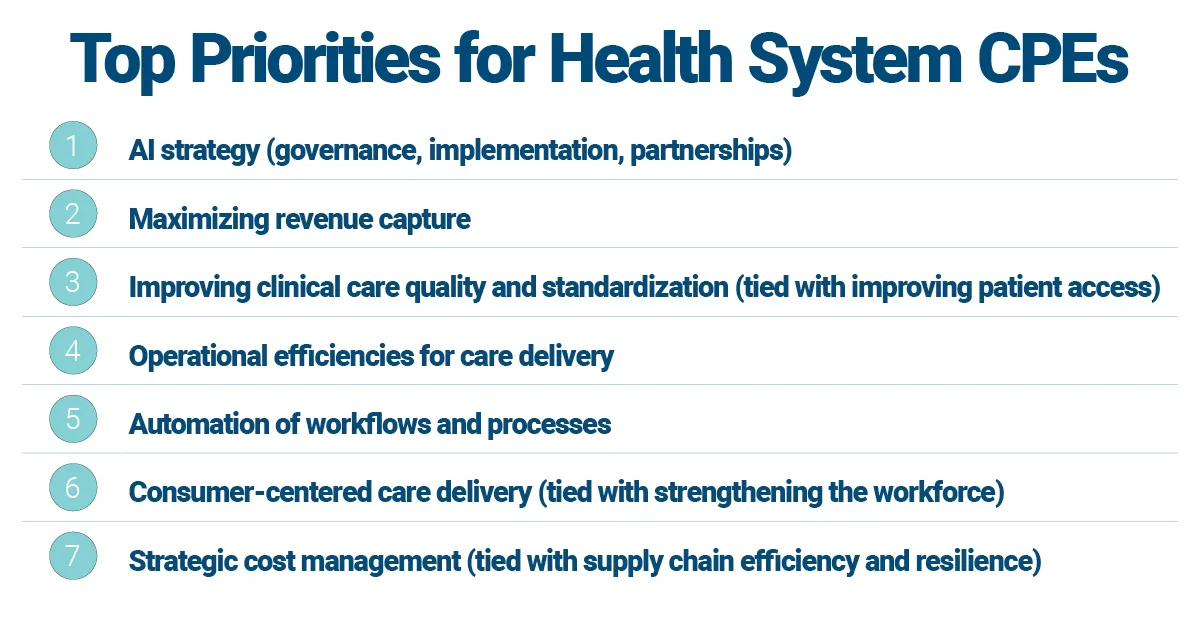
According to our latest CXO Priorities Survey, which drew responses from 198 executives across 90 leading health systems, Chief Physician Executives rank their top ten strategic priorities as follows:
AI strategy (governance, implementation, partnerships)
Maximizing revenue capture
Improving clinical care quality and standardization (tied with improving patient access)
Operational efficiencies for care delivery
Automation of workflows and processes
Consumer-centered care delivery (tied with strengthening the workforce)
Strategic cost management (tied with supply chain efficiency and resilience)
The placement of AI strategy at the top is particularly notable. Among all CXO cohorts surveyed, CPEs rated AI strategy the single highest priority at 4.9 on a 5-point scale, exceeding even CIOs (4.5) and CFOs (4.7). This signals that Chief Physician Executives view themselves not merely as recipients of AI tools deployed by IT, but as the executives who should be governing how AI is adopted, validated, and scaled across clinical settings.
Cross-CXO Comparisons
The priorities data also reveals where CPEs diverge from their peers. CPEs place notably higher emphasis on maximizing revenue capture (ranked second, compared to a lower priority for CIOs and CHROs) and on clinical care quality and standardization, a priority that is largely unique to the physician executive lens. Meanwhile, priorities like strategic cost management and supply chain resilience, which rank higher for CFOs and CPOs, sit further down the CPE list, reflecting the clinical rather than operational orientation of the role.
Where the Biggest Gaps Remain
Our research also identifies where CPEs see the largest gap between current performance and desired outcomes. The top improvement opportunities for Chief Physician Executives are: care at home strategy (including acute and infusion services), patient affordability, automation of workflows and processes, divesting underperforming assets and services, and AI strategy. That care at home ranks as the number-one improvement opportunity while not appearing in the top ten strategic priorities suggests that CPEs view it as an area of significant unrealized potential, one where the clinical model is understood but operational execution has lagged.
What CPEs Are Focused On Right Now
Beyond the survey data, our direct engagement with Chief Physician Executive cohorts through in-person forums reveals the themes that are shaping their day-to-day decisions and long-term planning.
Policy Volatility and Service Line Viability
The policy environment has become one of the most urgent topics in CPE conversations. In our recent forums and regional executive debriefs, CPEs described what several called a "policy triple threat": site-neutral payment reform, the One Big Beautiful Bill and its Medicaid financing implications, and mounting pressure on the 340B drug pricing program. These three forces are converging to compress revenue across service lines that many health systems have long treated as reliable. Oncology, infusion, and outpatient ambulatory care came up repeatedly as areas of acute exposure.
CPEs at independent systems have been especially candid about this pressure. Several acknowledged that they have no contingency plan if site-neutral payment differentials are eliminated, and that oncology lines and outpatient ambulatory clinics could become nonviable in short order. As a result, many are standing up cross-functional teams to scenario-test service line viability and identify where redesign or divestiture may be necessary.
For industry partners, this creates both risk and opportunity. Solutions that can reinforce vulnerable service lines with measurable throughput gains, protect revenue capture under shifting reimbursement models, or support the data infrastructure needed for rapid scenario planning are well-positioned with this audience.
Governance and Disciplined Transformation
A recurring theme across our CPE forums is the recognition that health systems can no longer operate in perpetual crisis mode. After years of pandemic recovery, workforce disruption, and financial volatility, Chief Physician Executives are actively building governance systems designed to produce repeatable, sustainable change rather than episodic interventions.
In practice, this means CPEs are investing in structures with clear metrics, defined timelines, distributed accountability, and clinician involvement from the ground level. One system shared its approach of deploying cross-functional teams around specific high-priority operational targets, such as operating room optimization and staffing models, with defined metrics and executive review cadences. That system reported $52 million in combined performance gains and capacity improvements. Another articulated a governance philosophy built on collaboration and alignment rather than hierarchy, empowering local leaders to drive consistency while a central strategy group coordinates system-wide momentum.
The implication for industry partners is that CPEs are not looking for tools that require them to build new infrastructure. They want partners who can integrate into the governance rhythms and operational cadences that already exist within the system. As one of our forum facilitators summarized, the most effective partners are those who learn the system's existing meetings, steering processes, and accountability structures, and then find ways to contribute within them rather than layering additional complexity on top.
Why AI is an Enabler, Not a Strategy
Chief Physician Executives have matured considerably in their perspective on artificial intelligence. In earlier forums, the conversation centered on whether and where to use AI. In our most recent convenings, CPEs were clear that AI is a tool, not a strategy unto itself, and that its value depends entirely on the organizational readiness and process discipline underneath it.
The CPEs who reported the most successful AI deployments described a common pattern: they mapped their clinical processes first, identified the specific friction points and gaps, and only then evaluated whether AI was the right intervention. One system shared how it used AI-assisted discharge workflows to recover 37 beds daily, but only after first aligning the people, processes, and technology required to operationalize the tool.
Governance is also central to the CPE perspective on AI. Chief Physician Executives are focused on building executive-level AI literacy within their organizations, standardizing guardrails for safe use, and creating clear messaging frameworks for how AI is communicated to patients. They want partners who begin by understanding the organization's specific clinical context and who involve clinicians in the development process from the outset. The AI solutions that have earned the greatest traction, in the CPE's view, are those where physicians had a hand in shaping the tool and where transparency in how the model works built the trust required for sustained adoption.
What CPEs Care About When Evaluating Partners
The partnership expectations of Chief Physician Executives have shifted meaningfully. Across both our leading and independent health system forums, the dominant message has been a desire to move away from traditional vendor relationships and toward genuine co-creation.
Co-Creation Over Transactions
CPEs describe the problems they are solving as too complex for any single organization to address alone. They want partners who invest the time to understand their specific organizational context before proposing a product. They want shared accountability, where outcomes are aligned and both parties carry genuine stake in the result. And they want agility built into the relationship through mechanisms such as quarterly check-ins, early relationship reviews, and the ability to pivot together as circumstances evolve.
From our forums, the partnership attribute that CPEs emphasized most was grounding the engagement in shared outcomes. When both the health system and the industry partner define success in the same terms, and when those terms are measured against patient experience and clinical impact rather than purely contractual deliverables, the relationship moves from transactional to durable.
Plug Into Existing Systems
A closely related theme is the expectation that partners integrate into the health system's existing operational infrastructure rather than asking the system to build around the partner's preferred model. CPEs have been clear that they are not looking for organizations that arrive with an unfamiliar methodology or require wholesale adoption of a new platform. They want partners who can learn the system's governance cadence, join existing steering processes, and deliver value within the structures that are already working.
For independent system CPEs, this expectation is even more pronounced. These leaders want directionally correct, consistent data that clinicians can act on immediately. They want visual reporting over dense spreadsheets. They want partners who show reliability through a series of early, incremental wins rather than promising transformative outcomes that take years to materialize. In their words, the preference is fewer large-scale promises and more consistent, tangible results.
How Leading and Independent Health System CPEs Differ
Understanding the distinction between leading health systems and independent health systems is one of the most important factors in crafting an effective engagement strategy with Chief Physician Executives.
Leading health system CPEs operate within organizations that generally have stronger balance sheets, broader capital planning capacity, and the organizational bandwidth to pursue longer-term strategic initiatives. Their forums center on topics such as building next-generation physician leadership pipelines, scaling AI governance, advancing care-at-home models, standardizing clinical practice across large multi-site enterprises, and investing in physician alignment strategies that support system-wide growth. The conversation is strategic and forward-looking, with a focus on enterprise-level transformation.
Independent health system CPEs operate in a fundamentally different environment. Margins are tighter, often sustained in part by 340B revenue that is now under direct threat. Capital markets are less accessible. The financial horizon for evaluating any new investment is compressed, and the CPE personally carries a broader set of responsibilities with less institutional support. In our regional executive debriefs, independent system CPEs talked about partnership primarily as a financial strategy: a way to access capabilities the system cannot build internally, diversify revenue through models like specialty pharmacy and direct-to-employer arrangements, and manage risk through turnkey solutions that deliver results quickly without requiring extensive in-house buildout.
The engagement implications are substantial. With a leading health system CPE, the conversation can be more exploratory, focused on long-term roadmaps, co-development opportunities, and strategic alignment. With an independent system CPE, the conversation needs to be more immediate: what specific problem does this solve, how fast can it be implemented, and what measurable financial or operational return will it produce within the current budget cycle?
Both audiences value authenticity and partnership over salesmanship, but the cadence, the proof points, and the contracting expectations differ in ways that matter.
Where to Meet and Engage CPEs

For industry professionals seeking direct access to Chief Physician Executives, the setting of the engagement is as consequential as the substance. CPEs are physician leaders whose time is constrained and whose tolerance for surface-level conversations is low. The most productive engagements tend to happen in curated, retreat-style environments where candor is the norm and the format supports genuine dialogue rather than exhibition.
The Chief Physician Executive Forum
Our Chief Physician Executive Forum convenes senior physician executives from the nation's leading health systems in an immersive, retreat-style setting twice each year. The forum is designed to discuss the trends shaping healthcare, highlight strategies for accelerating business model transformation, and create space for collaborative problem solving. Recent forum topics have included the evolving role of the physician executive in enterprise leadership, developing the next generation of physician leaders, physician alignment strategy, AI governance, and caring for care teams in a sustained period of workforce pressure.
The CPE Forum is suited for HC IT, medical device, and pharmaceutical companies whose solutions touch clinical strategy, care delivery, physician enterprise performance, or clinical technology.
The CPE Circle
For industry partners focused on independent and regional health systems, our CPE Circle provides a parallel convening designed specifically for this audience. The CPE Circle brings together system-level physician leaders from independent and integrated health systems alongside select industry innovators in an intimate, retreat-style setting. With continuing education accreditation and a one-to-one health system-to-industry ratio, the Circle is structured for authentic dialogue, practical insight, and enduring professional relationships.
The CPE Circle is particularly well suited for companies whose value proposition is tailored to the realities of smaller and mid-size health systems, including solutions that address margin pressure, workforce cost inflation, turnkey revenue diversification, and operational efficiency in resource-constrained environments.