The Non-Epic Vendor Landscape: Where Health Systems Use Specialized Solutions

Even in health systems that have standardized on Epic, non-Epic software runs in nearly every technology category. Our 2026 Technology Investment Survey of 31 Leading Health System technology executives found specialized solutions operating alongside Epic across imaging, supply chain, documentation, virtual care, and more.
For commercial leaders who sell into these organizations, the practical question is not whether a health system uses specialized tools. It is where the gaps sit, and why a specialized solution earns a place next to the system of record.
This piece maps that terrain. We draw on what health system technology leaders told us about where they run specialized solutions, which capabilities pull them toward purpose-built software, and how those tools integrate with Epic rather than displace it. The intent is a strategy map for industry partners, not a verdict on any one platform.
Why Health Systems Run More Than One Platform
Most large health systems treat Epic as the integrated platform that holds the patient's chart and unifies clinical and financial data. Around that core, they assemble specialized solutions where a focused tool does a specific job better. This best-of-breed strategy is a deliberate response to the limits of any single integrated platform, which cannot lead every category at once.
Running multiple systems carries a real operating cost. When platforms do not exchange information cleanly, data siloing follows, and clinical workflows fragment across tools that were never designed to talk to one another. Providers end up waiting on records that live in separate systems, and staff fall back on manual processes to reconcile what the software will not. Each of these frictions is also where a specialized solution can create value, provided it integrates rather than adding another island of data.
The Core-EHR Market in Context
Epic leads the hospital electronic health record market, but it is not the only core EHR with a large footprint, and that structure shapes where specialized solutions enter. A quick read of the landscape helps frame where opportunity concentrates.
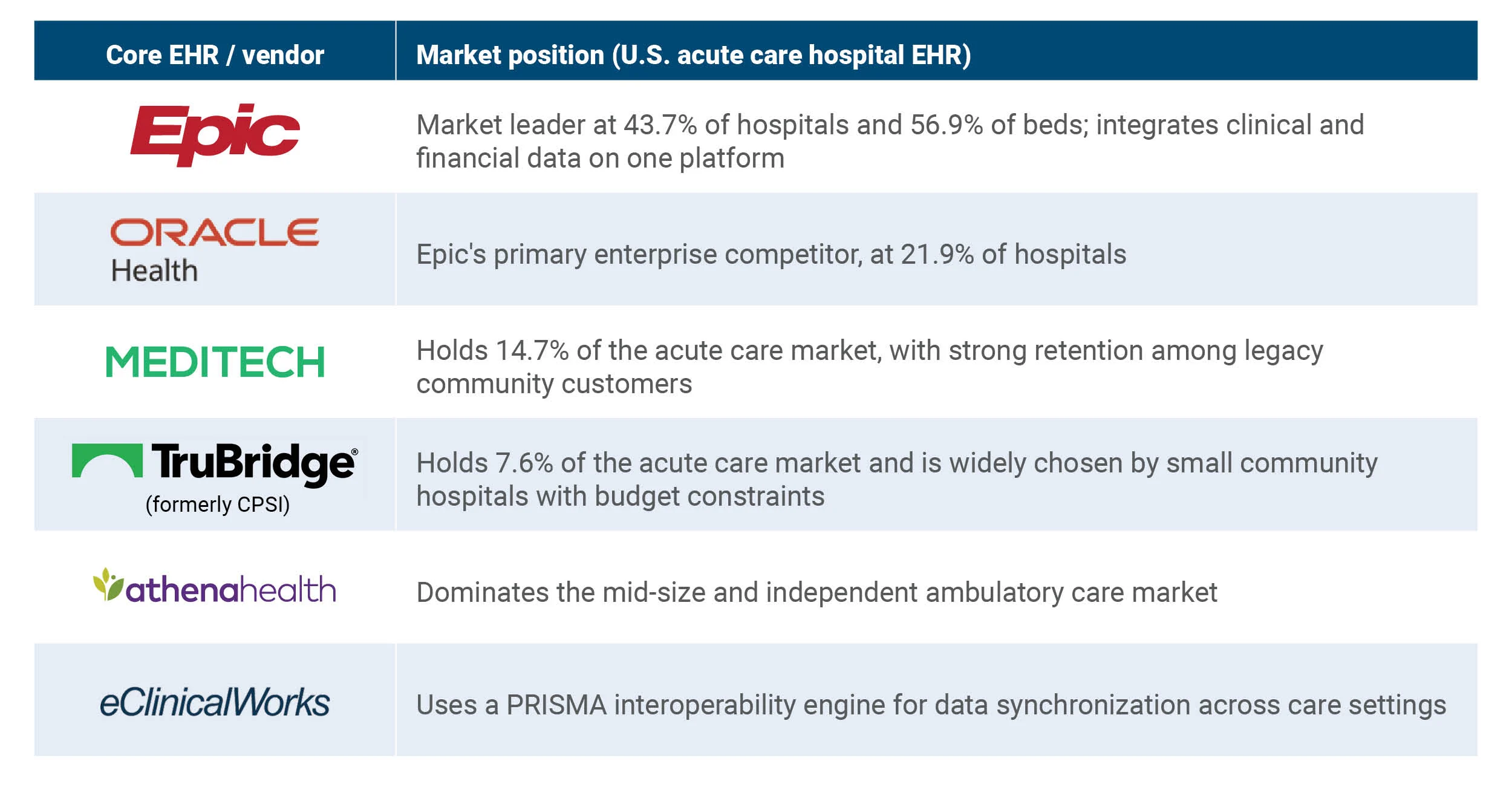
Source: KLAS Research, “US Acute Care EHR Market Share 2026” (EHR decisions made January through December 2025). Figures reflect acute care hospital share; segment-level share among small standalone hospitals differs. athenahealth and eClinicalWorks lead in the more fragmented ambulatory market. Not The Health Management Academy survey data.
These alternative core EHR systems command meaningful share, and they often thrive in outpatient medicine, specialized clinical diagnostics, and agile operational management. Where they take hold, the surrounding market for specialized solutions tends to open as well.
What Our Research Shows: Non-Epic Use By Category
Non-Epic use is most widespread in imaging, supply chain, and documentation. The differentiator is capability, not cost.
We asked 31 Leading Health System technology executives to identify every category where their organization currently runs a non-Epic vendor and to name the primary one. The pattern below is the heart of this analysis: specialized solutions are not a fringe phenomenon. In the most affected categories, more than two-thirds of these systems run a non-Epic tool.
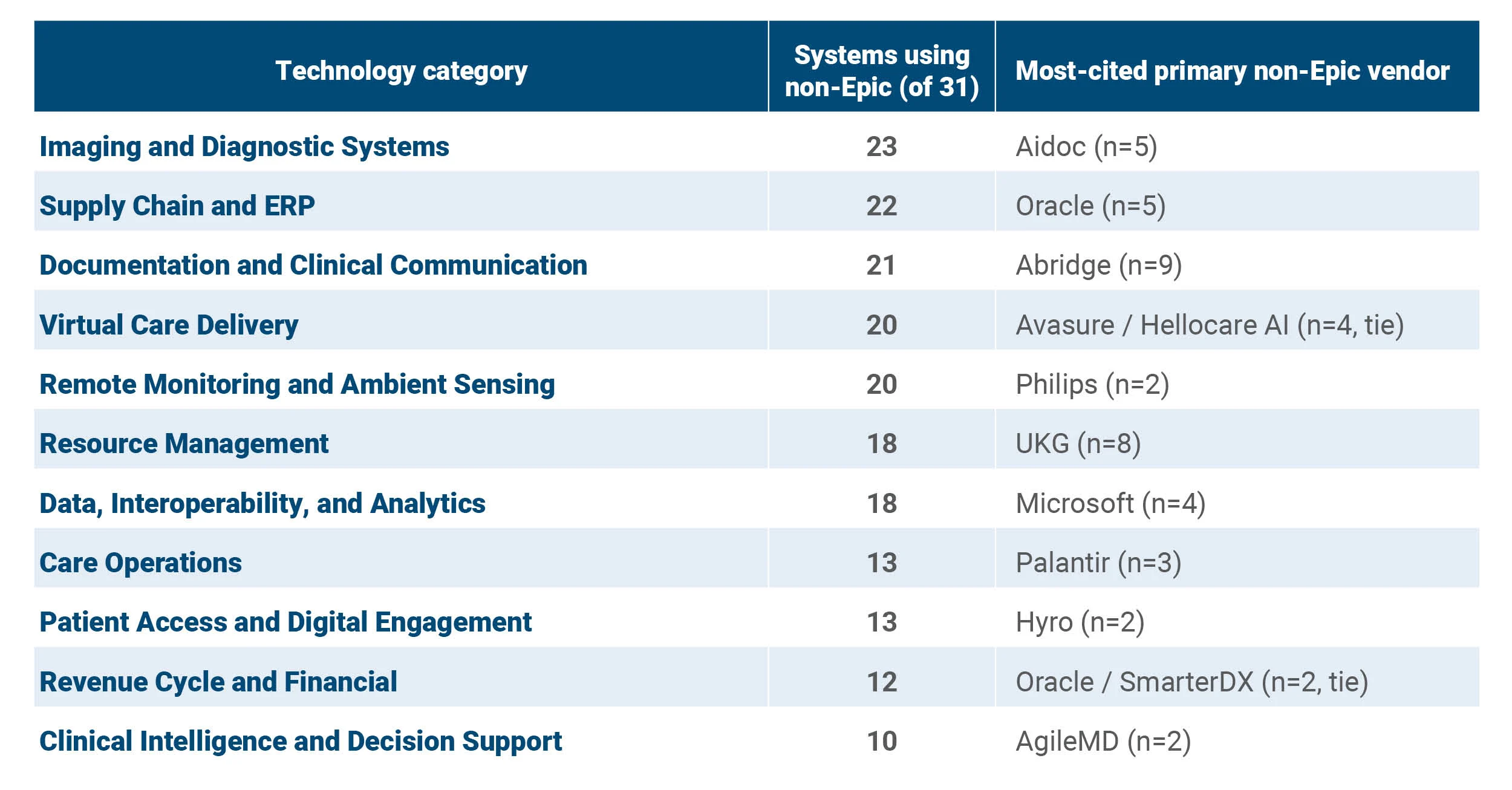
Sources: The Health Management Academy 2026 Technology Investment Survey (n=31). Research and analysis by The Health Management Academy.
Two findings deserve emphasis. First, Abridge in documentation and UKG in resource management stand out as recognizable category leaders, yet most categories remain fragmented, with no single non-Epic vendor dominating. That fragmentation signals open competitive ground. Second, and most important for how partners position themselves: when these executives explained why they chose a non-Epic option, they pointed to advanced AI, analytics, and automation far more often than to price. Non-Epic differentiation in our data is capability-led, not cost-led, and it shows up most clearly in documentation, imaging, virtual care, and supply chain.
Where Specialized Solutions Win, and Why
Four conditions reliably create room for a specialized solution alongside Epic. Each represents a different buying motion, and recognizing which one is in play changes how a partner should frame the conversation.
1. Deep Specialty Workflows
Some clinical areas carry treatment patterns too specific for a general-purpose module to model well. Niche specialty EHRs supply deep, pre-built clinical workflows for complex care, and health systems routinely require purpose-built software for oncology, cardiology, radiology, and behavioral health. Picture archiving and communication systems, or PACS, are a clear example: health systems rely on them to manage the advanced medical imaging data loads that general systems are not built to carry. Specialty networks frequently opt for these purpose-built platforms precisely because a broad EHR adds complexity they do not need.
2. Speed to Value
Core EHR work runs on a long horizon. A full Epic implementation typically unfolds over many months of design, build, and testing. As an illustrative pattern, an Epic implementation that begins in January can reach go-live in October of the same year, and the organization behind it may have run separate systems for critical functions since well before that, in some cases since 2008. Specialized vendors compete on the opposite axis. They offer rapid deployment and integration, and in one anonymized example a health system modernized its technology landscape in roughly ten months by layering focused tools rather than rebuilding the core. When a system needs a capability now, speed itself becomes the value proposition.
3. Best-of-Breed Capability
This is the condition our survey surfaces most strongly. Where a specialized solution delivers AI, analytics, or automation that a general-purpose module has not yet matched, technology leaders are willing to add it. Data aggregation platforms illustrate the point: by pulling information from many sources into a unified view, they support population health management in ways a single feed cannot. The advantage here is functional depth, and it is what our respondents cited most often.
4. Agility and cloud-native delivery
Specialized solutions also differ from the largest vendors in how they ship. Many are cloud-native and built for frequent iteration, which lets them move faster than monolithic upgrade cycles allow. That agility plays well in outpatient care, specialized diagnostics, and operational management, where requirements shift quickly and a smaller, focused tool can adapt without a system-wide release.
The Integration Question Every Buyer Must Answer
The durable strategy is to integrate with Epic, not to replace it.
The specialized solutions that earn lasting placement tend to connect to the system of record rather than compete with it. In practice, that means integrating through FHIR or open APIs. Epic supports hundreds of standards-based APIs and has implemented the FHIR standard for data exchange, which gives third-party applications defined paths into the chart. Integration is rarely trivial, since it requires navigating complex system architectures, planning data migration carefully, and avoiding the new data siloing that a poorly connected tool can introduce. Done well, the deliverable is genuine workflow integration, not another parallel system.
It is also worth being clear-eyed about Epic's own trajectory, because honest framing serves partners better than wishful thinking. Epic continues to extend its native capabilities into areas that specialized vendors have historically owned. Its Agent Factory brings AI into healthcare workflows, its cognitive computing platform enables teams to deploy predictive models, and AI-powered clinical documentation can automate real-time note-taking from patient-clinician conversations. AI-driven decision support is increasingly available within Epic workflows themselves. For a commercial team, the right posture is to acknowledge this directly and to articulate where a specialized solution still does more, rather than to argue that the core platform stands still.
The friction that makes integration matter is easy to underestimate. Consider a simple downstream example outside the hospital: organizations that need clinical records from an EHR but sit outside it, such as law firms requesting records for a case, often wait on delivery and then receive files in inconsistent formats that demand manual organization. EHR platforms like Epic serve healthcare providers first, so other organizations frequently absorb that administrative burden. The lesson for partners selling in is direct. Data access is the real battleground, and a solution that reduces manual handling and respects existing clinical data structures will outperform one that forces another export.
What This Means for Commercial Teams Selling Into Health Systems
Position against the gap, integrate with the platform, and prove hard ROI with clear attribution.
The technology executives in our research were specific about what separates a solution that advances from one that stalls. Their evaluation checklist maps cleanly onto the conditions above, and it gives commercial teams a practical standard to meet.
Integrate into existing EHR workflows without requiring extensive data export. Workflow integration that respects the chart beats a tool that demands a parallel feed.
Lead with capability, supported by hard ROI and a clear methodology for attributing value. Our respondents chose non-Epic options for advanced AI, analytics, and automation, then asked partners to prove the return rather than assert it.
Bundle change management, training, and post-go-live support. Informatics teams are stretched, and a solution that arrives with adoption support carries less internal cost.
Name your cybersecurity posture and support business continuity. As specialized tools touch more clinical workflows, technology leaders weigh resilience alongside capability.
These priorities reflect a larger shift our survey documented. Technology decisions are staying close to the executive level. The Chief Information Officer is the most-cited final decision-maker in 7 of 11 technology categories, and CIO review now triggers at smaller contract values, frequently around the $100,000 mark, and on shorter agreement terms than it did a year earlier. When we asked these leaders what they wish industry partners did better, their answers clustered into five asks: prove ROI rather than product features, integrate deeply instead of selling point solutions, price transparently, take time to understand the organization, and stay engaged after implementation rather than moving on.
Knowing which information officer is across the table, and what that specific leader weighs, is often the difference between a meeting and a partnership. That is the work our community is built to support.