
This week’s featured graphic is based on data from a recent Medscape report on physician mental health and well-being, highlighting differences in self-reported happiness across 29 different medical specialties. Instead of asking whether the respondents themselves are happy, the survey asked whether it’s possible to be a happy, well-balanced person practicing in their specialty.
By this metric, the happiest specialties are overwhelmingly the ones with controllable, predictable schedules and a high share of elective or scheduled work: fields like dermatology, ophthalmology, and radiology. Many of the least happy specialties—like general surgery, emergency medicine, critical care—are unscheduled and high-acuity fields where the work arrives on the patient's timeline rather than the physician's, and where the emotional and cognitive stakes of a given shift run highest.
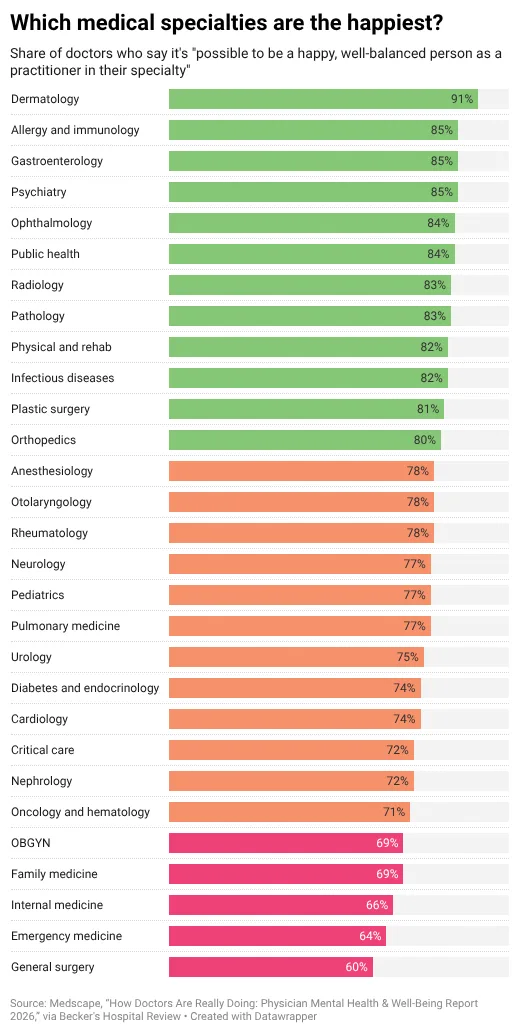
The upshot for health system strategists is that the specialties reporting the lowest sustainability are disproportionately the ones a system can't function without. Emergency medicine, general surgery, critical care, and primary care sit at the front door of acute access and can't be deferred or outsourced the way some ambulatory services can. That concentrates burnout and retention risk in exactly the roles most tied to throughput, access, and margin.
Wellness perks like meditation apps and free snacks can help on the margin, but they don’t change the day-to-day reality of these roles. To truly move the needle, health systems need to change how the work is structured: better schedules and shifts, more manageable patient loads, team-based care, and AI tools that cut down on administrative work. These changes cost money, but so does the alternative: low morale, turnover, and endless recruiting.