
In mid-February, a federal judge struck down a new rule—finalized in 2024—that dramatically expanded the scope of information companies must provide to the FTC at the outset of a proposed merger under the Hart-Scott-Rodino Act. If the decision stands, it would represent a major rollback of the agency’s increasingly vigorous approach to M&A oversight that began under former FTC Chair Lina Khan.
The Trump administration appealed the ruling, surprising some observers who expected the FTC to take a more hands-off approach to mergers under a Republican administration. The 2024 merger rule will remain in place while an appeals court hears further arguments.
The U.S. Chamber of Commerce’s lawsuit challenging the rule was also supported by the American Hospital Association, which argued that mergers are often “the last hope for keeping a hospital open.”
Siding with the challengers, Judge Jeremy Kernodle determined that the agency failed to prove that the rule’s purported benefits outweighed its significant costs. The FTC estimated that companies would spend an average of 105 hours to complete the new merger form, compared to 37 hours under the previous rules. More broadly, business groups fear that the new disclosure requirements could be used to more aggressively challenge mergers that otherwise adhere to legal limits on market consolidation.
So What?
1. The Trump administration’s appeal suggests the push to expand antitrust enforcement continues to enjoy some bipartisan support.
The FTC’s appeal signals that this administration is not looking to abandon the Biden-era push for greater M&A oversight altogether. While Republicans are sometimes seen as “the party of business,” it’s worth recalling that Vice President JD Vance himself praised Lina Khan’s regulatory approach to the tech industry as recently as 2024.
Health systems continue to face vigorous antitrust scrutiny at the state and federal levels—a fact underscored by the Justice Department’s new lawsuit against OhioHealth focused on the system’s payer contracting.
Still, despite the appeal, the Trump administration has taken some steps to liberalize M&A oversight. In antitrust cases over the past year, FTC Chair Andrew Ferguson has argued for greater use of divestitures and consent decrees instead of a more aggressive “block-and-sue” posture. While the administration is embracing some parts of the Biden-Khan agenda (like the new HSR form), there’s still arguably an overall shift towards greater flexibility.
2. If the ruling stands, a more permissive legal environment for M&A could create more strategic options for both the “haves” and “have-nots” of healthcare.
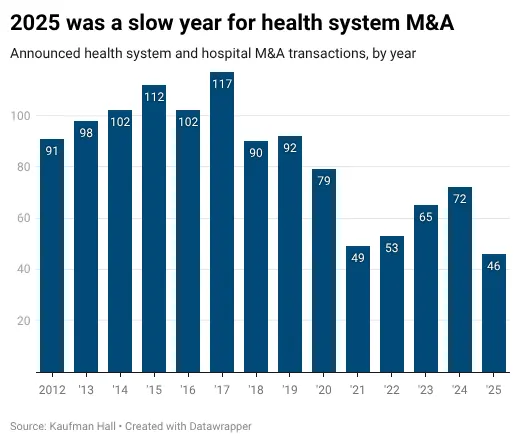
Last year was a historically slow year for health system and hospital M&A not only because of the new merger rules, but also because of broader economic uncertainty and a shifting healthcare policy landscape. The pace was beginning to pick up again at the end of 2025, and a reversion to the previously less onerous reporting requirements could further accelerate the trend if the ruling ultimately stands.
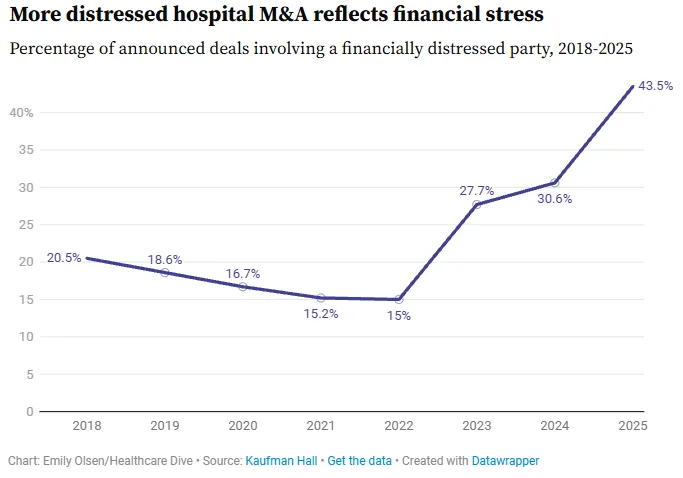
Well-capitalized health systems seeking rapid scale or greater control over care delivery volumes could have a freer hand to absorb strategic assets. Likewise, financially struggling hospitals and rural systems will have an easier time convincing potential acquirers that “the juice is worth the squeeze.” The enlarged systems that emerge from this process would have greater leverage with payers but also greater challenges with standardization and systemness.
3. A new wave of health system M&A could revive existential questions about the importance of scale.
At last year’s Spring CSO Forum, one participant representing a major system in the Northeast argued that 80% of care will be controlled directly or indirectly by the 20 largest systems at the end of the decade. Another participant representing an academic system relayed his board’s fear that too much scale would create a “health system with a university attached” rather than vice versa.
Greater scale can help systems raise capital at cheaper rates, which could make the difference in the transition to outpatient care. At the same time, greater scale attracts negative media attention and can drive a perception that “big money” is influencing care decisions regardless of nonprofit status.
While these are interesting topics for debate, it’s too early to say whether 2026 will be an active year for health system M&A—especially while this legal case continues to work its way through the courts.