
Editor’s Note: This special feature highlights the emergency preparedness work of Strategy Catalyst member Nebraska Medicine. Though outside our typical coverage, recent news of hantavirus quarantine and rising global infectious disease activity makes this a moment for strategy leaders to consider where their own systems sit on a national readiness map—and what Nebraska's twenty-year head start can teach them.
In May, federal authorities needed somewhere to monitor a group of Americans potentially exposed to a deadly virus. They had been aboard the MV Hondius, the cruise ship tied to an Andes hantavirus outbreak linked to three deaths. Passengers with high-risk exposure were flown to the only federally funded quarantine unit, built to monitor people exposed to a high-consequence infectious disease (HCID): the National Quarantine Unit (NQU) at Nebraska Medicine/UNMC.
This was not Nebraska's first call. In 2014, the Nebraska Biocontainment Unit was one of only three U.S. sites that received American patients evacuated from West Africa during the Ebola outbreak. In February 2020, they took in cruise ship passengers exposed to COVID and supported the federal quarantine of Americans evacuated from Wuhan.
The Nebraska Biocontainment Unit was established in 2005, with state and federal funding made available after 9/11, when anthrax-laced letters, the Midwest mpox outbreak, and the 2003 SARS outbreak that overwhelmed Toronto hospitals convinced UNMC's Dr. Philip Smith that the country needed more dedicated space and a specially trained team to monitor and treat patients with HCIDs.
For nearly a decade, the unit sat empty save for a handful of false alarms.
What would it take for your system to make a multi-million-dollar investment with no clear ROI, and no patients in sight? How would you sustain the discipline to maintain it year after year, firm in the conviction that what you are building is essential for the health and safety of the community? For most systems, this is a thought exercise. Nebraska has lived it.
We recently spoke with Angie Vasa, Director of Emergency Preparedness and Special Pathogen Programs, and Kara Tomlinson, VP of Acute Care Operations at Nebraska Medicine, to understand what other member health systems can learn from their approach.
Why Nebraska Does This
Nebraska's leaders frame the unit as an extension of their mission, not a business line. Tomlinson points to the organization’s reputation and stated mission—to lead the world in transforming lives—and argues the biocontainment work is that mission in practice. Vasa frames it operationally: “Our posture has always been how we prepare and ensure we have the people, space, and supplies to respond and protect the healthcare workforce while providing safe and effective care. And that’s really been our driving mission this entire time.”
After the 2014 Ebola outbreak, the focus shifted outward. With its own program established, Nebraska helped expand national capacity, which, before the outbreak, amounted to a handful of dedicated biocontainment beds. Knowing most hospitals couldn't invest in similar capabilities, Nebraska's team focused on helping providers work with the resources they already have. That outward training role is now as central to Nebraska's identity as the clinical care itself.
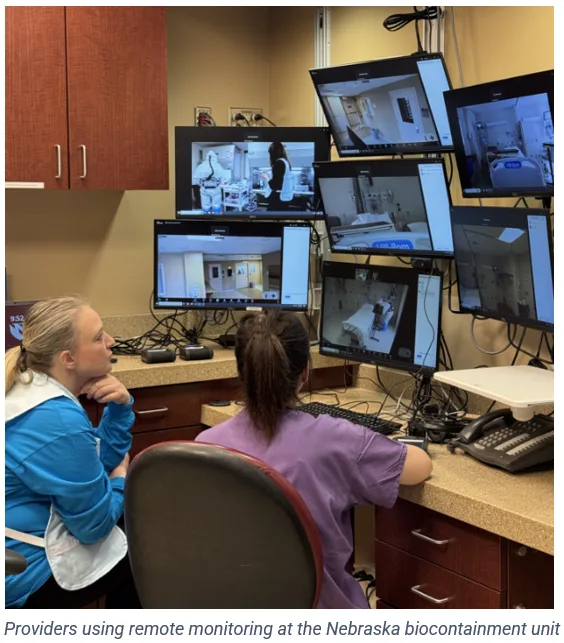
As Tomlinson puts it,“It’s not feasible or realistic to expect that every hospital will have a biocontainment unit. So how do we make sure that everyone knows where those resources are, what their limitations are within their healthcare setting, and who they go to for additional resources?”
Whether the threat is a measles resurgence, seasonal influenza, or a high-consequence disease like Ebola, what can strategy leaders learn from Nebraska Medicine?
So What for Strategy Leaders?
Embed preparedness in work you already must do. Nebraska’s program endured a small budget and nearly a decade without patients because it was anchored in emergency preparedness, not treated as a standalone infectious disease line item, and because exercises were dual-purposed to satisfy CMS and Joint Commission requirements. The argument that resonated with executives wasn’t pandemic risk. It was business continuity and workforce protection: a single suspected Ebola case in your ED creates exposures, requires disproportionate staffing, and threatens both operations and reputation, whether or not a diagnosis is ever confirmed.
Identify first—most hospitals can't. Nebraska, as a founding member of the National Emerging Special Pathogens Training and Education Center (NETEC), teaches the three-part framework: Identify, Isolate, Inform. In consulting with other systems, they’ve found that, especially post-COVID, many can reliably isolate and inform. However, most still cannot reliably and consistently identify the patient at the point of entry—even when their EHR ships with a travel-screening module ready to turn on. If you can't flag a suspected case at the door, the rest of the protocol never activates.
Match scale to community risk, not to peer comparison. A rural critical access hospital and an urban AMC should not be running the same playbook. The National Special Pathogen System is focused on right-sizing a tiered system for HCID care (including an upcoming federal call for applications to fund additional Level 2 treatment centers). Every hospital needs to identify and isolate safely; not every hospital needs a biocontainment unit. The strategic question is whether your system knows what it's equipped to handle, what it isn't, and who to hand off to when it isn't.
Pair an operational champion with executive air cover. A capability with no near-term ROI doesn’t survive on budget—it survives on people. Nebraska’s program made it through the lean years because a passionate operational leader kept a volunteer team trained and ready, while executive leadership continued to protect program funding, attention, and governance. As Vasa puts it, you need “an executive leadership team that is committed to the mission, and an operational response team with the expertise to make sure the team is ready.” Lose either half, and the capability quietly erodes between crises.
Nebraska’s bet has paid off in a currency that never shows up on a balance sheet: when the federal government needs somewhere to send exposed Americans, there is exactly one place to call. That's the result of decades of disciplined, mostly invisible work.
For most systems, the lesson isn’t to build a quarantine unit. It’s to understand—deliberately, before the next outbreak forces the question—what your organization is equipped to handle, and what it isn’t. Ready or not, patients will present for care; most systems are only one flight away from an imported infectious disease. What one step could your system take now to be ready when the call comes?