
Executive Summary
Early-tenure RN turnover remains unsustainably elevated – even as many health systems have reduced turnover from pandemic-era peaks. Nearly one-third of new graduate nurses (NGNs) leave within their first year. For executives managing margins, this persistent churn is not just a workforce challenge; it is a measurable cost. Replacing one bedside RN is estimated at ~$61,000, creating additional avoidable expenses at scale at a time when margin management is paramount.
Nurse residency programs remain a necessary investment and continue to build baseline clinical competence. However, our benchmarking data suggest that residency is no longer sufficient as a stand-alone retention strategy. The missing ingredient is clinical confidence – a factor tightly linked to whether early-career nurses intend to stay once structured residency supports taper.
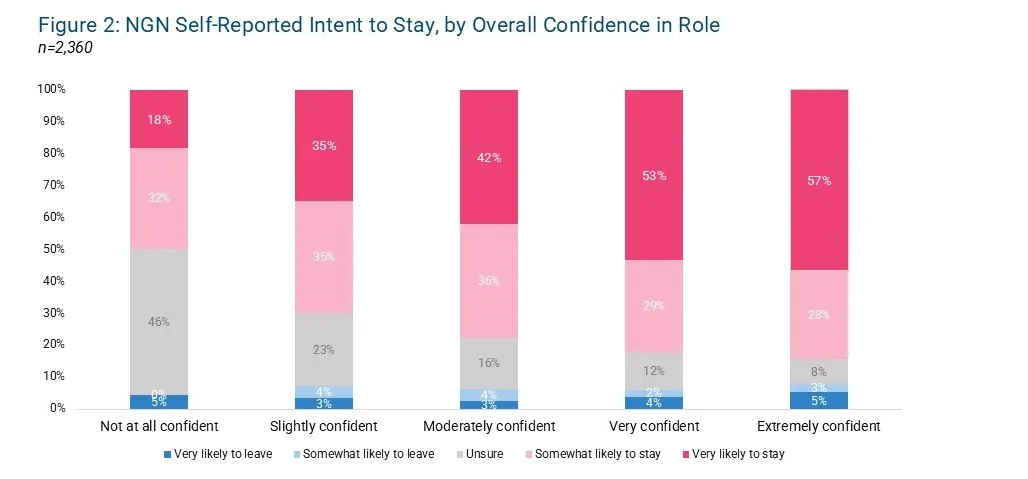
Nursing Catalyst’s national benchmarking data show that NGNs with the highest confidence are 39% more likely to report strong intent to stay than their least confident peers. The strategic implication of this is clear: nursing workforce strategy must evolve beyond residency as a blunt instrument and address clinical confidence as a primary retention imperative sustained across the first three years of practice.
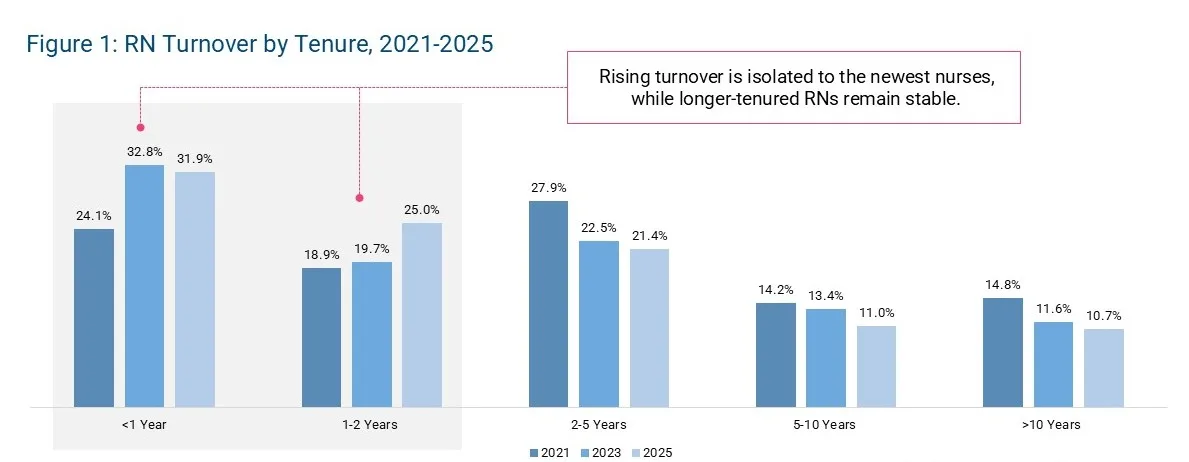
Source: 2025 NSI National Health Care Retention & RN Staffing Report, NSI 2025.
Key Takeaways
1. Clinical confidence is the missing X factor in early-tenure retention strategy.
NGNs reporting the highest confidence are 39% more likely to express strong intent to stay than less confident peers.
2. NGNs want to stay at the bedside – but turnover risk rises as confidence dips and work conditions erode resilience.
While 69% of NGNs envision long-term bedside careers, those considering leaving most often cite workplace culture/leadership, workload/burnout, and limited growth visibility as the drivers. These challenges become even harder to navigate when clinical confidence is low.
3. Retention gains come from precision, not more spend.
High-performing approaches stage support to protect and grow confidence beyond initial onboarding by sequencing from early confidence stabilization, mid-transition belonging and mentorship, to late-stage growth pathways.
Section 1: Why Clinical Confidence Predicts Retention Risk
Health systems have invested heavily in retaining early-career nurses, yet turnover remains stubbornly high in the first one to two years. Nursing Catalyst’s benchmarking data point to a strategic blind spot: clinical confidence is tightly linked to intent to stay, but it is rarely treated as an explicit workforce-building objective.
NGNs who report higher confidence are significantly more likely to express intent to stay. Those in the highest confidence tier are 39% more likely to report strong intent to stay than their least confident peers. This is accompanied by a nearly 40% decline in uncertainty about staying as confidence increases.
Strategic implication for executives: Clinical confidence is not a “soft” concept – it functions as a measurable retention indicator. Systems should treat confidence as a design target and monitor low confidence as an early warning signal of intent to leave.
Section 2: Why Nurses Consider Leaving – and What Drives Intent to Leave
Many health system leaders assume early-career nurses view bedside care as a short-term stop en route to advanced practice or non-bedside roles. Nursing Catalyst data suggests otherwise: most NGNs still envision long-term bedside careers, but they do not always feel confident and supported enough to see a sustainable path in the inpatient environment.
In Nursing Catalyst’s survey, 69% of NGNs envision long-term bedside careers. That is a positive signal for workforce stability, but it does not eliminate early-tenure retention risk. Even nurses who want to stay can reach a tipping point when confidence dips and day-to-day conditions make the role feel unsustainable.
Confidence dip – the first catalyst for intent to leave:
Residency programs are succeeding at what they were designed to do: build baseline competence and early confidence. From the start to completion of residency, overall confidence increases by 39%, supported by structured preceptorship, hands-on learning, and consistent feedback.
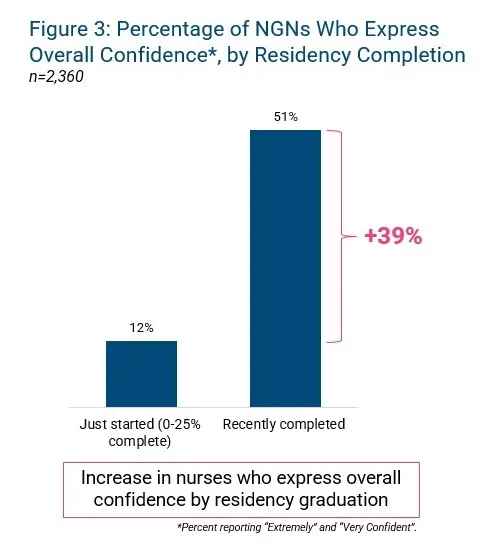
However, confidence gains are not inherently durable. As nurses transition into independent practice, confidence can plateau – particularly when workload intensity increases, unit culture is strained, or nurses lack a consistent support system to validate them. When confidence is low or begins to dip, intent-to-stay weakens and turnover risk rises.
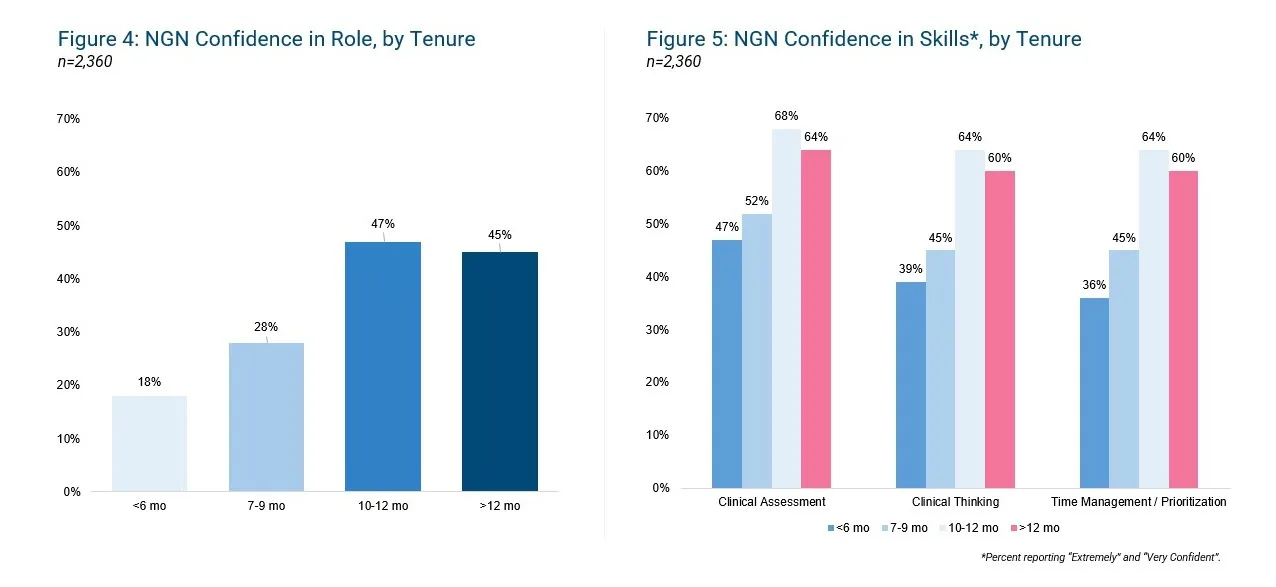
This does not mean NGNs are regressing in clinical competence. Rather, many are encountering escalating complexity and variability in their work without proportional scaffolding. For executives, the implication is straightforward: residency is necessary, but it is not a reliable retention mechanism on its own.
Other factors that push nurses out – and why confidence matters:
When asked what would influence their decision to leave, NGNs most frequently point to three themes: workplace culture/leadership, workload/burnout, and limited growth. These drivers are not separate from confidence – they intensify when confidence stalls.
When nurses feel uncertain in their practice, high workload is harder to absorb, strained unit culture feels less psychologically safe, and limited growth visibility can make the role feel like a dead end rather than a developmental phase. In other words, low confidence amplifies the impact of these stressors and becomes the catalyst that turns challenges into intent to leave.
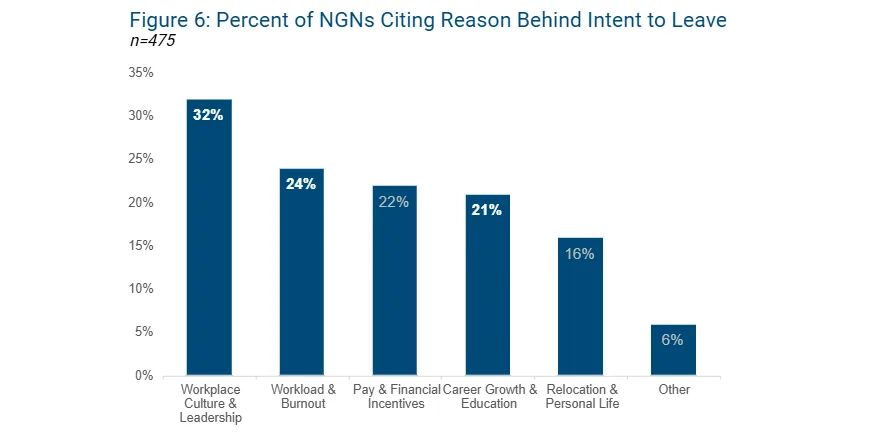

Strategic implication for executives: Reduce early-tenure turnover by treating clinical confidence as a workforce design objective and reinforcing it through targeted supports that reduce friction, strengthen relational support, and make next steps visible.
Section 3: What High-Performing Retention Strategy Looks Like
Nursing Catalyst’s benchmarking efforts find that improved retention is not driven by higher residency spend alone. Most participating systems keep first-year turnover below 15%, regardless of investment level. However, nearly all systems see elevated second-year turnover—even those investing more than $100,000 per NGN. This indicates that how and when supports are deployed matters more than total spend.
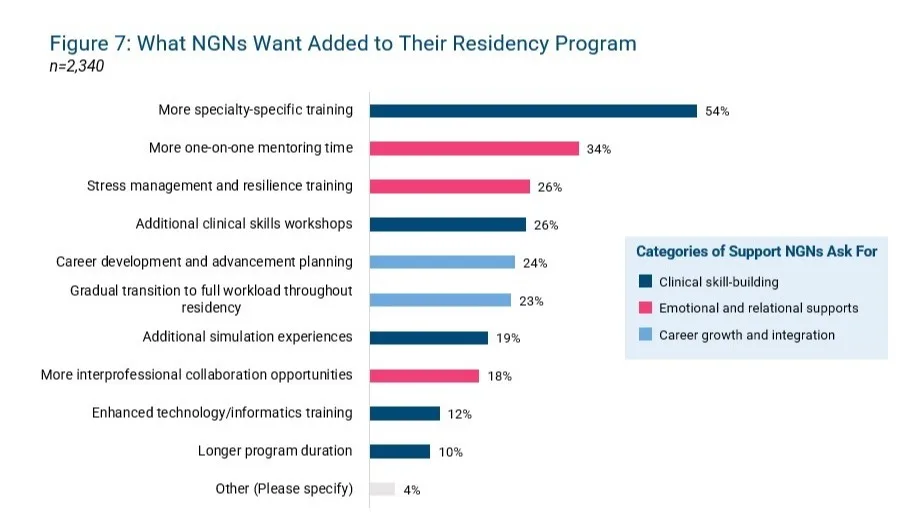
Importantly, NGNs are not asking for longer residency programs: only 10% express interest in extending program duration. Instead, their requests cluster around targeted supports that help strengthen and sustain confidence, including:
More specialty-specific training (54%)
More one-on-one mentoring time (34%)
Stress management and resilience training (26%)
Support needs also vary by confidence level. Less confident nurses seek foundational scaffolding (e.g. individualized mentoring, gradual workload progression, and structured feedback) that help them stabilize during transition to practice. In contrast, more confident NGNs prioritize career and development advancement planning (32%, compared to 14% among less confident peers). This is a signal that once confidence consolidates, attention shifts toward growth.
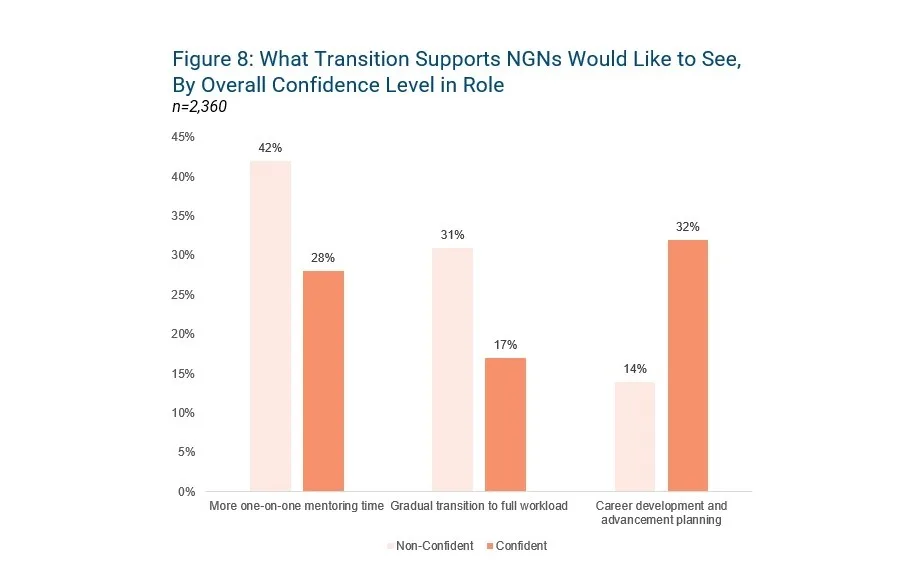


Strategic implication for executives: Prioritize targeted supports that strengthen confidence in the flow of work, without expanding residency duration. Specifically, high-performing approaches invest in (1) specialty-specific training and real-time skill development, (2) one-on-one mentoring and consistent relational support, and (3) visible development pathways once confidence strengthens. Systems that outperform in early-tenure retention align supports to nurses’ confidence level and needs, rather than relying on residency alone as the endpoint.
Methodology
In 2025, Nursing Catalyst launched a national nurse residency benchmarking study to move beyond identifying the early-tenure retention challenges and toward clarifying which investments measurably improve outcomes.
This study examined the transition-to-practice (TTP) period through two complementary lenses: the system lens and the new graduate nurse lens – enabling analysis of both organizational investment and frontline experience.
Researchers surveyed 2,360+ new graduate nurses to assess self-reported clinical readiness, confidence, belonging, and evolving support needs. In parallel, 35+ participating health systems shared data on residency structure, investments, and early-career retention performance.
By pairing system-reported investments with NGN-reported experiences, we identified which supports most strongly correlate with sustained confidence and early-career retention.