Table of Contents
Kaiser Permanente (KP) recognized that patients expect the same seamless digital experiences in healthcare that they receive from other consumer industries. Yet healthcare’s complexity—multiple portals, varied appointment types, and differing acuity needs—often left members confused about how to “get in the door.”
The Kaiser Permanente Intelligent Navigator (KPIN), an AI-powered patient portal, is an emerging strategy that fits within Kaiser’s broader access strategy. KPIN addresses three interlocking challenges:
Complexity of access: Patients often struggled to find the correct entry point within KP’s large system.
Resource allocation in value-based care: Efficiently matching patients to the right level of care became essential for outcomes and cost control/financial performance.
Experience and perception gaps: Patient perceptions of access—how easy, fast, and intuitive it feels—are as important as clinical quality in driving satisfaction and loyalty.
“Experiences are based on expectations and healthcare is such a black box to most consumers that you have a unique opportunity as an organization to actually set their expectations around what they're going to see.”
— SVP, Ambulatory Care, Chief Administrative Officer
Overview
The KPIN allows patients to type their reason for seeking care in plain language through the patient portal or mobile app. Natural language processing algorithms interpret the request and connect the patient to the most appropriate service (e.g., an appointment, urgent-care referral, video visit, pharmacy refill, or provider messaging) without the patient having to navigate preset options.
Two key components of the KPIN:
Clinical Alert System: Detects red-flag or high-acuity symptoms and directs patients to emergency or expedited care.
Clinical Navigation System: Determines the best pathway for non-emergent needs.
Data from language input, demographics, and patient history inform routing decisions. The tool is integrated with other human agent-assisted contact center and interactive voice response channels as part of the omnichannel strategy.
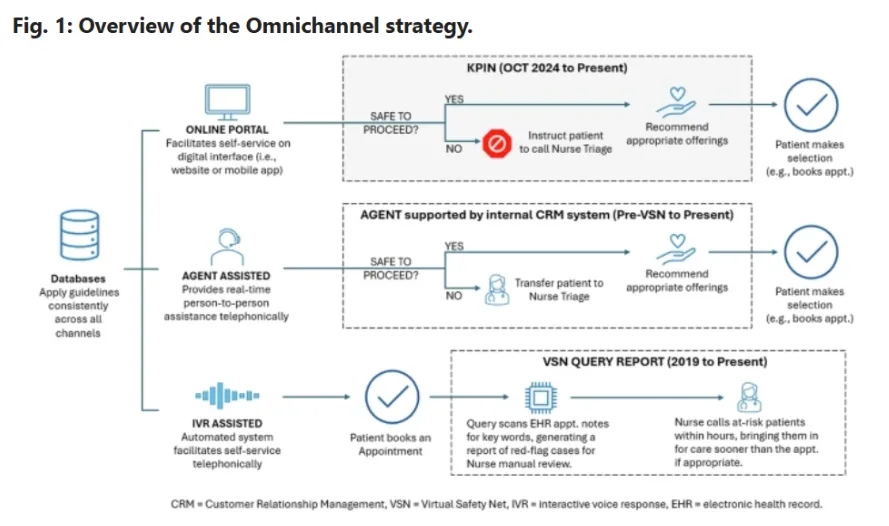
Source: Nguyen et al
Time Frame
Launched October 2024
Pilot Scale
Initial rollout to ~4.9M members of the Kaiser Permanente Southern California region, with plans to expand to a growing share of Kaiser Permanente’s 12M membership base.
Between October 2024 and March 2025, the KPIN processed nearly 3M encounters, averaging 19,000 interactions daily and peaking near 40,000 per day. More than 1M unique members used the tool during this period.
Goals and Competitive Advantage
Simplify entry into an increasingly complex care ecosystem and improve patient experience scores.
Results
Successful booking rate: ≈ 54 % (up from 34 % with the prior system)
Abandonment rate: ≈ 3 %, dramatically lower than typical digital-commerce averages (50–70 %)
Positive patient-sentiment improved by ~9 percentage points (from 58.8 % to 67.4 %)
Urgent medical case detection: 98% accuracy
Appropriate care pathway recommendation: 89% accuracy
Level of Investment
KPIN was built in-house. While exact financial figures remain undisclosed, the initiative requires:
Proprietary AI and transformer-model development
Integration across patient-facing systems and backend infrastructure
Ongoing governance and model-training resources
Lessons Learned
Expectation-setting drives satisfaction: Educating patients about what to expect is as vital as delivering the service itself. How patients feel about the encounter determines perceived value, and there is an opportunity for health systems to set expectations on what patients may experience.
User experience is non-negotiable: Simplified interfaces (≤ 3 questions per screen) and multilingual input options were critical to minimizing drop-off and ensuring equitable use of KPIN.
Technology is only as effective as the humans and systems guiding it: KP instituted quality checkpoints where a team of physicians, data scientists, and operations leaders regularly audit misrouted cases or ambiguous outcomes and systematically question the AI’s decisions. This continuous learning loop is a necessary operational discipline.