
Table of Contents
As part of Sutter Health’s strategic vision to become the most comprehensive, integrated and connected health system for getting and staying well, improving access to care emerged as a top organizational priority. Leadership recognized that while Sutter had a long-standing reputation for high-quality, compassionate care, patients and care teams were navigating increasingly complex scheduling processes and fragmented coordination. Rising consumer expectations for convenience underscored the urgency to simplify and modernize Sutter’s scheduling experience.
In mid-2024, Sutter’s Access to Care team presented a plan to rapidly improve patients’ and care teams’ scheduling experience to the system’s Physician Strategy Cabinet, comprised of its affiliated medical groups’ presidents/CEOs and board chairs. The group agreed to a systemwide standard expectation for online scheduling enablement for new and returning patients across family medicine, internal medicine and pediatrics, as well as for return-visit scheduling across all other specialties. The decision marked both an operational and cultural turning point, driving stronger systemwide collaboration and accountability around improving the access experience for both patients and care teams.
Sutter addressed a critical operational need: enabling patients to book appointments efficiently without overburdening call centers or experiencing friction-filled processes. Prioritizing online scheduling aligned with the enterprise-wide goal of creating a seamless, digital experience that provides connected, convenient access for patients and enhances care team efficiency. Equally important, the new expectation quickly shifted organizational norms by positioning access initiatives as a shared responsibility. It underscored that improving access was a collective priority, no longer optional or limited to certain departments.
"Sometimes you just have to make the decision and let people adapt to it versus waiting for conditions to be perfect and then doing the thing you were going to do. That was a really momentous decision, and I think from a cultural standpoint really set the tone that this is our expectation as an organization."
— VP, Patient Access
Overview
Sutter set a standard expectation to participate in self-scheduling within My Health Online, its Epic-integrated patient app. Rather than introducing new technology, the focus was on optimizing existing tools and workflows to make better use of underutilized features. Success with online scheduling was the result of decisive leadership, meaningful cultural change, and rapid operational standardization—driven by close coordination across people, processes and technology.
Key Components
Standardizing Capacity and Schedule Templates: Before online scheduling could scale, Sutter had to ensure reliable supply. The health system centralized its schedule design and build infrastructure by creating a capacity management team of 27 full-time schedule builders responsible for standardizing templates across divisions. In 2024, this team executed the DARTs project (Designing Aligned and Reliable Templates), aligning 2,300 primary care schedules templates in just 90 days. The standardized templates introduced consistent visit types, time blocks and guardrails while preserving local flexibility. Before the changes, templates appeared consistent, but underneath the surface was a highly variable and unreliable build. For example, there were more than 50 distinct ways that “new patient” appointments were being booked. The new design standards were developed in collaboration with Primary Care clinician leaders and operations leaders from across the enterprise, and the team adopted a “flexibility within a framework” model that allowed for some autonomy to design a schedule that works for the clinicians’ unique needs while staying within a set of standard design components.
Integrating Referral Navigation: Once patients could self-schedule, Sutter turned to a centralized referral navigation model to ensure continuity between primary and specialty care. A growing team of more than 125 referral navigators now manages approximately 50,000 referrals per month across two of five divisions—with plans to expand to 325 team members supporting more than 200,000 referrals per month across all five divisions in 2026)—improving conversion from orders to scheduled visits. The team is reducing scheduling process variation and simplifying access to specialty care by removing obstacles that create confusion for ordering clinicians and friction for patients and scheduling teams. The effort is also strengthening data consistency, laying the groundwork to eventually enable referral-based self-scheduling through Epic’s “ticket scheduling” functionality. In specialty clinics, self-scheduling has been limited primarily to return visits, but Sutter knows that many of its specialty clinics can serve as front doors to the system. Additionally, patients with referrals, but who are new to a specialty, have been “vetted” by other clinicians, and therefore should be able to self-schedule themselves.
Building a Unified Culture of Access: The success of the scheduling transformation was rooted not only in decisive leadership but in the unified culture that grew around it. The standard set the direction, but sustainable change came from the unified approach, where access, clinical and operational teams worked together toward shared goals. Through deliberate change management and continuous communications, leaders helped teams see the “win-win” nature of the work: simplifying workflows for clinicians and staff while expanding convenience and choice for patients. The DART initiative, referral navigation work and other systemwide alignment efforts helped to reinforce this mindset—demonstrating that improving access wasn’t just a technical project, but a cultural shift that reflected the organization’s values and commitment to connected, patient-centered care.
“If you're waiting to create the consistent schedules, create the decision trees, and do all the things that you want to make online scheduling perfect, we're never going to get there fast enough. It takes a lot of time, and it isn’t really a requirement for some patients.” — VP, Patient Access
Time Frame
Early 2024: Centralization of schedule builders and creation of a capacity management team
June 2024: Support from Sutter-affiliated Medical Groups to enable online scheduling; Change management efforts begin
August 2024: Systemwide standard for online scheduling participation
October 2024: Completion of 2,300+ redesigned primary care schedule templates
2025: Expansion to specialty service lines and scaling of referral navigation and access analytics
Scale
Repeating DARTs project in other specialties (pediatrics, orthopedics, sports medicine, podiatry, OBGYN, dermatology, rheumatology, endocrinology)
Goals and Competitive Advantage
Expands patient access through better scheduling and referral processes that make it easier for patients to access care.
Increases systemwide consistency in scheduling and referral management to create a more consistent, efficient experience for patients and care teams.
Fosters a culture of access, positioning it as a shared responsibility across leadership and clinical teams.
Improves conversion of orders to appointments, ensuring patients move quickly from referral to care.
Results
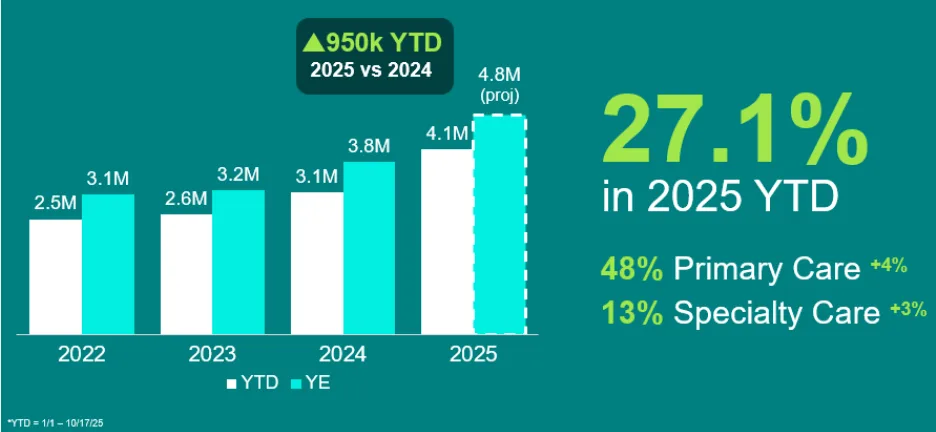

27.1% of all outpatient visits booked online YTD, among the highest nationally for Epic users. Up from 23% in 2024.
~50% of primary care visits self-scheduled online.
13% of specialty visits self-scheduled online.
Digitally engaged patients, defined as those using two or more digital features, rate Sutter twice as high in satisfaction and loyalty surveys compared to less engaged peers.
Level of Investment
Nearly $20M across talent and technology investments
Added 5 FTEs to the capacity management team in 2025 (27 FTEs total, including schedule builders, managers, and analytics leaders)
125 referral navigators currently; scaling to 325 by 2026
Sutter has made a significant investment and expects clear ROI. Even a 1% improvement in utilization of schedules could translate to nearly $20M in direct revenue from those visits before accounting for other downstream services such as lab, imaging, procedures, and inpatient admissions.
Lessons Learned
Go with good enough: Sutter achieved rapid adoption by setting a clear expectation for participation and broke through years of incremental progress. Adoption accelerated not because every workflow was perfected, but because cultural alignment followed decisive action.
Messaging matters: Early resistance could stem from misperceptions around loss of autonomy or “standardization for standardization’s sake.” Refining the narrative to emphasize shared purpose (i.e., getting patients to the right care at the right time) was critical to align culturally. Openly addressing myths like fear of automation or “Epic will schedule for us” dissolves perceived threat.
Let clinicians convince clinicians: Find the right voice to communicate an initiative. Having a clinical leader, CMO for Patient Access, who has a dual role as both clinician and access leader bridged intent and credibility. When the physician dyad leader explained the rationale, it no longer sounded like just an administrative mandate to clinicians.
Standardization can create personalization: Far from constraining clinicians, Sutter’s systemwide effort to align 2,300 schedules across a common structure freed them to focus on what matters most—patient care— instead of managing logistics.