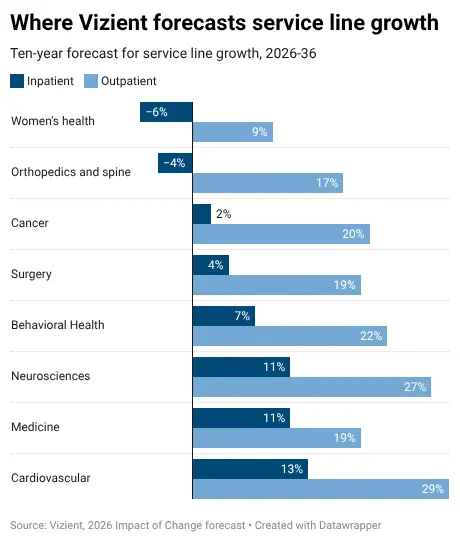
Musculoskeletal care (MSK) is one of the largest categories of care by volume, accounting for more than $380B in annual U.S. healthcare spending—with more than half of that total coming from commercial payers. But it’s also facing one of the fastest transitions to outpatient settings: according to Vizient’s annual forecast of 10-year service line growth, orthopedics is one of two service lines (along with women’s health) where inpatient volumes are actually projected to shrink instead of just growing more slowly:
For this week’s Key Market Dive, we’re looking a little more closely at the dynamics driving the service line’s outpatient shift and the growing role played by digital-first disruptors like Hinge Health and Sword Health. These companies have assembled a playbook for skimming low-acuity and commercially-insured MSK volumes, and now they’re trying to copy-paste that model to other service lines.
Key pressures on the service line
The outpatient transition has been accelerated by CMS policy moves: the wind-down of the inpatient-only list, the expansion of the ASC-payable procedure list, and the rollout of mandatory joint-replacement bundles (TEAM now, CJR-X nationwide by 2028).
As margin-generating commercial volumes shift settings, health systems are contending with a vast array of players—some that work with systems, and others that compete against them.
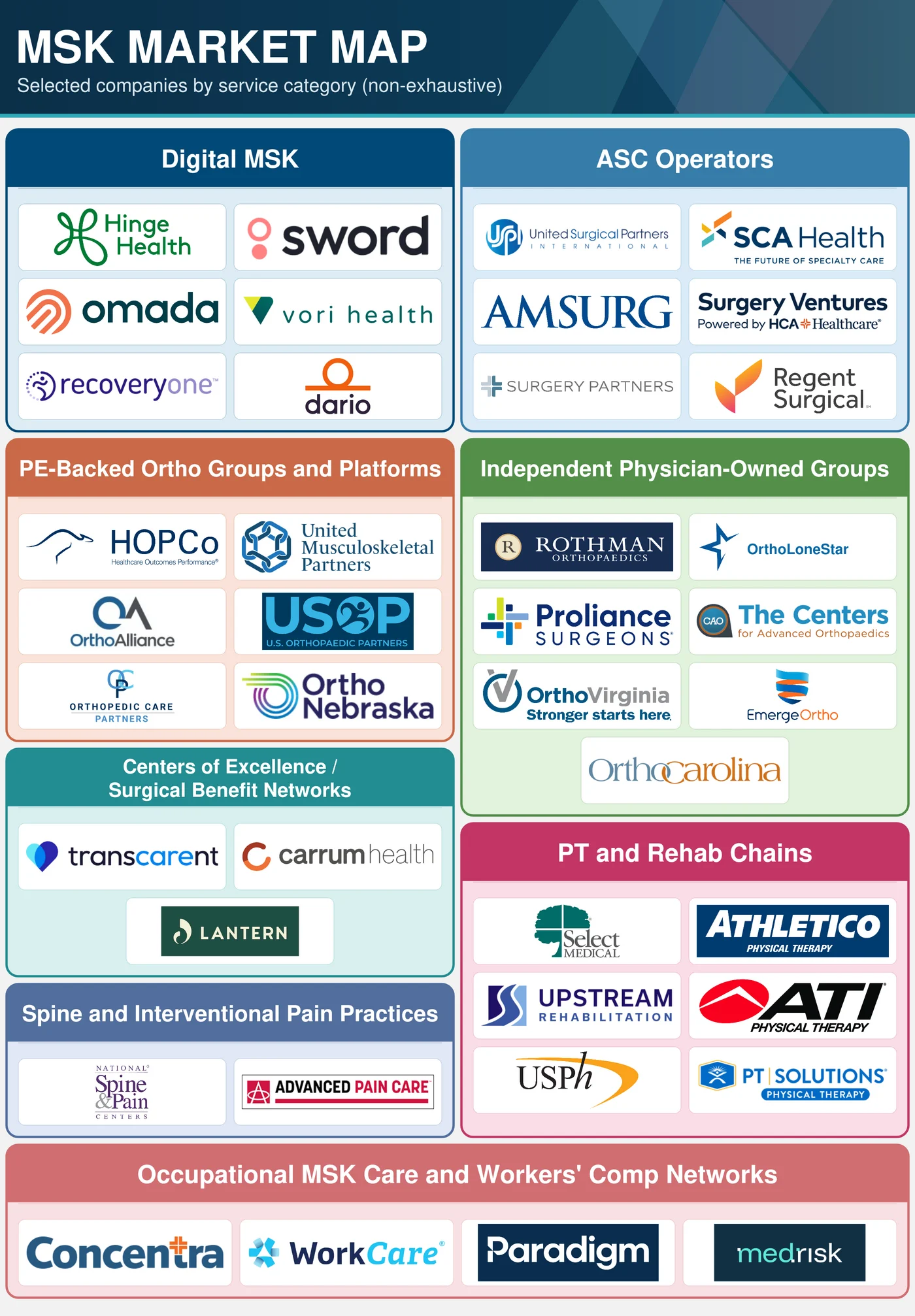
Each of these groups targets a different segment of the care journey:
Digital MSK disruptors and surgical benefit networks are primarily targeting the front of the funnel. They reach commercially insured patients through employers and health plans, capturing triage and conservative care before a referral is written. Their pitch is surgery avoidance, a cheaper alternative to PT, and steering patients to cheaper settings, which means suppressing the downstream volume health systems count on. Once dismissed as exercise apps, digital MSK startups have matured into multi-condition platforms.
ASC operators are competing for low-complexity procedures with predictable costs and a favorable payer mix at the midstream. When routine procedures are done in outpatient surgery centers, hospitals keep the sicker, more complex patients more likely to be covered by Medicare or Medicaid than by commercial insurance. For more on this topic, check out our previous reports on ASC strategy and health system efforts.
PE-backed platforms and physician-owned groups are buying the entire vertical stack: surgeons, ancillary services, and the surgery centers themselves. Rather than skim a slice, they consolidate the whole orthopedic P&L into one owned entity and compete with health systems as providers of capital and support services. But with valuations well off their peak, PE investors looking to exit maturing investments often turn to strategic buyers (like Optum) as an off-ramp.
And of course, there are other players in this market we don’t have room to dive into here: vertically-integrated payviders with their own ortho assets, imaging chains, and DME suppliers, to name a few.
Digital MSK disruptors are gaining a foothold in other service lines
While there are dozens of digital startups looking to grab a slice of the MSK market, Hinge Health and Sword Health are the only true “unicorns,” with valuations of $7.6B and $4B respectively. While they take slightly different approaches, both companies offer employers and health plans a cheaper alternative to traditional in-person physical therapy.
In recent months, these companies have sought to expand their models beyond MSK by acquiring digital care startups focused on other service lines—with Hinge targeting GI care, and Sword targeting behavioral health. Both are making $100M+ bets that a platform that works for digital MSK care will also work elsewhere.
Here’s a quick recap of their models:
Hinge Health
Ownership: Public company. Founded in 2014, $1.1B in VC funding. Additional $255M raised via IPO in 2025.
Finances and scale: $7.6B valuation. $588M revenue for FY2025 (up 51% YoY), 2026 guidance of $858M. 29% operating margin. 783K members, 22M self-insured lives and 2.6M lives across fully insured Medicare Advantage and federal employee programs.
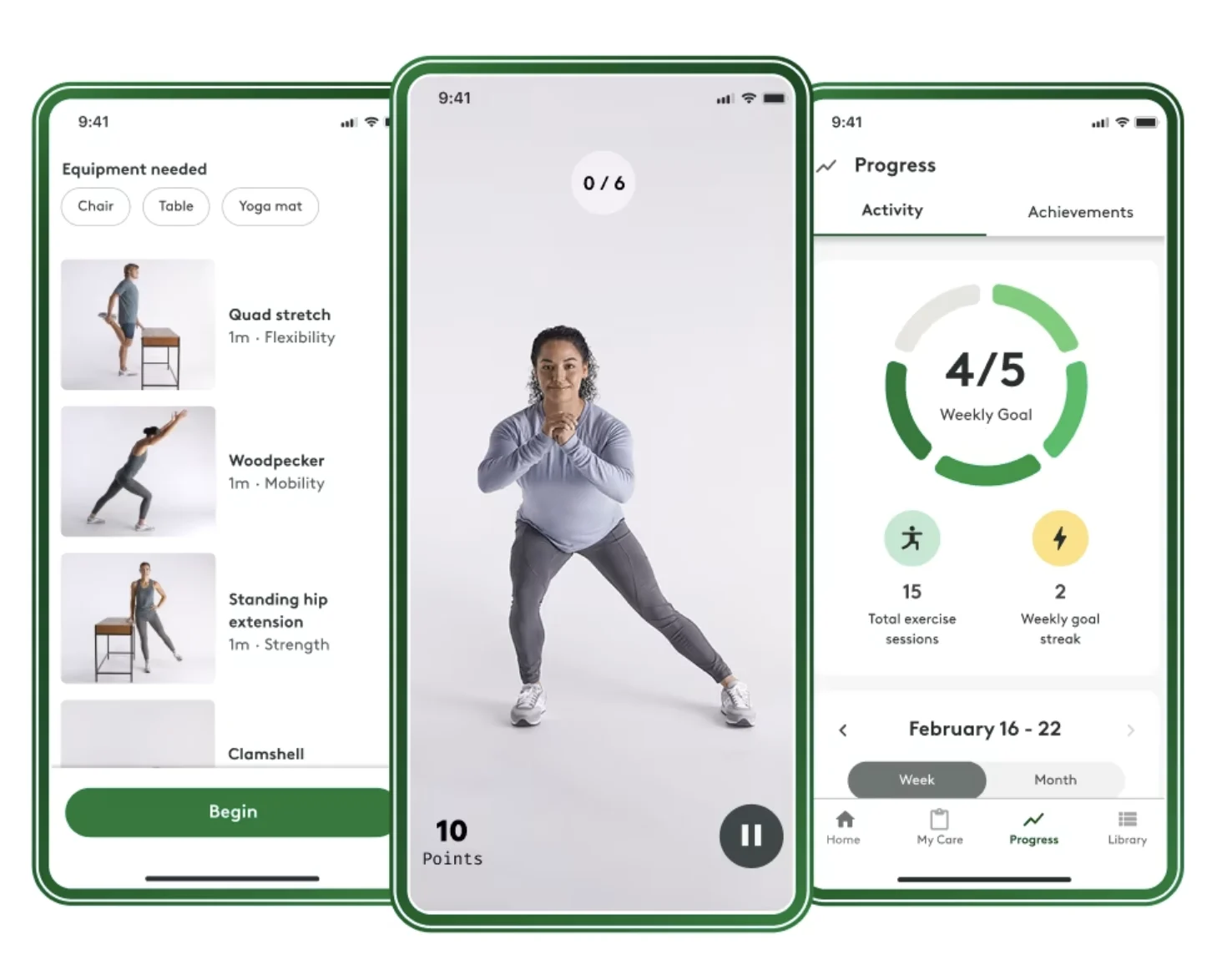
How their model works: Hinge Health delivers musculoskeletal care through an app: members do guided exercise therapy while their phone camera tracks form, backed by a remote team of PTs and coaches.
While some traditional PT providers are skeptical that this is equivalent to in-person care, there’s some independent evidence of clinical effectiveness and cost savings—enough to convince 53% of the Fortune 100 and 45% of the Fortune 500 employers to sign on, according to CEO Daniel Perez on an earnings call earlier this year.
Hinge Health also offers a wearable nerve-stimulation device called Enso for acute pain, and has extended the platform beyond back and joint care into new adjacent areas like pelvic health and migraine care.
In 2025, the company launched a referral network for in-person care called Hinge Select that routes members to pre-vetted physical therapists, imaging centers, injection providers, and orthopedic specialists at negotiated below-PPO rates when they need hands-on care beyond the app. On its Q3 2025 investor call, company leaders said that while it doesn't expect meaningful revenue impact until 2027, Hinge Select adds "a high margin revenue stream" because the company will recognize a percentage of the medical claims flowing through the network.
Plans for growth: In August, Hinge Health acquired digital gastrointestinal care management startup Cylinder Health for $105M and also announced plans to launch its own GI care program in 2027.
The bull case for this growth strategy is that the hard part—winning the employer contract and the member relationship—is already done, so adding GI is a low-cost cross-sell onto infrastructure that's already paid for. The bear case is that gastrointestinal care shares little clinical DNA with exercise therapy, and there’s less evidence for gut health savings to sway employers.
As the company’s Hinge Select referral network matures, GI could be a natural fit for that referral engine: it's a high-cost, procedure-heavy service line, where flagging members before an unnecessary endoscopy or colonoscopy—and steering the ones who do need care into a contracted network—is exactly the claims-capture play Hinge Select already runs for MSK.
Hinge Select remains an unproven bet: it does not yet generate much revenue, and it is unclear whether Hinge can convert members who initially signed up for digital exercise therapy into in-person referrals at meaningful scale. If it can, however, the model could pose a much more direct threat to health systems by competing for the front door of MSK care and redirecting downstream volume.
Sword Health
Ownership: Private company. Founded in 2014, backed by Khosla Ventures, General Catalyst, Founders Fund, and Sapphire Ventures. $493M raised to date. IPO targeted for 2028 or later.
Finances and scale: $4B valuation. Self-reported $200M in annualized revenue, 100% YoY growth in mid-2025. 700K users since 2020.
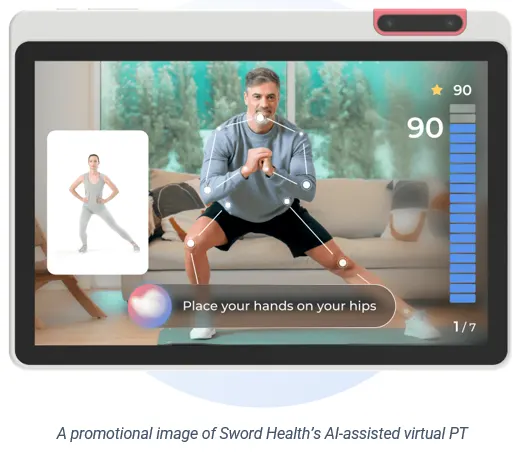
How their model works: Sword Health delivers musculoskeletal care through a clinician-designed kit—a tablet and wearable motion sensors the company ships to members. That’s then paired with its conversational AI, Phoenix, which talks members through each session in real time while a licensed physical therapist sets the plan and checks in a few times a week. Where Hinge leans on the phone camera and the coach, Sword leans on hardware and on the claim that its AI is the care specialist; the company now brands itself "the world's leading AI care company."
Its hook for employers is risk-bearing pricing tied to results, backed by a claimed 3.2:1 ROI it calls the only independently validated return in the category—though as a company-promoted figure, it's best read as a strong marketing claim than settled fact. It's been enough to build a business valued around $4 billion, cash-flow positive, and still private.
Like Hinge, Sword has pushed well past back and joint pain. Its AI Care Platform now spans four service lines—MSK (Thrive), women's pelvic health (Bloom), mental health (Mind), and cardiometabolic care (Pulse)—all running on the same Phoenix engine, with the pitch that "health does not happen one condition at a time."
Where the two diverge most is the in-person layer. Sword hasn't built a Hinge Select-style network to capture claims on physical care; its bet runs the other way. A predictive engine called Predict flags members at high risk of surgery so Sword can intervene and keep them in virtual, non-invasive care, avoiding the referral rather than monetizing it. And through a separate division, Sword Intelligence, it now sells AI care-management agents to payers and providers, positioning itself to profit from the rest of the industry's operations, not just its own members.
Plans for growth: Sword's biggest move is its 2026 acquisition of Headspace, the meditation and mental-health company once valued at $3 billion, in an all-cash deal reported at up to $300 million. Founder-CEO Virgílio Bento frames mental health as "the entry point to everything else," and the roughly half-billion dollars Sword has spent buying its way into new conditions shows how central the whole-person platform is to its thesis.
The bull case mirrors Hinge's: the employer contract and member relationship are already won, so bolting on mental health—one of the highest-demand benefits employers buy—is a cross-sell onto infrastructure that's already paid for. Headspace also brings tens of millions of users and a large employer footprint with it.
The bear case is that a consumer meditation app sits a long way, clinically and culturally, from risk-bearing physical therapy; Headspace's fall from its $3 billion valuation peak is a warning about how hard the category is; and mental-health savings are far harder to prove to a CFO than avoided surgeries and PT services.
Hinge is building a tollbooth on in-person care; Sword is trying to make the in-person visit unnecessary in the first place. Its risk-bearing contracts make it financially accountable for reducing exactly the surgical and specialist volume systems depend on, and its predictive engine is built to catch those patients before they ever enter the funnel.
Are Hinge and Sword actually displacing surgical volumes?
The companies market aggressive surgery-reduction numbers, but most headline figures measure surgery intent, not surgeries. Sword reports members are 60 to 70% less likely to say they intend to pursue surgery after its program—a soft proxy, measured by survey inside a self-selected group that completed conservative care.
A December 2025 peer-reviewed claims analysis found digital MSK participants had a 58% lower relative risk of surgery at 12 months than matched patients who started in-person PT. But it was sponsored by Sword and authored by its employees, it's retrospective, and its comparison group is other conservative-care patients, so it shows digital-first beating clinic-first, not digital MSK erasing surgical demand. Independent reviewer PHTI goes only as far as saying these programs match in-person therapy on pain, function, and cost.
What's missing is any independent evidence that these platforms have measurably cut a health system's actual surgical volume. No non-vendor study links Hinge or Sword to a falling caseload, and attribution is hard: inpatient orthopedic volume is declining, but that's the shift to ASCs far more than digital suppression of demand, and joint-replacement volume overall is still rising.
Our take is that the evidence of these companies’ impact on surgical volumes is tentative at best. The volumes mostly leaving hospitals right now are migrating to ambulatory sites, not disappearing into an app. That could change if Hinge’s new referral network becomes a major success, or if AI-guided therapies pushed by Sword’s model improve by leaps and bounds—but that’s a big if.
For now, the biggest reason to take Hinge and Sword seriously is that they’re starting to reach an impressive national scale while continuing to grow revenue at a pace that could double the size of the company every two years. Employers and health plans are routing hundreds of millions of dollars through these models because they truly believe these companies can offset costs elsewhere.
What health systems are doing in this space
Many health systems have evolved their MSK offerings to extend access and stay competitive.
Intermountain Health, for example, invested in digital health companies Omada Health in 2019 and Vori Health in 2021 (with a follow-up investment in 2025), both of which now compete in virtual MSK care. It has also built its own virtual PT and pain management offerings through Connect Care, giving patients direct access to licensed physical therapists via video for evaluation, treatment plans, home exercises, and referrals into in-person care when needed.
Many health systems and physician-owned groups have partnered with enablement vendors that sell to providers rather than compete with them, offering the digital tools to keep MSK patients tethered to their own orthopedic service lines.
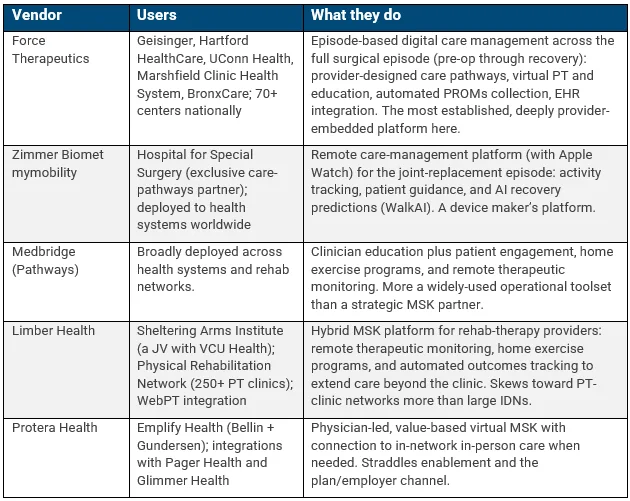


At past THMA forums, health system executives have also positioned PT partnerships as a strategic lever to expand ambulatory access, build market density, and scale more quickly without relying entirely on internal capabilities. The model can also strengthen PT’s role as a front door into the system and support referrals across service lines, but its value depends on strong partner alignment, integrated data, and disciplined care coordination.
If you have an MSK program or partnership you’d like to showcase in The Strategist as a case study, please reach out to us at StrategyCatalyst@hmacademy.com
Questions health system strategists should be asking themselves
What do my service line margins look like if digital-first disruptors and independent ASCs skim off the low-acuity volumes?
Which parts of MSK and ortho are actually important for mission vs margin?
How effective is my system at using PT as a patient acquisition funnel?
What would it look like for my health system to make a bold bet in this space?
What role can health systems play in coordinating ideas and innovations across different service lines? (Check out our recent podcast episode with Advocate Health’s CSO Shoeb Sitafalwalla, where he discusses turning care models into templates that can be copied to other service lines.)