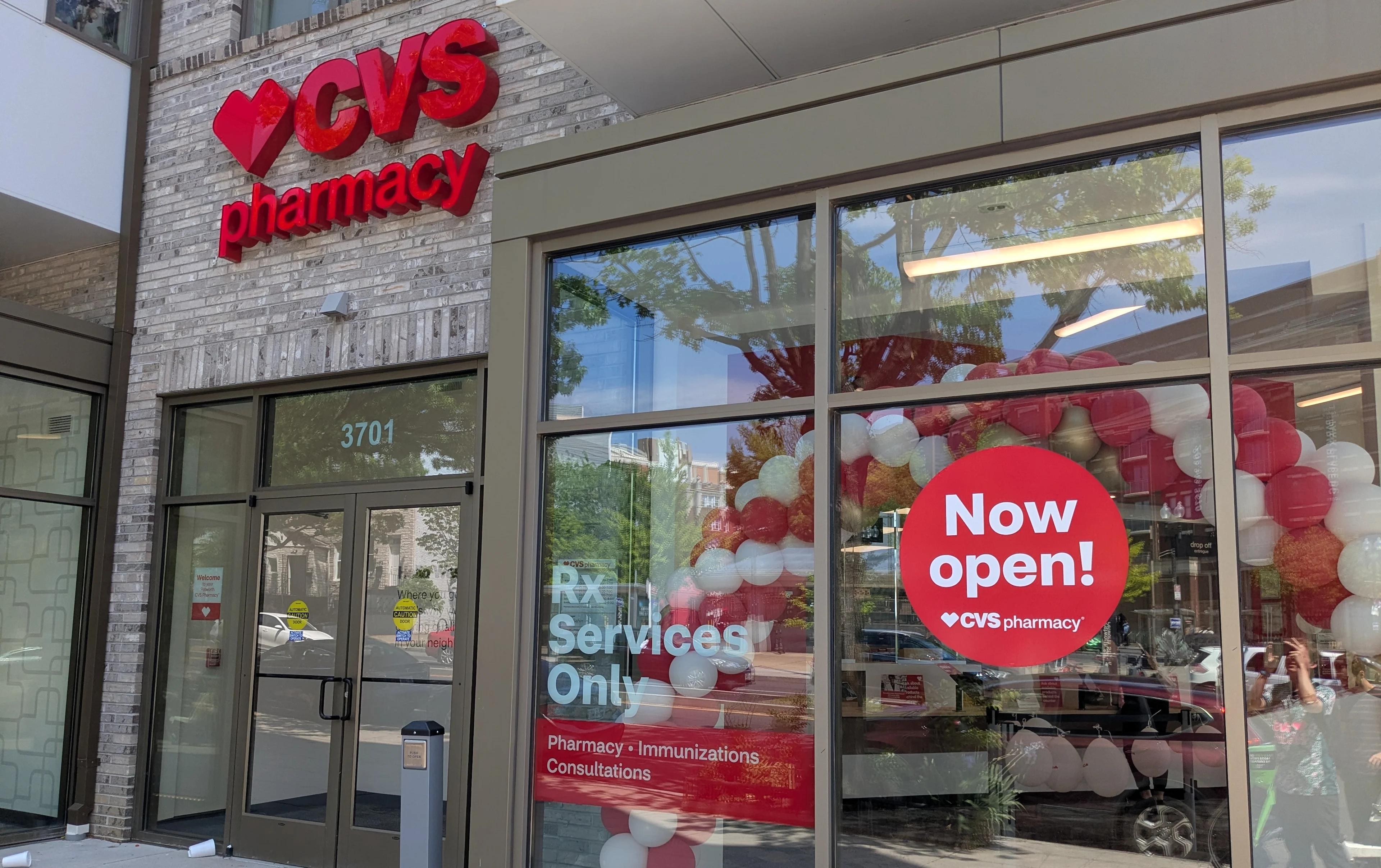
CVS Health has started opening smaller pharmacy-only stores, beginning late last year with their first location in Birmingham, Alabama. They followed that up with new pharmacy-only locations in Chicago and Washington, DC, with further plans to expand to Houston, Detroit, Brooklyn, and Boston.
The new stores have footprints around 3,000 square feet—about half the size of their traditional stores—and the location we visited seemed even smaller than that. These locations are limited to a pharmacy counter, queuing area, and pharmacy waiting area with seats, without the usual rows of snacks, cosmetics, greeting cards, and household goods. Signs in the store advertise typical pharmacy services like prescription fulfillment, immunizations, and consultation.
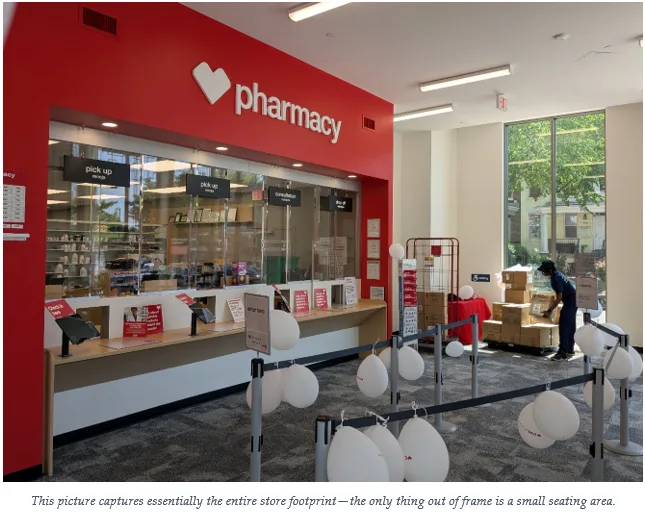
The new stores are part of a broader expansion plan to open 60 new locations nationwide (including 40 traditional stores), which will also feature stores co-located inside Target locations. While the pharmacy-only locations are a new concept for the chain in the U.S., many of their international locations have already adopted the model.
So What?
1. Shifting to a smaller retail footprint allows CVS to open more locations in underserved urban markets where real estate comes at a premium.
The smaller, more focused CVS locations are reminiscent of the corporate strategy adopted by the grocery chain Trader Joe’s, which expanded rapidly with smaller-format stores (roughly one-third the size of a typical grocery chain location) in urban markets where larger footprints are harder to acquire and sustain profitably. The smaller format serves as a strategic constraint that product offerings are built around (high-margin private label and pre-cooked goods for Trader Joe’s, and a more limited selection of OTC and prescription products for CVS). The tradeoff between product availability and store access is a feature, not a bug, of this arrangement.
In the case of CVS, this strategy will let them densify their presence in Medicaid-heavy neighborhoods with higher rates of prescription-heavy chronic diseases like diabetes, hypertension, asthma, and mental health conditions. The company’s press releases are leaning into the “underserved communities” angle, which could earn them goodwill with policymakers and the public. Better access to pharmacy locations could help this population with medication adherence.
This also means that CVS is intensifying its outreach to many of the same communities typically served by nonprofit safety-net health systems, which often rely on 340B drug pricing savings—generated by filling prescriptions for low-income patients—as a critical cross-subsidy for other parts of their mission. To preserve that margin, local health systems will need to bring these new CVS locations into their contract pharmacy networks.
2. CVS continues to focus its model on healthcare, but the emphasis on pharmacies could be interpreted as a “back-to-basics” strategy.
Chains like CVS and Walgreens have reported declining front-of-store general merchandise sales in recent years, driven by shifting consumer spending habits, inflation, theft, and competition from online retailers like Amazon. Declining store profitability has pushed Walgreens to close hundreds of locations, and CVS has had multiple waves of cost-cutting corporate layoffs. At the same time, CVS is doubling down on pharmacy growth, as seen in its acquisition of bankrupt Rite Aid and Bartell Drugs assets last October, including 63 physical stores and prescription files for 626 pharmacies across 15 states.
Unlike commoditized general retail, pharmacy is a regulated, licensed, relationship-based business with higher switching costs and a captive flow of chronically ill patients who need refills every 30 days. Even with PBM-driven reimbursement pressure compressing per-script margins, pharmacy generates something the front of the store cannot: a recurring clinical touchpoint with an identifiable patient that feeds valuable data into the rest of CVS Health's ecosystem: Caremark PBM services, Aetna insurance, MinuteClinic, Signify home health, and Oak Street Health.
With that said, many of the elements of the chain’s healthcare flywheel are struggling: CVS previously contemplated spinning off its Aetna subsidiary, and the company shut down 16 Oak Street Health locations (7% of its overall footprint) earlier this year. The new pharmacy-only sites notably do not have attached MinuteClinics. Arguably, the new locations signal a “back-to-basics” strategy where CVS once again refocuses on pharmacy as its primary competency, harkening back to the pre-2014 era when the chain was branded as “CVS/pharmacy” instead of “CVS Health”.