Health System Technology Purchases and the CIO's Expanding Authority
The Chief Information Officer at U.S. health systems now holds purchasing authority over a wider range of technology than at any point in the past decade, and our research shows that authority is consolidating further rather than dispersing. For the commercial teams at healthcare organizations selling into health systems, this is the single most consequential shift in how buying decisions get made. The conversation that once moved through six different executives now routes, in most categories, through one office.
We see this pattern clearly in our latest 2026 Trends in Healthcare for Industry Executives research, which pairs proprietary survey data from health system technology leaders with the financial and policy context shaping their decisions. The piece below draws on that work. We invite you to download the full insight document if you want the complete picture behind what follows.
The headline for commercial leaders is straightforward. Health information technology acquisition at most health systems is becoming a more centralized, more scrutinized, and more strategic process. Understanding how the CIO role works, what triggers a CIO's sign-off, and what criteria that sign-off rests on is now table stakes for anyone trying to build a relationship with a health system.
The CIO Role Has Changed at Its Core
The CIO role at most health systems has shifted from infrastructure manager to enterprise strategist with budgetary authority that reaches across clinical and operational technology.
A decade ago, the Chief Information Officer was largely a technical leader. The office managed servers, networks, and the systems that kept the hospital running. That description no longer fits. The CIO role has become a strategic business leadership position, and the people in these seats now sit at the center of enterprise decisions about where a healthcare system invests, how it manages risk, and how it competes.
Tenure reflects the weight of the role. Chief Information Officers at Leading Health Systems average nearly seven years in the seat, the longest of any executive role we study, and a majority hold an MBA alongside their technical background. These are not caretakers of infrastructure. They are business leaders who happen to own technology.
One of the most demanding parts of the expanded CIO role surfaces during mergers and acquisitions. Health systems undergo consolidation regularly, and when two organizations combine, the work of integrating digital assets, reconciling data, and rationalizing overlapping platforms falls to the CIO. That responsibility alone has pushed the office further into enterprise strategy and away from day-to-day technical management.
Our research confirms that authority is moving up, not down. The share of technology leaders who said they delegate more decision-making to their vice presidents or direct reports fell from 47 percent in 2025 to 26 percent in 2026. Over the same period, 68 percent reported being more personally involved in organization-wide technology investment decisions than they were a year earlier. Decision-making is consolidating at the executive level, and the CIO sits at the top of that consolidation.
What Our Research Shows About Purchase Authority
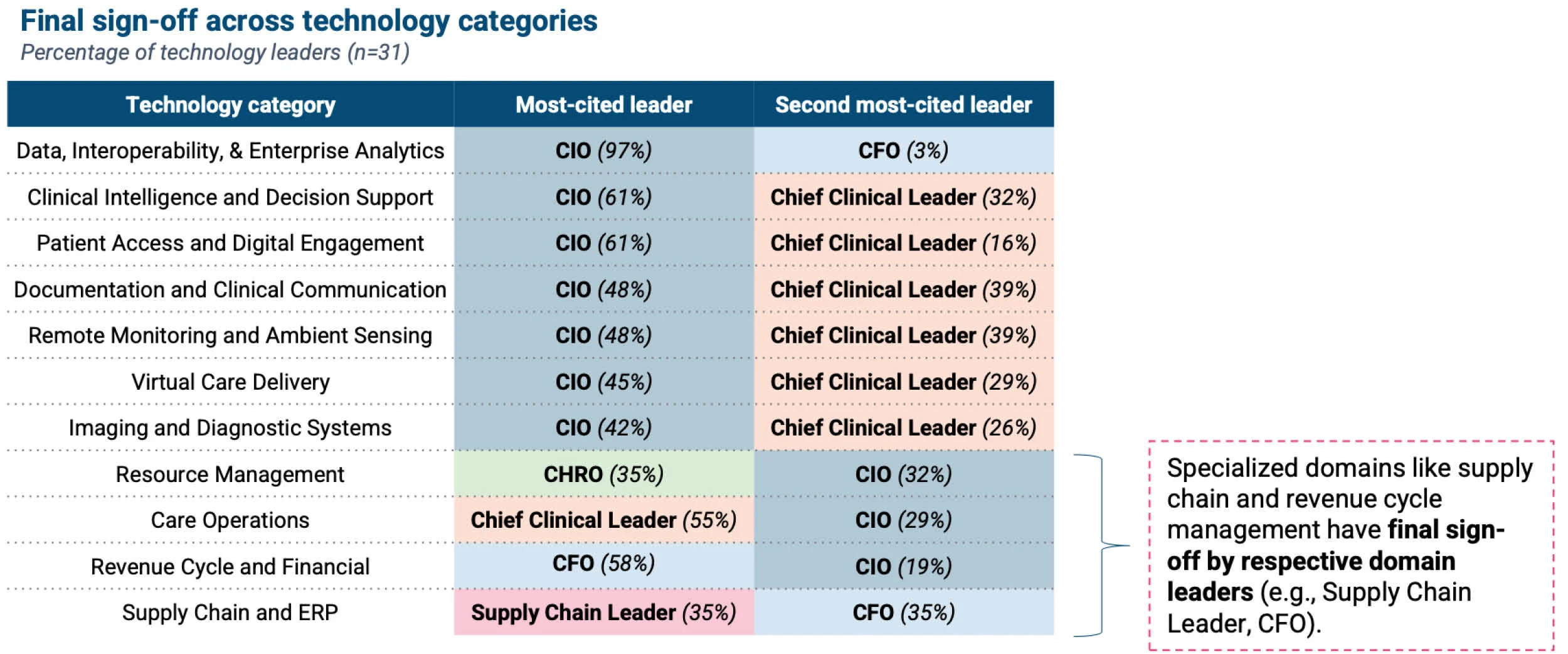
Our 2026 Technology Investment Survey of senior technology executives at 31 Leading Health Systems found that the CIO holds final sign-off in 7 of 11 technology categories.
We surveyed Chief Information Officers, Chief Technology Officers, Chief Digital Officers, and informatics leaders who hold system-level decision-making authority over technology investments. The picture that emerged is one of broad and deepening CIO control over health system technology purchases.
The CIO is the most-cited final decision-maker in 7 of the 11 categories we measured. The office's authority is near-total in data, interoperability, and enterprise analytics, where 97 percent of respondents named the CIO as the final sign-off. It is dominant in clinical intelligence and decision support (61 percent), patient access and digital engagement (61 percent), documentation and clinical communication (48 percent), and remote monitoring and ambient sensing (48 percent).
Two findings matter most for commercial planning. First, the contract value that triggers CIO sign-off dropped sharply, from a most-frequently-cited threshold of $500,000 in 2025 to $100,000 in 2026. The CIO is now reviewing smaller purchases that would once have cleared at a lower level. Second, dollar value is no longer the primary trigger. The most common stipulation that requires CIO approval is system integration or data sharing, cited by 61 percent of technology leaders, ahead of contract value above a dollar threshold at 42 percent. If a solution touches the data layer or needs to connect to other systems, it reaches the CIO regardless of price.
This tightening extends to artificial intelligence specifically. Chief Information Officers are revising their contracting so that AI-related proposals require direct CIO approval, a deliberate response to the proliferation of tools entering the organization and the governance questions they raise.
Knowing where the CIO is not the final authority is just as useful. Revenue cycle and financial technology routes to the CFO (58 percent). Supply chain and ERP decisions sit with the supply chain leader (35 percent, tied with the CFO). Resource management leans toward the CHRO (35 percent). For these specialized domains, the relationship that matters most belongs to the domain leader, not the CIO. Mapping the right office to the right category is the difference between a productive first conversation and a misrouted one.
The Criteria CIOs Use to Approve Technology
Health system CIOs approve technology that integrates natively with the electronic health record, supports interoperability, demonstrates a transparent compliance and security posture, and proves hard financial ROI with a clear attribution methodology.
Understanding who signs off is only half the equation. The other half is understanding the criteria behind the signature. Five filters shape nearly every CIO evaluation.
Electronic Health Record Integration
Chief Information Officers favor platforms that integrate natively with their EHR, and at most health systems that means Epic. The honest version of this conversation acknowledges Epic's expanding footprint rather than pretending it does not exist. Our survey found that where systems do choose a non-Epic vendor, the decision is capability-led, not cost-led. Across categories, technology leaders most often cited advanced AI, analytics, and automation as the differentiator. Abridge leads as the primary non-Epic vendor in documentation and clinical communication, and Aidoc leads in imaging and diagnostic systems. The lesson for partners is that a credible answer to "why not just use Epic" has to rest on a genuine capability advantage.
Interoperability
Interoperability functions as a gate. Data silos disrupt care coordination across the health system, so CIOs treat the ability to share data and connect cleanly to existing systems as a procurement requirement rather than a nice-to-have. A solution that requires extensive data export or creates a new silo will struggle to advance.
Application Rationalization
The direction at most health systems is consolidation, not expansion. CIOs are actively reducing the number of overlapping platforms they manage, which means a new point solution competes not only against alternatives but against the CIO's preference to do more with the tools already in place. Partners who can position as an integrated platform, or who can demonstrably retire other applications, have a structural advantage over those adding one more tool to a crowded environment. This is also a recurring theme at the venues where these leaders compare notes; for commercial teams tracking where the market is heading, our catalog of healthcare technology conferences is a useful map of where evaluation and peer benchmarking actually happen.
Compliance and Cybersecurity
Compliance and cybersecurity are non-negotiable. Technology acquisitions must demonstrate rigorous compliance with data privacy regulations, and a transparent security posture is increasingly part of the first conversation rather than the last. Vendor risk and identity management are areas of expanding CIO focus.
Financial ROI
The bar on financial ROI has risen. Chief Information Officers are moving from annual budget defense to multi-year investment management, and soft ROI measures are increasingly unacceptable on their own. Leaders want hard ROI with a clear methodology for how value is calculated. There is also a quieter dynamic worth understanding: CIOs are fighting to ensure that information technology retains credit for the value AI generates, rather than ceding that credit to finance or operations. A partner who arrives with a defensible attribution methodology helps the CIO win that internal argument, which makes the partner more valuable.
How the Criteria Shift by System Size
The way these criteria are weighted shifts with system size. Systems under $3 billion in total operating revenue most often cite regulatory, privacy, or ethical concerns as their biggest barrier to advancing AI. Systems between $3 billion and $7 billion cite limited funding and competing budget priorities. Systems over $7 billion press hardest on proof of ROI and measurable value. The same solution needs a different opening line depending on the size of the organization across the table.
Budgets Are Growing, but the Gate Is Narrower
Technology budgets are increasing, with 92 percent of systems over $7 billion in operating revenue expecting growth in 2026, but that growth is concentrating in existing solutions, which raises the bar for any new partner.
Growth and access are not the same thing. Technology budgets are expanding across the board, but the largest health systems lead the trend. Among systems over $7 billion in total operating revenue, 92 percent expect a budget increase. That figure falls to 64 percent for systems between $3 billion and $7 billion, and to 50 percent for systems under $3 billion. The money is real, and it is concentrated at the top.
Where is it going? The categories most likely to see budget increases are patient access and digital engagement (77 percent), virtual care delivery (74 percent), and documentation and clinical communication (74 percent). These are the areas where health systems see the clearest line to operational efficiency and improving patient outcomes.
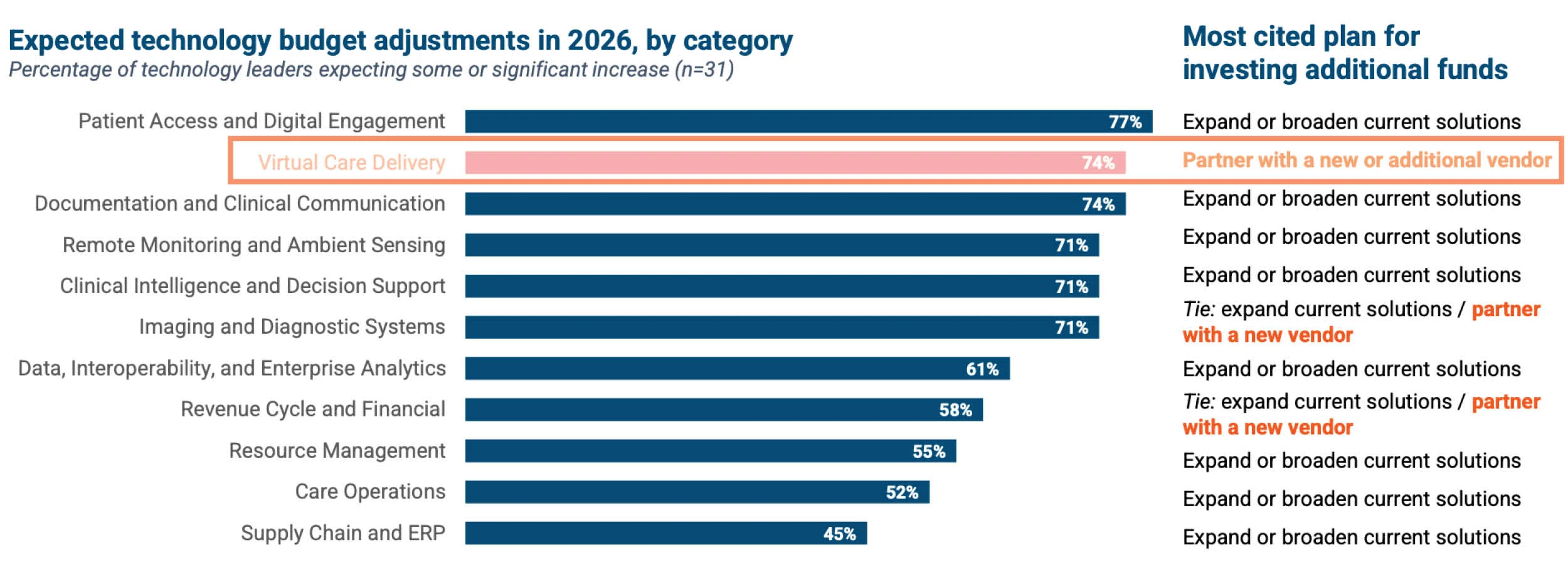
The harder truth for new entrants is what systems plan to do with the additional money. In nearly every category, the most common plan is to expand or broaden current solutions rather than partner with a new vendor. Virtual care delivery is the standout exception, the one category where partnering with a new or additional vendor was the most-cited plan. For commercial teams, that single data point is a meaningful signal about where the door is most open.
Budget growth also does not automatically translate into AI investment. The gap between expected budget increases and planned AI investment is widest in patient access, virtual care, and documentation. Revenue cycle, care operations, supply chain, and resource management show the closest alignment between budget growth and AI intent. Assuming that a growing budget means a growing appetite for AI specifically will lead teams to misread the room.
When we asked technology leaders directly what they wish industry partners did better, their answers clustered into five asks: prove ROI rather than product features, integrate deeply rather than deliver point solutions, be transparent on pricing up front, take the time to understand the organization's real challenges, and stay engaged after implementation rather than moving on. One leader put the buying philosophy plainly: they do not buy technology, they buy solutions. Another asked simply for pricing up front, rather than spending hours determining whether the product was even affordable.
What the Margin Backdrop Means for Commercial Teams
Technology purchasing in 2026 is happening against significant margin pressure, which concentrates CIO scrutiny on solutions that reduce cost, protect revenue, or meet mandatory compliance requirements.
No CIO evaluates technology in a vacuum. The financial environment shapes every decision, and that environment is difficult. The median health system operating margin slid to 0.4 percent year to date as of March 2026, down from 1.6 percent in 2024 and 1.0 percent in 2025. Revenue and expense growth converged at 8.4 percent in 2025, erasing the prior year's tailwind.
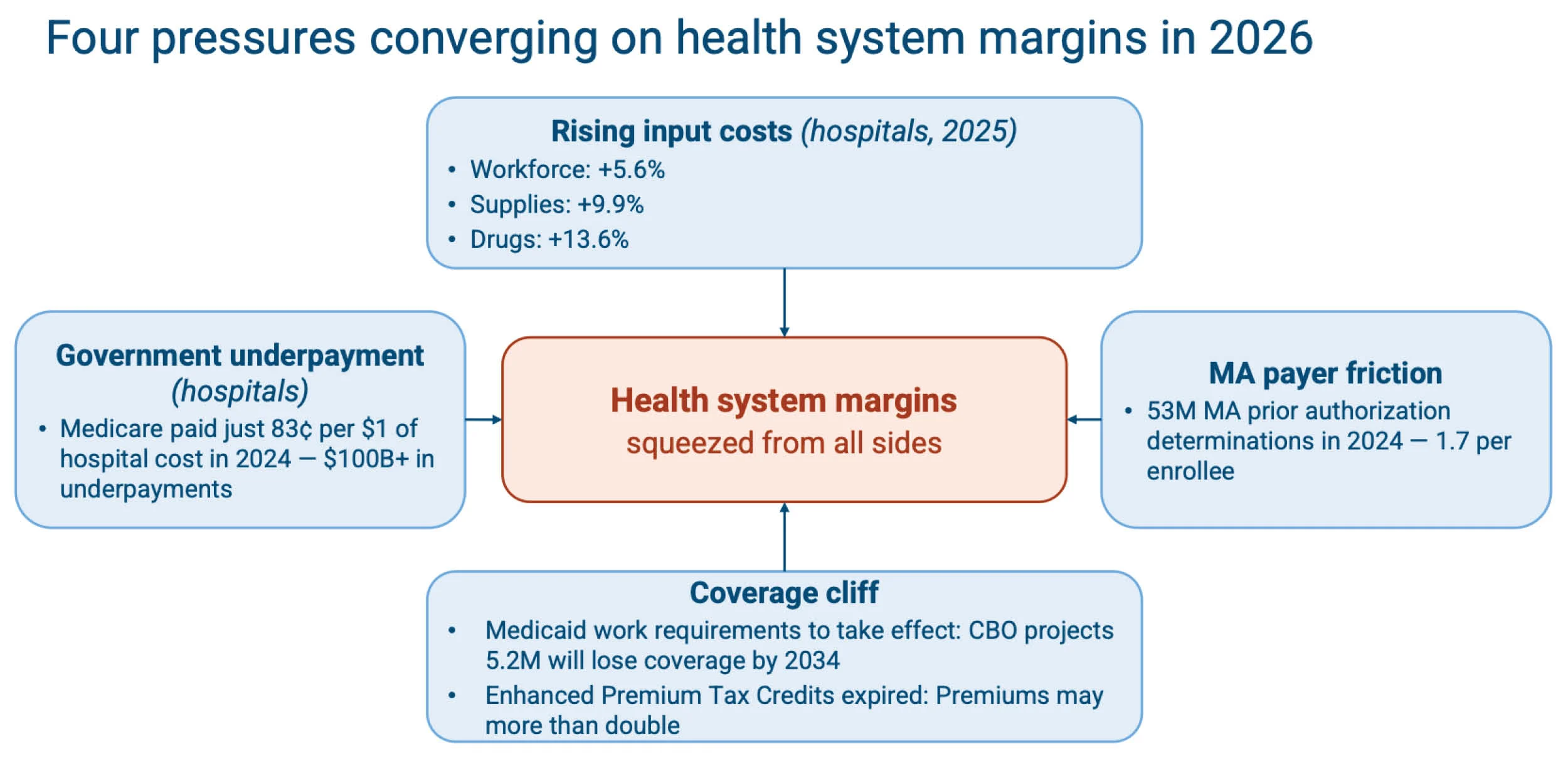
Four pressures are squeezing margins at once. Input costs are rising faster than reimbursement, with hospital workforce costs up 5.6 percent, supplies up 9.9 percent, and drugs up 13.6 percent in 2025. Government underpayment continues, with Medicare paying just 83 cents per dollar of hospital cost in 2024, more than $100 billion in annual underpayments. Medicare Advantage friction persists, with 53 million prior authorization determinations processed in 2024. And a coverage cliff looms as Medicaid work requirements and the expiration of enhanced premium tax credits threaten to push millions off insurance and increase uncompensated care.
For commercial teams, the implication is direct. Technology that ties clearly to one of these four pressures, cost reduction, revenue protection, payer friction relief, or managing the coverage cliff, has a structural advantage in the budget conversation. Inflation and rising operational costs ranked as the single largest financial pressure shaping technology investment, followed by policy and regulatory change and workforce cost. A solution framed around operational efficiency and measurable financial return speaks the language the CIO is already speaking.
Mandatory federal payment models add urgency. The Transforming Episode Accountability Model is live as of January 2026, and two more mandatory models are likely to follow in 2027. Most health systems lack the episode analytics, post-acute coordination, and risk-stratification infrastructure these models require. That gap is a clear opening for partners who can help systems build readiness before the requirements take full effect.
What This Means for Your Approach to the CIO
The Chief Information Officers we hear from in our forums say it plainly: they do not buy technology, they buy solutions to problems they can name and measure.
The practical guidance follows directly from the data. Lead with the operational problem, not the product capability. Arrive with peer outcome data rather than feature lists, because proof of what happened at a comparable system carries more weight than a specification sheet. Be specific and proactive about integration requirements, compliance posture, and security, because those questions are coming regardless and answering them early builds credibility. And bring a clear methodology for attributing value, so the CIO can defend the investment internally and keep the credit where it belongs.
Building these relationships takes more than a well-timed email. It takes sustained, trusted access to the executives who hold the authority. Our CIO Forum brings health system technology leaders together with industry leaders in a peer-driven setting built for exactly this kind of dialogue, where the conversation is about shared challenges rather than transactions. For commercial teams whose success depends on understanding how these decision-makers think, that direct access is the foundation everything else rests on.
We also publish detailed persona research on these leaders through our Executive Insights Hub, including our Access Information Officer persona, which breaks down how Chief Information Officers and their informatics counterparts prioritize, what they reject, and the checklist they apply when evaluating a solution. Knowing your customer before you are in the room is the most reliable advantage a commercial team can build.
The CIO's authority over health system technology purchases is wide, and it is still expanding. The teams that succeed in this environment will be the ones that respect the scrutiny, speak to the operating pressures driving it, and show up as partners in solving a named problem rather than sellers of a product.