What Drives Oncology Drug Adoption Inside a Health System
What drives oncology drug adoption inside a health system is rarely the drug itself. Strong clinical trial data and FDA approval open the door, but whether a therapy reaches patients depends on economics, reimbursement, and the everyday workflow of a cancer program. A health system can have clear evidence, marketing authorization, and a motivated physician champion, and still adopt a new therapy slowly, or not at all, if the pathway, the payer, and the balance sheet do not line up.
There Is No Single Answer to Why Oncology Drugs Get Adopted
Ask why one oncology drug took off within eighteen months of launch while a similarly effective competitor stalled for years, and the answer is rarely “the science.” Many oncology drugs enter the market with comparable efficacy data and FDA approval on similar timelines yet see very different uptake once they reach real health systems.
The key question industry and health system leaders keep asking each other is not whether a therapy works. It is whether a specific system, with its specific pathways, staffing, and payer mix, is set up to use it.
One example: two targeted therapies approved for the same indication within a year of each other can see divergent adoption curves depending on formulary placement, prior authorization burden, and other factors specific to how a program operates. There is no magic bullet variable that predicts adoption on its own.
Clinical Evidence Still Comes First, but It Does Not Adopt Itself
Physicians still weigh overall survival and progression-free survival data before adopting a new oncology therapy, and treatment outcomes from clinical cancer research remain the starting point for any adoption decision. But oncology has moved past the era when a single physician’s read of the clinical research determined clinical practice on its own. Multidisciplinary teams, oncologists, pharmacists, nurse navigators, and increasingly patient advocates, now weigh clinical evidence against the practical realities of everyday clinical care: toxicity management, monitoring burden, and whether a therapy fits how a specific patient population is treated.
Biomarkers have become central to that discussion. Biomarkers help select which patients are likely to respond to a therapy, can predict acquired resistance over time, and increasingly inform which drug combinations make sense for a given tumor profile. Advanced diagnostics, including next-generation sequencing, now factor into adjuvant therapy decisions that used to rest on staging alone.
The complication is that this diagnostic layer has outpaced the workforce trained to read it: survey research has found that many oncologists report low confidence interpreting complex genomic and biomarker reports, which slows exactly the kind of precision-guided adoption those tests were meant to speed up. Physicians’ individual characteristics, comfort with new data types, tolerance for ambiguity, and willingness to deviate from a familiar regimen still shape who first adopts a new oncology therapy within any given practice.
FDA Approval Establishes What Is Legal, Not What Gets Used
What the FDA determines is whether a drug can be marketed, not whether a health system will use it. Oncology drug development has moved fast over the past decade, and the FDA’s own numbers show it: about a third of new FDA drug approvals now land in oncology. In 2021, the agency approved 50 novel drugs, and roughly 15 to 16 of them were cancer therapies; that share has held up since. That pace means health systems are asked to evaluate and integrate new indications and new therapies faster than most pathway committees can meet.
The FDA is also raising its own bar for what a drug application needs to show before approval. Project Optimus, the FDA’s initiative to fix how oncology drugs are dosed, now pushes companies to identify an optimal dose before pivotal trials rather than defaulting to the maximum tolerated dose from early-phase testing.
Accelerated approvals, once a reliable fast path to market for promising cancer therapies, are facing more scrutiny: a growing number have been withdrawn in recent years when confirmatory trials failed to confirm the expected benefit. Regulatory bodies have also grown more open to real-world data as evidence. Real-world data served as the primary evidence behind an FDA label expansion for a breast cancer therapy, palbociclib, in a male breast cancer population too rare to support a traditional randomized trial, and the agency has signaled it will keep using real-world data to fill gaps for rare cancers where enrollment in a conventional trial is not realistic.
None of this determines adoption on its own. A drug’s approval in other countries ahead of the United States, the arrival of generic manufacturers once exclusivity lapses, the profit margins that shape whether a manufacturer keeps producing an older but still effective regimen, and how a new indication is worded on the label all shape how a health system’s pharmacy and therapeutics committee treats a drug once it clears the FDA. Marketing authorization is the entry ticket. It is not the adoption decision.
The Economics That Decide Whether a Drug Reaches the Bedside
Cost shapes oncology drug adoption at every level of the system. Payer coverage and formulary placement dictate which therapies a physician can prescribe without a fight, and a high launch price can restrict adoption even for a drug with strong clinical support; formulary placement alone can lead a physician toward one therapy over a clinically similar alternative.
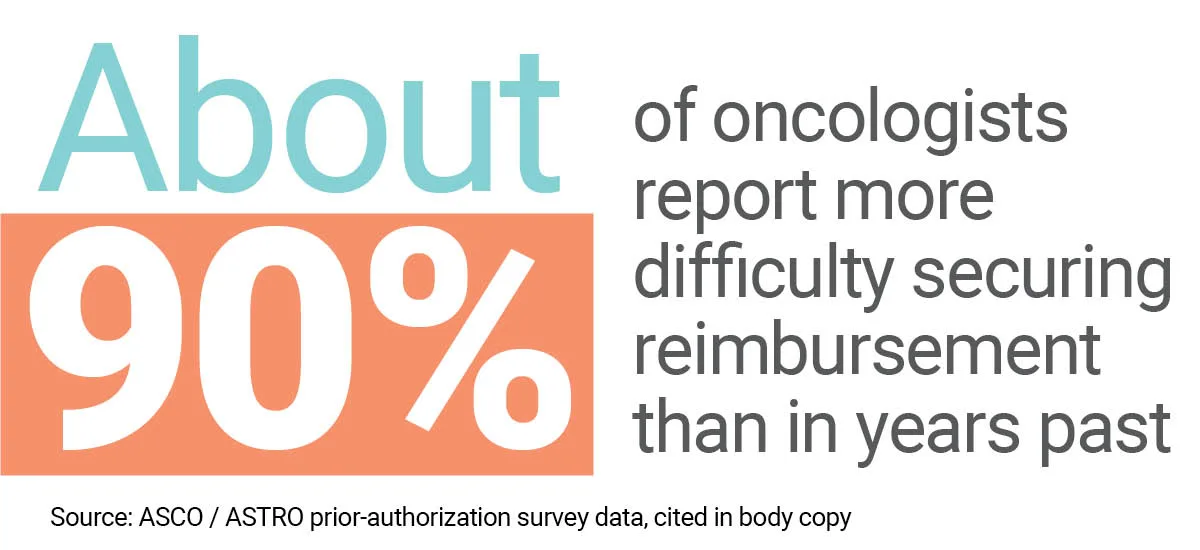
The administrative burden has grown alongside the clinical pipeline: about 90 percent of oncologists now report more difficulty securing reimbursement than in years past, much of it tied to prior authorization requirements that can delay a therapy’s first dose by weeks. That reimbursement pressure is building across the broader oncology market, not just around any single drug launch. Drug shortages, most visibly among generic sterile injectables used across chemotherapy regimens, have posed significant challenges, forcing oncology programs to build substitution protocols and formulary contingencies that did not exist a decade ago.
Cancer patients absorb a version of the same pressure. Rising out-of-pocket costs limit adoption of oncology medications even for insured patients, and broader survey data on health care avoidance, 44 percent of Americans report delaying or skipping care because of cost, suggests financial strain shapes treatment decisions well before a patient reaches the infusion chair.
Health system leaders who have spoken candidly in our Oncology Forum sessions have described building the financial case for a new therapy or diagnostic-guided treatment approach around cost avoidance rather than downstream revenue, particularly in value-based arrangements where there is little fee-for-service upside to chase.
One version of this: a molecular tumor board that tracks, in dollars, how much unnecessary drug spend it avoids by ruling out therapies unlikely to work for a given patient’s tumor profile. That kind of cost-avoidance case, quantified monthly and reported back to finance, has proven more persuasive to health system leadership than clinical enthusiasm alone. Mitigation strategies built around financial navigation and payer engagement have become as central to launch planning as the clinical value proposition, and the support those functions need is now a standing line item, not an afterthought.
Inside the Health System, Pathways and Protocols Decide Who Prescribes What
Clinical pathways and hospital protocols set the default for treatment sequencing, and a therapy that is not built into that default competes against inertia even after it clears every other bar.
Health system leaders have pointed to workflow friction, not clinical skepticism, as the more common barrier to adopting biomarker-driven therapy selection: complicated order sets, dense genomic reports, and disconnected handoffs between ordering and interpretation slow adoption more than doubt about the underlying science does. Raising awareness of a new therapy among frontline oncologists matters less than making it operationally easy to use. Programs that build a preferred pathway or a default order directly into the electronic health record tend to see adoption move faster than programs that rely on training clinicians to remember a new option.
Vertical integration plays into this directly. Health systems that operate their own labs, imaging, and infusion sites within a single hospital setting can standardize testing and route results back into one record, cutting out the friction that comes from a separate lab requiring its own order form, its own sample type, and its own shipping logistics. That kind of integration, more than any single champion, is what lets an oncology program establish a new therapy as routine rather than exceptional.
Scaling any of this also requires clarity about who owns the decision: precision medicine and other advanced oncology programs increasingly touch pharmacy, diagnostics, and service lines beyond oncology alone, and oncology programs that have not resolved which stakeholders own that governance tend to move slower as growth outpaces structure, regardless of how much clinical enthusiasm exists for a given therapy.
Community Oncologists Are Often the Real Adoption Bottleneck
The pace of oncology drug approval has outrun the ability of any one community oncologist to track every new therapy, making the community setting, not the academic center, the actual constraint on how fast a drug reaches most cancer patients. A cancer center with a dedicated subspecialty service can absorb a new approval quickly. A community oncologist treating a broad patient population across many cancer types often has a much smaller share of that population with any single complex or rare diagnosis, which makes it close to impossible to stay current on every new therapy and every new indication in every disease. That gap is structural, not a failure of effort, and it explains a lot about how slowly innovation can spread across the oncology space even after a drug earns approval.
Trust, more than clinical protocol, tends to be the binding constraint on whether an advanced therapy reaches a patient being treated in a community setting. Community oncologists’ core hesitation about referring a patient to a subspecialty hub is losing that patient for good, and health system leaders who have made real progress on this describe positioning the hub explicitly as a resource rather than a competitor, built through in-person relationships and shared cases rather than a referral protocol alone.
Financial sustainability tends to matter just as much as trust: leaders have pointed to the conversation with a hospital’s finance team, not its clinical team, as the deciding factor in whether a community site takes on delivery of a therapy that requires extended monitoring, since that kind of therapy needs a billing and operational model, and the staff and resources to run it, that fit the setting before a program will commit to offering it locally. Coordinated care models built around early consultation, rather than late-stage referral, have shown real gains in access without requiring patients to leave their local oncologist.
Where that adoption gap does not close, patients sometimes end up on alternative treatments simply because the newest indicated therapy is not yet workable where they are being treated, which is its own argument for closing the gap rather than working around it.
The Bottom Line on Oncology Drug Adoption
No single factor, clinical, regulatory, economic, or institutional, decides whether an oncology drug succeeds inside a health system. It is the interaction of all four, playing out drug by drug and program by program. For a pharmaceutical company, success is not the approval date. It is the adoption curve that follows it.
A pharmaceutical company launching a new oncology therapy often builds its model around the clinical and regulatory story: the trial data, the approval timeline, the label on the drug application. That story matters, but it is an incomplete picture of adoption. The companies that see faster, more durable uptake tend to be the ones that understand, ahead of launch, how a specific health system’s pathways, reimbursement realities, and internal incentives will process a new therapy, not just whether its oncologists are clinically convinced. Traditional market research often misses this entirely, because it studies clinical preference and access mechanics separately instead of watching how they interact inside a real cancer program.
Cancer research, drug development, and the search for a cure will keep producing new oncology therapies faster than any one committee, community practice, or reimbursement system can easily absorb. The health systems and companies that treat adoption as its own discipline, distinct from clinical development, are the ones most likely to turn a drug’s approval into a real improvement in patient outcomes, and the ones best positioned for whatever the future of the field brings next.
The Health Management Academy’s Oncology Forum brings senior oncology service line executives together with industry leaders twice a year in a closed-door, 1:1 setting built for exactly this kind of exchange. Explore the Oncology Forum to hear directly from the health system leaders shaping oncology drug adoption in real time.