The States Working Their Heart Out: America's Most Heart-Unhealthy Work Cultures, Ranked
Published 7/13/2026
Author: Andrew Reed, Assoc. Director, The Health Management Academy
Most Americans will have heard that chronic sleep deprivation raises the risk of hypertension. Sustained psychological stress accelerates arterial inflammation. Physical inactivity is among the most consistent predictors of cardiovascular mortality. And yet, for millions of full-time workers, these are not risks they choose to take. They are built into the structure of the working day, into the shift that starts at 4 am, the lunch break that never happens, the “urgent” email that arrives just before bedtime.
For many, the job makes those decisions for them. The Health Management Academy’s newest poll finds that the states whose workers report the most demanding job habits tend to be the same states carrying the heaviest cardiovascular burden. The findings indexed all 50 states and the District of Columbia on ten everyday work behaviors known to strain the cardiovascular system, including lost sleep, long hours, skipped lunches, punishing commutes, on-the-clock nicotine use, and chronic stress. When those scores are compared against an independent composite built from CDC data, the two measures move side-by-side.
The states with the most demanding work cultures are largely the same states the CDC flags for poor heart health. That pattern holds whether the comparison is made on obesity, smoking, or physical inactivity, the three CDC measures used to build the independent cardiovascular composite.
Key findings
Ohio ranks first for the most heart-unhealthy work culture in the country. Kentucky, Mississippi, Alabama, and West Virginia round out the top five. At the other end, South Dakota, Connecticut, Minnesota, and Colorado rank as the least stressful on workers' hearts.
About two in three (68%) full-time workers say they would take a pay cut for a less stressful job, including about one in twelve (8%) who would accept a reduction of more than 20 percent.
About six in ten (60%) full-time workers say their job is harming their physical health, and another 17% are unsure. Workers in the lowest income bracket are the most likely to say that’s the case.
Nearly half (47%) of full-time workers are contacted about work outside their scheduled hours at least a few times a week.
42% of full-time workers sit for six or more hours during the work day, and about four in ten (43%) are physically active outside work no more than one or two days a week.
Lower-income workers carry a disproportionate share of work-culture heart risk. Workers earning under $35,000 a year report the most demanding and stressful work habits of any income group surveyed, and are more likely than higher earners to work shifts, skip lunch, and go without adequate paid time off.
By industry, transportation, healthcare, hospitality, and manufacturing rank as the most heart-unhealthy work cultures, driven by shift work and overtime. Government and construction rank as the least strained. Black and Hispanic workers are overrepresented in the highest-risk industries, according to Bureau of Labor Statistics data.
The States With The Most Heart-Unhealthy Work Cultures
A survey of 2,448 full-time U.S. employees finds that Ohio has the most heart-unhealthy work culture in the country. Kentucky, Mississippi, Alabama, and West Virginia follow. Workers in these states report higher-than-average rates of shift work and overtime, are more likely to work through lunch and skip paid time off, and report elevated daily stress compared to workers in other states.
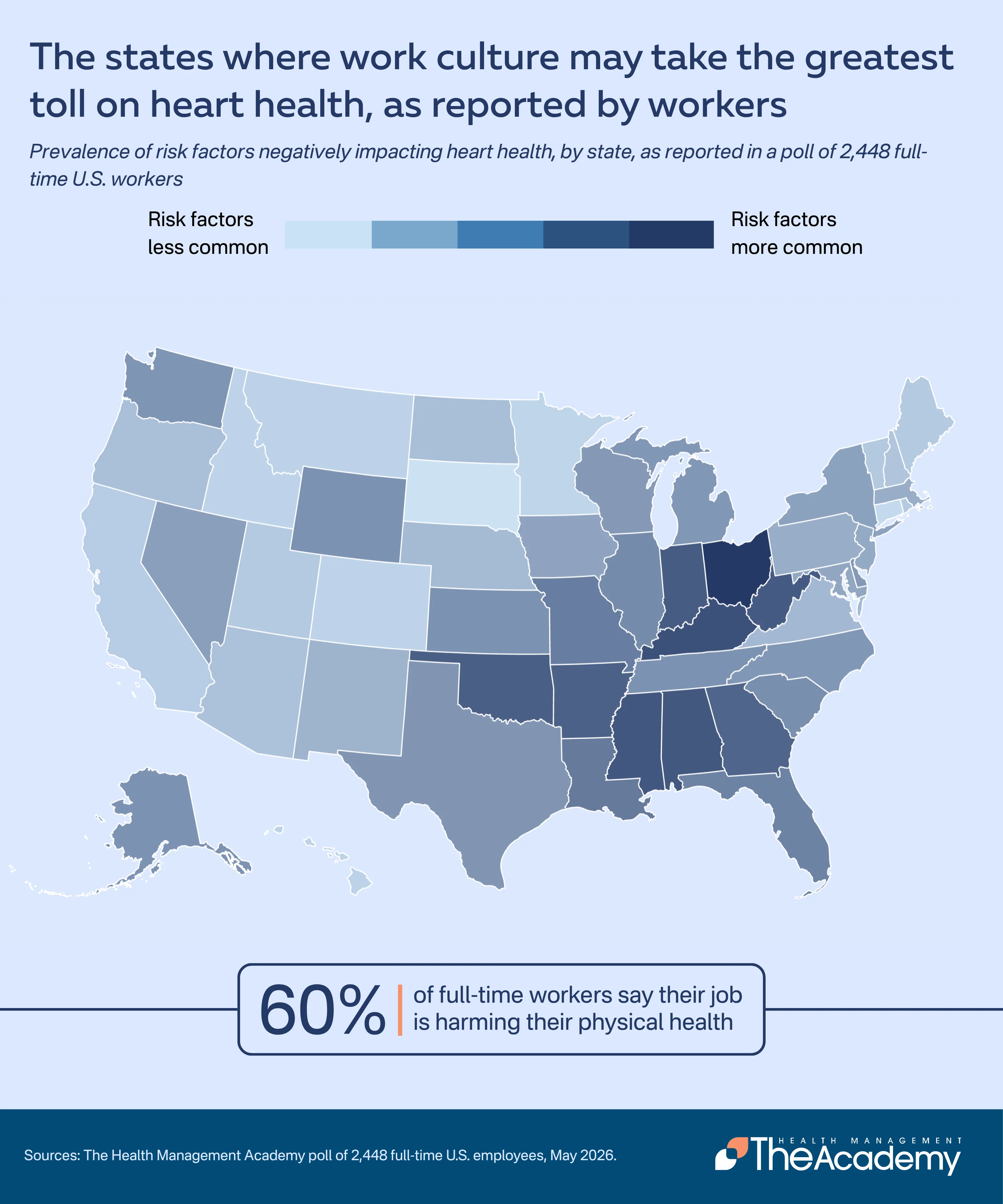
At the other end of the rankings, South Dakota, Connecticut, Minnesota, and Colorado report the least heart-damaging work cultures. The data captures the typical worker in each state. For workers in transportation, healthcare, hospitality, and lower income brackets, the typical workday experience is considerably more demanding, regardless of locality.
How The Health Management Academy’s Ranking Compares To CDC Cardiovascular Data
To assess whether the survey findings reflect real-world health outcomes, the rankings were compared against CDC state-level data on adult obesity, smoking, and physical inactivity, three established markers of cardiovascular risk drawn from the 2024 Behavioral Risk Factor Surveillance System. The CDC data were not used to build the survey index; they serve as an independent check on whether the work-culture ranking tracks actual heart health at the state level.
The CDC data broadly confirm the survey findings. Mississippi ranks third on the work-culture index and third on the CDC's cardiovascular composite, one of the closest state-level matches in the dataset. At the other end, Colorado ranks among the lowest on work-culture strain and among the lowest on the CDC composite. Of the three official measures, physical inactivity shows the strongest alignment with the survey results, consistent with an index that heavily weights sedentary work habits and lost activity time.
Overtime, Lunch Breaks, and Paid Time Off
About two in three (66%) full-time workers report working some overtime in a typical week, and about one in three (37%) work six or more hours beyond their scheduled hours.
Fewer than a quarter (24%) take a full lunch break every day; about three in ten (30%) rarely or never do. Nearly half (46%) say they have not enough or far too little paid time off, and about three in four (75%) do not use all of the PTO available to them, with about one in four (24%) using only a little or none at all.
Stress, After-Hours Contact, and the Cost Workers Would Pay to Escape It
About four in ten (41%) full-time workers report high or very high daily work stress. Nearly half (47%) are contacted about work outside their scheduled hours at least a few times a week, and about one in four (25%) say this happens daily or constantly.
About two in three (68%) say they would take a pay cut for a less stressful job. Among all workers, about one in four (23%) would accept a reduction of five to ten percent, about one in five (19%) would accept less than five percent, and about one in twelve (8%) would accept a cut of more than 20 percent.
Sitting, Movement, and the Commute
The structure of the working day leaves little room for movement. 42% of full-time workers sit for six or more hours during the work day, including about one in five (19%) who sit for more than eight, and only 16% spend less than two hours of their day seated. Outside of work, the picture is no better: nearly half of full-time workers (43%) are physically active on one or two days per week at most, and 17% report no outside activity at all.
The commute adds a sedentary bracket to either end of the day. A commute of 30 minutes or more each way is the reality for 38% of full-time workers, about one in six (17%) travel 45 minutes or more, and seven in ten (71%) make the trip by car, while just one in ten (11%) works from home and escapes the commute entirely.
Step counts reflect the same trends. About a third of full-time workers (32%) report fewer than 5,000 steps on a typical work day, and only 9% reach 10,000, the threshold long cited in public health guidance, though recent research suggests meaningful benefits begin at lower levels. Another one in five (21%) say they do not track their steps at all. Among workers who do track, the average works out to roughly 5,800 steps, well below the levels associated with cardiovascular benefit in clinical research.
Workers Describe Effects on Their Own Health
A majority of full-time workers (60%) say their job is harming their physical health; another 17% are unsure. Non-daytime schedules – rotating, overnight, early morning, and evening shifts – are the norm for 46% of full-time workers. On caffeine consumption, about one in four (24%) consume four or more caffeinated drinks on a typical work day, and about one in sixteen (6%) consume six or more.
Which Industries Pose the Most Risk to Heart Health?
healthcare workers report the highest rates of non-daytime schedules, skipped lunches, and perceived health harm of any industry. More than a third (35%) say they rarely or never take a full lunch break, the highest share of any industry. About two in three (67%) say their job is harming their physical health. This aligns with our recent research on just how exhausted healthcare workers are, with 58% of nurses reporting severe or complete burnout, and more than half are actively considering leaving the profession.
Workers in transportation and manufacturing report a similar pattern. About seven in ten transportation workers (69%) and manufacturing workers (73%) work non-daytime or rotating schedules, and about six in ten transportation workers (60%) report getting less than seven hours of sleep on work nights, the highest rate of sleep deprivation in the survey. Hospitality follows, with about seven in ten workers (71%) on non-daytime schedules and fewer protections around breaks and paid time off than workers in other industries.
The demands of shift-based clinical work mean healthcare workers face some of the most challenging conditions for cardiovascular health of any industry. Providing around-the-clock patient care requires shift work, overnight schedules, and sustained time pressure that few other sectors ask of their workers.
Technology and finance workers face a different risk profile. Shift work is rare in both industries, but after-hours contact is not. About half of technology workers (50%) report being contacted about work daily or constantly outside of their scheduled hours, the highest rate of any industry, and about four in ten finance workers (44%) report the same. Finance workers also report the highest rates of high or very high daily stress of any industry, at about five in ten (50%). About three in four technology workers (75%) say they would take a pay cut for a less stressful job, the highest share in the survey. Workers in professional services report a similar pattern, with about four in ten (40%) contacted after hours daily or constantly and about seven in ten (72%) willing to trade pay for less stress.
Government workers report the least heart-damaging work conditions across most measures. About half (51%) say their job is harming their physical health, the lowest share of any industry, and after-hours contact is rare, with about one in seven (14%) contacted daily or constantly. Construction workers also rank near the bottom overall, though they report higher rates of overtime than their overall ranking would suggest, with about four in ten (45%) working six or more hours beyond their scheduled hours per week.
Work-Culture Heart Risk by Income and Race
The polling found that work-culture heart risk is highest among the lowest earners. About six in ten (62%) workers earning under $35,000 a year say their job is harming their physical health, compared to 57% of those earning between $75,000 and $100,000. Workers in the lowest bracket are also the most likely to work non-daytime schedules, at about half (52%), a rate that falls steadily as income rises. Workers earning $150,000 or more report similarly elevated risk to the lowest earners, driven in part by after-hours contact, where they are tied for the highest rate of any income group (28%).
CDC data show that Black adults have higher rates of hypertension and shorter average sleep duration than white adults. Bureau of Labor Statistics data show that Black and Hispanic workers are overrepresented in transportation, healthcare support, hospitality, and manufacturing, the four industries that rank highest on this survey's work-culture heart-risk measure.
The Long-Term Cost of How Americans Work
The cardiovascular cost of how Americans work falls, ultimately, on the health system. It shows up in emergency department visits, in early disability claims, and in the productivity losses employers absorb when workers cannot sustain the conditions the job demands. Cardiovascular disease already costs the U.S. healthcare system $223.2 billion per year in direct costs, with an additional $191.5 billion in indirect costs from mortality, according to the CDC. Nearly six in ten full-time workers (60%) say their job is harming their physical health; another 17% are unsure. Health systems face that burden from two directions at once: as the institutions treating patients whose cardiovascular risk was shaped in part by occupational conditions, and as major employers of the workers this survey identifies as carrying the greatest risk, a challenge the Health Management Academy's Cardiovascular Forum was built to address.
Methodology
The Work Culture Heart-Risk Index is based on a May 2026 survey of 2,448 full-time U.S. workers, 48 in each of the 50 states plus the District of Columbia, by The Health Management Academy. The index scores ten work-related habits tied to cardiovascular health, weighted by strength of association. The validation composite combines three CDC Behavioral Risk Factor Surveillance System 2024 measures, adult obesity, adult cigarette smoking, and no leisure-time physical activity, standardized and averaged; physical inactivity figures are reported via America's Health Rankings. The two rankings correlate at 0.71. Tennessee's official figures were unavailable in the 2024 source tables and were drawn from prior CDC releases. Racial disparity figures are drawn from CDC BRFSS and Bureau of Labor Statistics Current Population Survey data and are not derived from this survey.