This insight was featured in the June 11th, 2025 edition of the AI Catalyst Pulse.
AI vendors in healthcare suddenly can't stop talking about "agentic AI." Epic has announced an “agentic platform,” Microsoft is promoting a “healthcare agent service” in Copilot Studio, and Salesforce has launched an “AI agent platform” called Agentforce.
Still, when pressed for specifics, vendors offer wildly different definitions of what “agentic” really means — from basic workflow automation to autonomous decision-making systems.
Here's what you need to know to cut through the noise.
What exactly is ‘agentic AI,’ anyway?
“Agentic AI” refers to systems that can independently pursue goals across multiple steps, adapting their approach based on results. Unlike traditional AI that simply responds to prompts — such as when you ask ChatGPT a question — agentic systems can plan, execute tasks, and modify their strategies without constant human input.
This represents the latest evolution in AI capabilities. Just as machine learning moved beyond rules-based systems by learning patterns from data without explicit programming, agentic AI goes further by independently planning and adapting its approach to achieve goals.
In principle, AI “agents” could do any task that a human with access to a computer can do. But in healthcare, “agentic AI” most commonly refers, at least for now, to limited-purpose agents that help patients with well-defined, mostly administrative tasks, such as scheduling or preparing for appointments.
Are there different degrees or kinds of agentic AI?
Yes! The term “agentic” is immensely fuzzy. Think of it as being like “self-driving” technology in cars, a term that could refer to anything from basic lane-keeping assistance to a fully autonomous robotaxi.
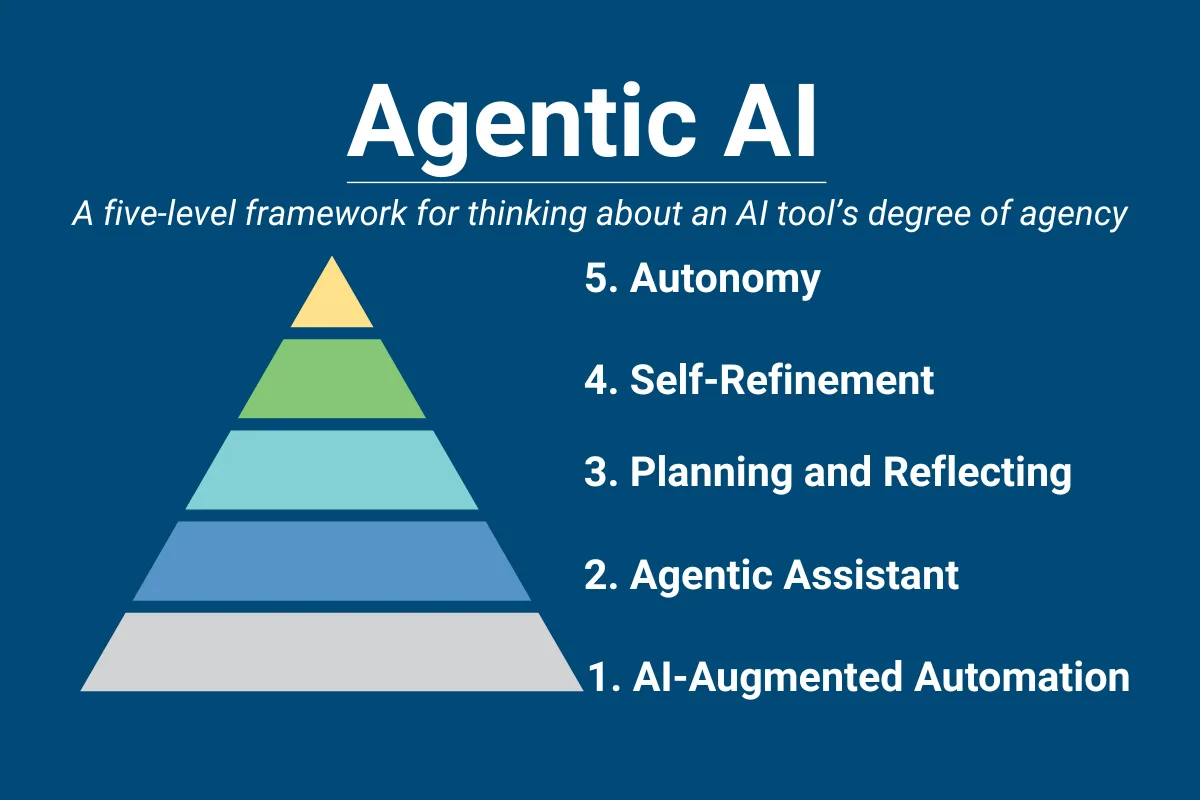
Similarly, “agentic AI” capabilities range from basic workflow automation to fully independent decision-making. Here’s one useful, five-level framework for thinking about an AI tool’s degree of agency:
Level 1: AI-augmented automation. These tools run through a predefined series of tasks, with some or all steps supported by AI.
Level 2: Agentic assistant. These tools similarly run through predefined tasks, but they can call on other tools to provide enhanced capabilities, such as searching through files or browsing the internet.
Level 3: Planning and reflecting. Rather than executing a fixed set of tasks, these tools can flexibly modify their task list, reasoning through unexpected obstacles to keep pursuing their end goals.
Level 4: Self-refinement. These tools, which remain hypothetical, can actively improve themselves without human input, gaining new capabilities to flexibly pursue their goals.
Level 5: Autonomy. These not-yet-developed tools represent artificial general intelligence (AGI), capable of essentially any task a human worker could complete with a computer – and potentially much more.
Current healthcare implementations cluster around levels 2 and 3. WellSpan's deployment of Hippocratic AI's Ana, for instance, demonstrates Level 3 autonomy: The system adapts conversations based on patient responses, handles English and Spanish speakers differently based on engagement patterns, and manages more than 98% of calls without human intervention.
Health systems are drawn to agentic AI because it can handle the kind of complex, back-and-forth problem-solving that previously required human staff. The ability to retrieve information, clarify needs, and iteratively work toward solutions makes agentic AI particularly valuable for patient communication and care coordination tasks that have historically consumed significant staff time.
Why does it matter whether an AI tool is ‘agentic’ or not?
For an AI agent to be useful, it must flexibly complete multiple tasks on its own. This means there’s no “human in the loop” for routine decisions, removing what has historically been a key safety precaution for healthcare’s AI implementations.
For low-risk, backend administrative tasks, this autonomy may not present any concerns. Even if an agent makes an error, it’s unlikely to cause patient harm.
Patient-facing AI agents, however, raise bigger challenges. For example, MyEleanor at Montefiore Einstein conducts sensitive conversations about why patients missed cancer screenings. The system must navigate cultural barriers, health literacy challenges, and patient anxiety — all without human oversight for most interactions.
If you’re exploring this latter kind of agentic AI tool, you’ll need to ask new-in-kind questions: What decisions should these systems make independently? When must they escalate to humans? Do humans audit the agent’s final choices?
Smart agentic implementations navigate these challenges by defining clear boundaries and metrics for success. For instance, MyEleanor escalates complex emotional situations to human staff, and it has achieved a 57% patient engagement rate and a 25% procedure completion rate.
Can AI agents ever collaborate with other AI agents?
This question highlights another key dimension in evaluating agentic AI: whether you're dealing with one AI agent or multiple agents working together.
Single-agent systems use one AI to handle an entire workflow. With MyEleanor, for instance, one agent manages the complete patient outreach process. It initiates contact with patients who missed colonoscopy appointments, conducts a sophisticated conversation to identify barriers (assessing 14 different potential obstacles from transportation to work conflicts), helps problem-solve those barriers, facilitates rescheduling, and documents the interaction.
Multi-agent systems coordinate multiple specialized AIs, each handling specific subtasks. Think of this as a relay race rather than a solo sprint. An example is Notable's platform, which uses different agents to handle contact center operations, clinical documentation, and care coordination. They work together across the revenue cycle, from patient intake through claims processing.
Single agents work well for contained workflows with clear start and end points, such as patient outreach or document processing. Multi-agent systems are more appropriate when workflows cross departmental boundaries or require diverse expertise. They're harder to implement initially, and may pose even more challenging governance and safety questions, but easier to build on over time.
How should I evaluate vendors who are offering agentic AI solutions?
We’ve previously shared our FUMBLE Framework for cutting through AI vendor hype, as well as UVM’s questionnaire for vetting AI vendors. In addition to using those tools to assess agentic AI vendors, consider asking these questions:
Autonomy and decision-making:
"What actions can your system take without human approval?"
"Can you walk me through a specific example of how your system handles an exception?"
"What percentage of cases require human intervention, and why?"
"How can we audit decisions made autonomously by your system?"
Architecture and integration:
"Draw your system architecture — is this one agent or multiple?"
"What happens when an agent fails or produces an unexpected result?"
"Which existing systems does this tool need to access, and what actions can it take within those systems?"
Governance and oversight:
"What monitoring capabilities come built-in?"
"How do we set and modify the boundaries of agent autonomy?"
"What's your recommended governance structure for this level of autonomy?"
"How do other clients handle liability for autonomous decisions?"
What strategic questions should our executive team be considering about agentic AI?
Here’s a list of prompts to get you started:
About governance readiness: "Do our current AI oversight structures work when humans aren't reviewing every decision?" Most organizations need to reevaluate their oversight processes once AI reaches Level 3 autonomy and begin independently structuring their own decision-making processes.
About liability models: "Who's accountable when an autonomous agent makes a mistake?" Current malpractice frameworks assume human decision-makers. Legal and risk teams need involvement before, not after, implementation.
About success metrics: "How do we measure success beyond efficiency?" MyEleanor improved patient compliance, not just call volumes. Ana revealed unmet demand in Spanish-speaking populations. The most valuable outcomes may be unexpected.
About workforce impact: "How should we message our use of agentic AI to staff who may fear displacement?" WellSpan succeeded by involving nurses in selecting use cases, positioning Ana as handling overflow work rather than replacing existing roles.
About timing: "When will agentic AI become table stakes?" Early adopters will face integration challenges but stand to gain competitive advantages. Later adopters will get more mature products but may struggle to differentiate themselves from competitors or may lag in offering their patients much-needed capabilities.
What’s the bottom line?
Agentic AI matters not (just) because it's more powerful than previous AI, but because it fundamentally changes who makes decisions. For the first time, AI systems can handle entire workflows independently, from initial patient contact through problem resolution.
This shift requires you to ask harder questions than demanded by past AI implementations. Not just "Is it accurate?" but "Should it operate autonomously?" Not just "Does it integrate?" but "Who's accountable when it acts independently?"
The health systems that succeed with agentic AI will be those that meet these powerful new technologies with a similarly sophisticated degree of organizational readiness.
Are you implementing and using agentic AI tools at your organization? Or has your team developed a successful questionnaire to vet agentic AI solutions? Let us know! We’d love to hear about your experiences at aicatalyst@hmacademy.com.