Executive Summary
Improving access to care isn’t just a capacity, scheduling, or affordability problem. It’s a culture problem. Systems that are pulling ahead treat access as a system capability with shared accountability: they unlock capacity they already own, standardize how the system works, and manage experience as a measure for access. This article distills lessons from four health systems that executed on those principles:
Inova Health (Inova) uncovered hidden capacity by standardizing core operational and clinical processes (provider scheduling templates, visit-type definitions, and workspace and hoteling standards).
Sutter Health (Sutter) mandated systemwide online scheduling for new and returning patients across family medicine, internal medicine, and pediatrics, as well as for return-visit scheduling across all other specialties. Sutter established a systemwide standard expectation to enable online scheduling for new and returning patients across family medicine, internal medicine, and pediatrics, as well as for return-visit scheduling across all other specialties. Within 90 days, they standardized 2,300 primary care templates and broke through years of incremental progress.
Emory Healthcare (Emory) used a three‑month “pressure‑cooker” sprint to add 800+ daily ambulatory arrivals with no new clinical FTEs. They proved what’s possible with a hard reset and then locked in gains with a three‑year roadmap to embed sustainable, standardized access practices across the enterprise.
Intermountain Health (Intermountain) elevated consumer experience management to a systemwide responsibility and built a near-real-time, experience management system that helps identify and remove access barriers.
Key Insights
You can’t hire your way out. Unlock capacity you already own.
Reboot or not, align the culture and lock in a system.
Don't let patient experience pitfalls be your downfall.
Part I: The Cultural Shift Required
Access transformation starts with culture. It requires changing how an organization thinks, acts, and aligns around the shared responsibility of connecting patients to care. Simply adding appointment slots won’t fix broken norms, because the root issues go beyond limited capacity or staffing. When expectations and processes vary across sites, access collapses. A cultural reorientation that redefines what it takes to solve access challenges lays the foundation for a transformative access strategy.
Insight 1: You can’t hire your way out. Unlock capacity you already own.
Much of access capacity is trapped in design, standards, and flow, not necessarily headcount. Adding clinics or clinicians before fixing scheduling logic, standardizing templates, and managing referral flow is a slow-motion margin leak. Without first assessing existing inefficiencies and addressing opaque, inconsistent expectations around scheduling, referrals, etc., expanding your provider base only multiplies existing inefficiencies.
So who’s approaching this differently?
In late 2020, Inova began a multi-year effort to address access challenges that stemmed from years of inconsistent expectations and processes across sites. The system rapidly doubled its employed physician base to meet market demand after COVID, yet wait times didn’t improve. Once they had reached a critical mass of providers, the bottleneck wasn’t clinical. It was structural. The system needed a cultural reset around standards.
What happened?
Schedule templates were inconsistent, hoteling wasn’t optimized, and staff operated by local norms rather than shared standards. Given that, Inova set out to standardize core operational and clinical processes, focusing on provider scheduling templates, visit-type definitions, and workspace and hoteling standards. The initiative sought to uncover hidden capacity by aligning enterprise and clinical leaders on what access really means: not adding more staff or clinics, but using existing resources more consistently.
The cultural side of the work was just as intensive. Leaders engaged in deliberate, systemwide conversations with clinical chairs, medical directors, and operations managers to identify where inefficiencies had become embedded in daily routines and define new expectations for scheduling, template utilization, and accountability.
Why did it work?
Cleaning up legacy variation unlocked hidden capacity. Many of Inova’s access barriers were homegrown. Over time, acquired practices, outdated EMR builds, and uneven scheduling norms had created unseen inefficiencies. Aligning those systems and resetting expectations across sites revealed capacity that already existed.
Trusted, cross-functional leadership also created sustainable change. Instead of setting expectations from the top down, Inova brought together respected physician, nursing, and operational leaders to define what “standard” should look like for each specialty.
By grounding targets in both RVU performance and contact-hour realities, those leaders ensured standards were realistic and defensible, avoiding the distrust that arises when metrics feel disconnected from clinical practice.
Results
Increased scheduling efficiency and visibility into provider availability, allowing for more balanced patient loads across clinics.
Improved internal confidence in data and access metrics, shifting conversations from “we feel full” to “here’s where our capacity actually is.”
Tangible cultural change reflected in provider participation and acceptance of standardized workflows.
Read the full Inova case study here.
Insight 2: Reboot or not, align the culture and lock in a system.
Some systems start small, piloting access improvement efforts in one service line or hospital. This test-and-learn model allows teams to experiment, adapt, and scale proven practices over time. Others take a bolder route: a system reboot. Instead of iterating from the edges, they ignite a time-bound, enterprise-wide sprint with a hard reset and a clear finish line.
Which path is right for your system? It depends on where the organization is starting and how far it needs to go. If the gap is narrow, it may work to pilot and scale. If the gap is large or if the organization can tolerate a major reset, consider rebooting. A hard reset may be needed to reorient around a new strategy when incremental change simply isn’t enough. Whatever the pace, operational momentum must be on a parallel path with governance and culture change for lasting impact.
Understanding this, in mid-2024, Sutter’s Access to Care team presented a plan to rapidly improve patients’ and care teams’ scheduling experience to the system’s Physician Strategy Cabinet, comprised of its affiliated medical groups’ presidents/CEOs and board chairs. The group agreed to a systemwide standard expectation for online scheduling enablement for new and returning patients across family medicine, internal medicine and pediatrics, as well as for return-visit scheduling across all other specialties.
What happened?
Within 90 days, Sutter aligned 2,300 primary care templates. The standardized templates introduced consistent visit types, time blocks, and guardrails while preserving local flexibility. Before the changes, templates appeared consistent, but underneath the surface was a highly variable and unreliable build. For example, “new patient” appointments could be booked in more than 50 distinct ways.
Why did it work?
The success of the scheduling transformation was rooted not only in decisive leadership but in the unified culture that grew around it. The systemwide standard set the direction and catalyzed rapid adoption. Sustainable change came from a unified approach in which access, clinical, and operational teams worked together toward shared goals. Through deliberate change management and continuous communications, leaders helped teams see the “win-win” nature of the work: simplifying workflows for clinicians and staff while expanding convenience and choice for patients.
Results
Year-to-date, 27% of all outpatient visits are booked online (among the highest for Epic users). Even a 1% improvement in utilization of schedules could translate to nearly $20M in direct revenue from those visits before accounting for other downstream services such as lab, imaging, procedures, and inpatient admissions.
Read the full Sutter case study here.
Similarly, Emory radically revamped its access strategy with a three-month emergency sprint. In early 2023, the health system faced mounting financial strain following a challenging Epic rollout the year prior. Under new executive leadership and increasing pressure, the system needed a transformational catalyst to restore both operational stability and patient confidence. A provocative question posed by the C-suite, “What would it take to see every patient today or tomorrow?” sparked the creation of Emory NOW and later Emory Aspire.
What happened?
Over 300 physician, clinical, and operational leaders convened for an Alignment Summit to align on current performance and to establish shared expectations and operational standards across divisions. Emory NOW’s key standard expectations for physicians were to:
Implement Self-Scheduling and FastPass: Let patients book their own appointments online at convenient times and automate waitlists to better fill open time slots.
Incorporate Same Day Scheduling: Shift to a culture where patients can schedule same day appointments
Align Capacity with Budget: Match expected clinic FTE to available time in Epic; clinic session blocks should be 4 hours long
Release Blocked and Private Time: Enable flexibility by releasing time previously blocked or reserved with sufficient lead time (i.e., 48 hours)
After the sprint came Emory Aspire, a three-year transformation plan emphasizing patient-centric and innovative redesign of care delivery models beyond scheduling optimization, coalition-building across specialties and sites, and data-driven decision-making to address variation.
Why did it work?
Emory’s sprint succeeded not because of pressure alone, but because a decade of behind-the-scenes infrastructure-building which made the moment of urgency actionable. When the system aggressively pivoted, it already had an army of access architects, contact center agents, and playbooks in place to help convert panic into performance. The sprint’s “pressure-cooker” design demonstrated Emory’s ability to move decisively and quickly. It also exposed the fact that lasting change would require cultural alignment, sustained leadership engagement, and new care models. Sustainability also required the elements that Emory Aspire later built: standardization and templates, consistent expectations, and cultural reinforcement over time.
Results
From Emory NOW:
800+ additional daily ambulatory arrivals without adding any new FTEs
674+ additional return patients seen daily
500+ additional daily imaging arrivals
700% increase in self-scheduling adoption
Read the full Emory case study here.
Insight 3: Don't let patient experience pitfalls be your downfall.
Access to care often breaks down before a scheduling failure or missed appointment. It begins when a patient struggles scheduling online, grows frustrated on hold, or loses clarity about next steps. If patients can’t easily “find, get, or do” what they came for, access has already failed. Thus, health systems would benefit from actively building a culture that prioritizes consumer experience and anticipate pitfalls.
Intermountain recognized that improving access to care demanded an understanding of how consumers actually navigated the system. In order to leverage consumer experience as a strategic differentiator, the organization needed to be able to measure and manage it at a system level. By unifying patient, consumer, and caregiver experience on a single platform, Intermountain built the visibility and accountability needed to make access improvement everyone’s job. What began as an initiative to understand patient sentiment evolved into a systemwide effort to manage access in near real-time and to measure success through the patient’s eyes.
What happened?
In 2023, Intermountain partnered with Qualtrics and implemented the XM Platform enterprise-wide to connect consumer, patient, and caregiver feedback to workflows near-real-time. Later, they integrated with Epic and introduced AI-driven dashboards. The organization replaced weeks-delayed satisfaction surveys with near-real-time, predictive experience management, giving leaders visibility into access friction points as they emerged. By linking experience data with access metrics, Intermountain identified where patients were getting lost in navigation or unable to complete scheduling, allowing teams to intervene proactively.
Why did it work?
Intermountain elevated the consumer journey to a systemwide responsibility. The initiative reframed experience as a leading indicator of access, not a downstream reflection of it. For example, by quantifying “patient hours saved,” Intermountain made the reduction of patient effort a measurable access outcome. This approach shifted the mindset from supply-driven (“Did we open enough slots?”) to demand-driven (“Can people easily get to the care they need?”). Unifying platforms also strengthened accountability, ensuring that insights flowed across service lines instead of being trapped in silos.
Results
Reduced lag from weeks to near real-time for service recovery actions
‘Improved trust’ emerged as the strongest predictor of loyalty (likelihood to recommend)
The Experience Index (the average top-box score across Accomplishment, Ease, Emotion) proved the best predictor of trust, outperforming operational measures such as staff courtesy or wait times
Experience Index: Year-over-year improvement to date of 5% to 81%
Created a closed-loop service recovery program that empowers teams to resolve issues quickly and proactively
Aiming to conduct fewer surveys while surfacing more insights
Read the full Intermountain case study here.
Conclusion
In short, the refrain we heard from health system leaders interviewed was that bypassing foundational cultural and structural changes in many ways sets you up for failure from the outset. As with so much in healthcare, the solution to access challenges is not merely about designing perfect processes, but about the legacy structures we work around rather than evolve, as well as the people who implement new processes. We need to zoom out before we zoom in.
Accordingly, health systems that successfully make access to care a competitive advantage take clear steps to create a culture of access. They unlock capacity they already own, align the culture and lock in systems, and anticipate patient experience pitfalls. Through this, they lay a strong foundation before pivoting to address specific access challenges related to digital entry points and throughput.
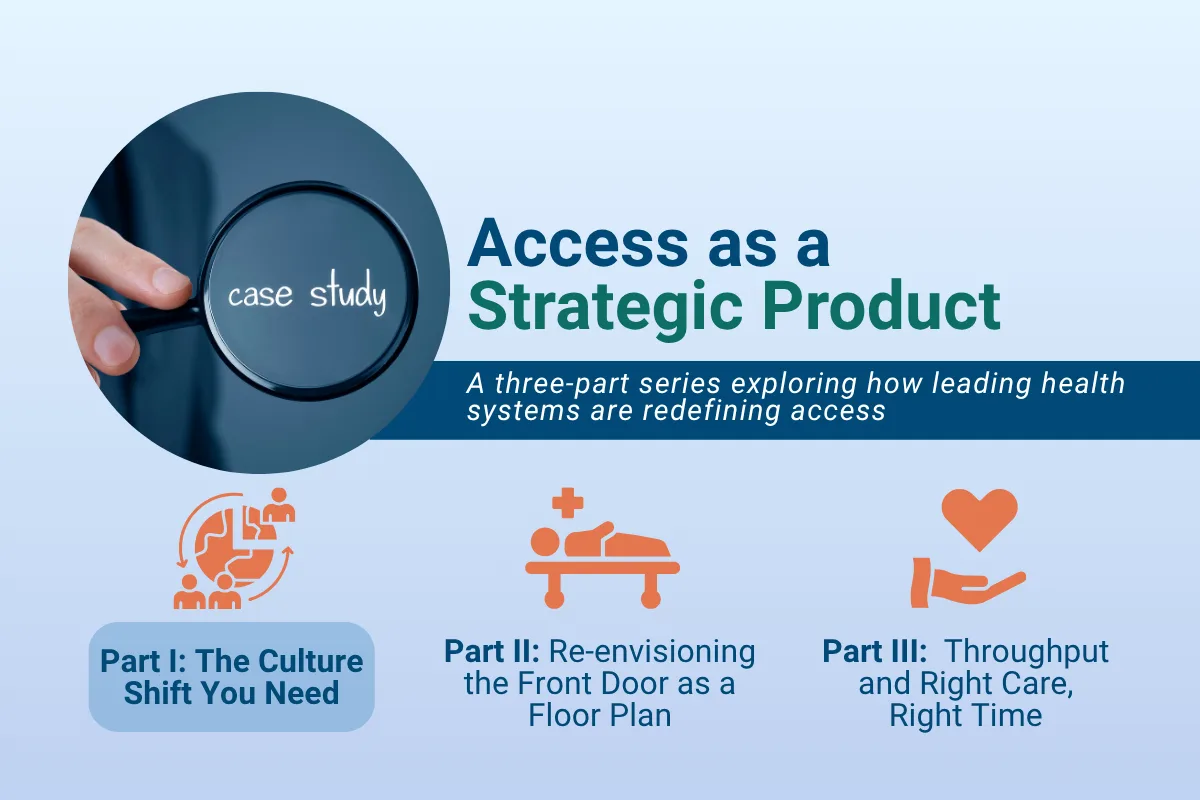
This article is the first in a series looking at how health systems are redefining access to care. Future articles will explore how to simplify the consumer experience of finding and entering care and how capacity, navigation, and care pathways enable timely and appropriate access.
Acknowledgement
Strategy Catalyst would like to thank the health system leaders from Emory Healthcare, Inova Health, Intermountain Health, and Sutter Health for their time, insight, and generosity in sharing the lessons and outcomes of their impactful work.