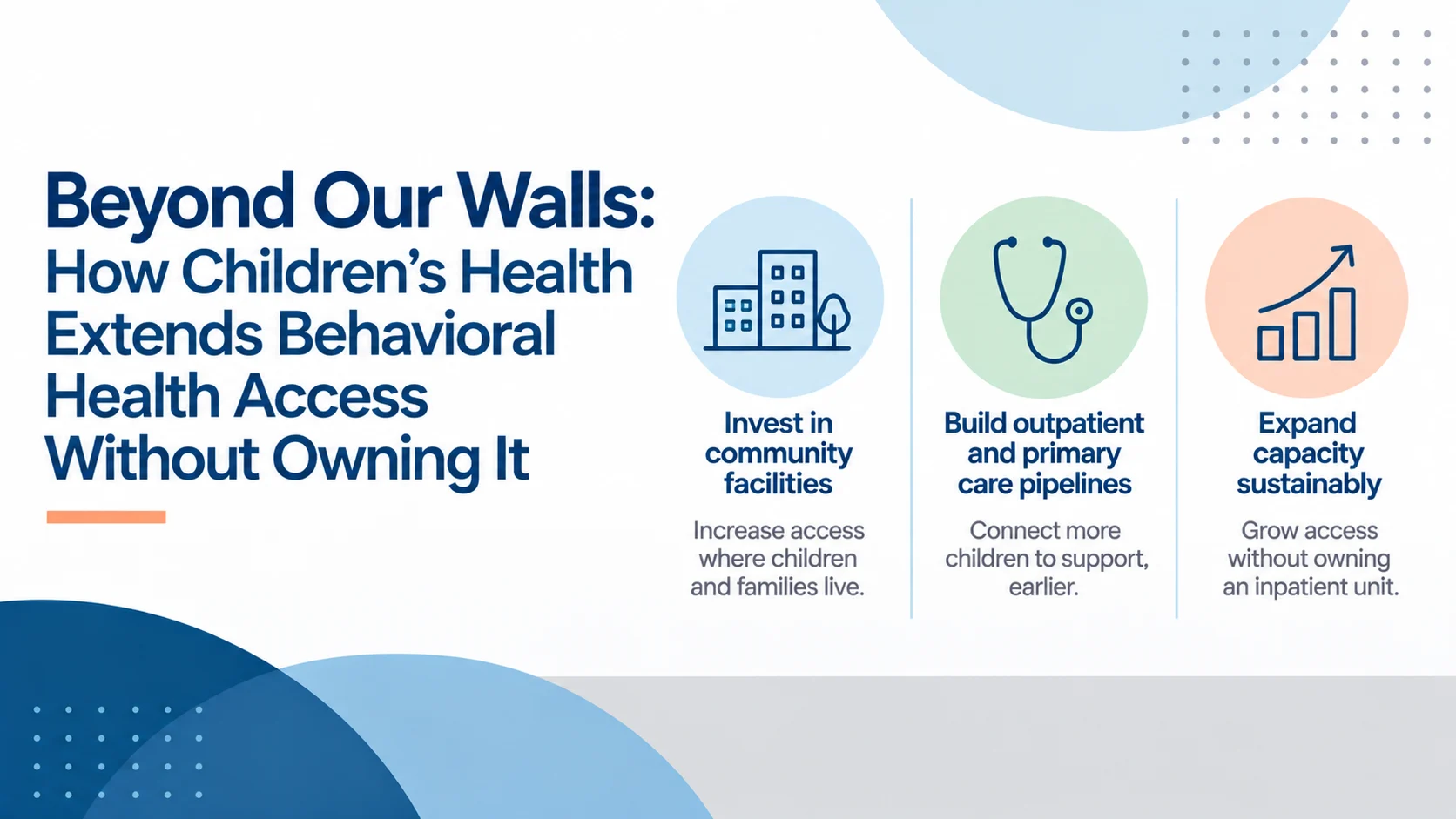
Strategy Catalyst's 2026 Service Line Portfolio Strategy Survey found partnership to be the most common strategic shift underway in behavioral health. Children's Health treats behavioral health as core to its mission but has concluded that the best way to improve community access is targeted partnership rather than serving every need itself. It closed its own 8-bed inpatient unit and contracted with two community hospitals for beds; as that arrangement wound down, it committed $261 million to the 92-bed pediatric wing of a state behavioral health hospital in which it holds no financial or operating interest. Its own outpatient behavioral health presence has meanwhile grown, embedded at the service-line level, advanced in primary care, and built into a widening ambulatory footprint, most recently with four outpatient programs at Plano.
Case Study Snapshot
Footprint: Pediatric AMC in Dallas-Fort Worth, Texas: 700 licensed beds across two facilities, 60 specialty care locations, and 151,108 ED visits in 2025. A new $5 billion pediatric campus is under construction in Dallas in partnership with UT Southwestern, replacing Children's Medical Center Dallas with 552 beds when it opens around 2031, and Children's Medical Center Plano opened a new tower in December 2024 that brought its bed count from 72 to 212. Ambulatory expansion has continued across the metroplex, with behavioral health integrated into the sites.
Challenge: Pediatric behavioral health need across the region is deep and growing, and it surfaces first in the EDs. Children's Health's 2025 community report, Beyond ABC, found diagnoses of emotional disturbances and addictive disorders rising across most of the eight North Texas counties it serves, and its advisory board named access to mental and behavioral health care the region's leading health priority.
Approach: A two-phased solution: a near-term per-diem partnership with two community behavioral health hospitals, then a $261 million donation toward the pediatric wing of a new state behavioral health hospital to sustain that capacity. Alongside both, Children's is extending outpatient specialty care to the areas where that demand is surfacing and moving milder conditions upstream into primary care.