Inside the Report
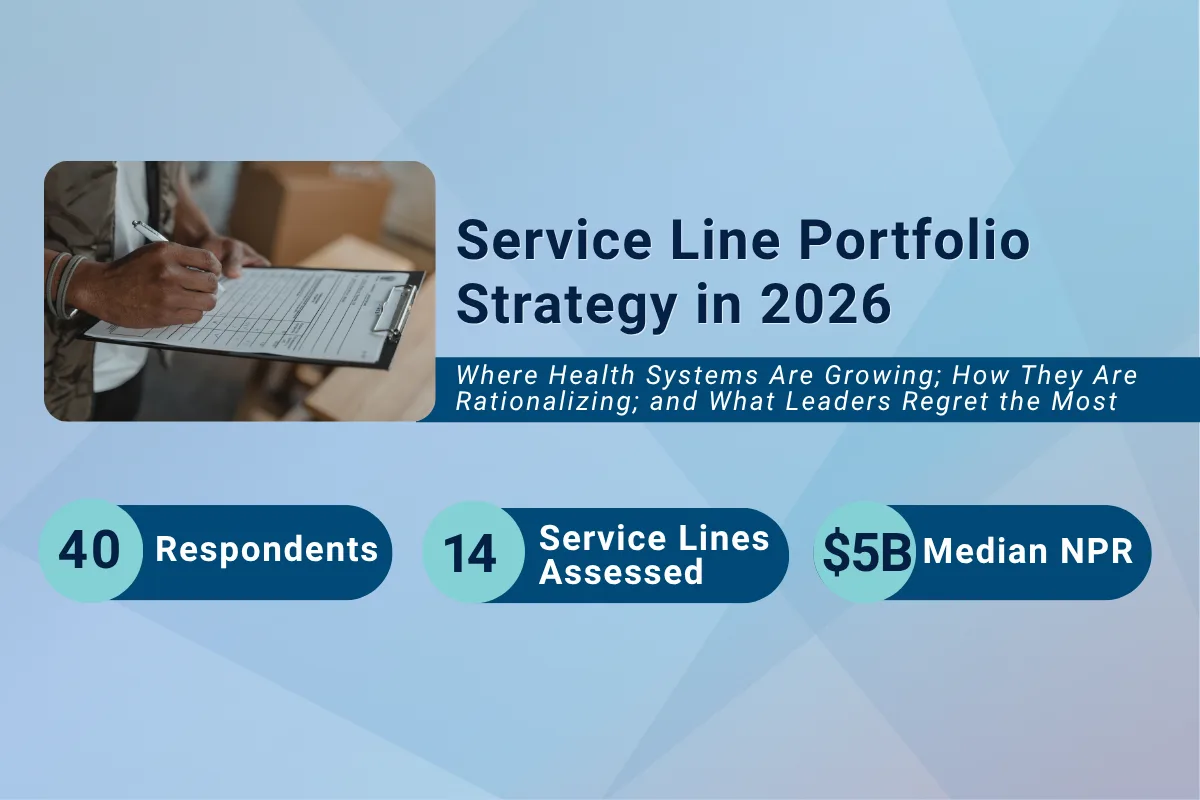
The 2026 Strategy Catalyst Service Line Portfolio Strategy Survey sampled 40 Chief Strategy Officers, Chief Operating Officers, EVPs/VPs of Strategy and Operations, and service line executives across U.S. health systems with over $500M in annual net patient revenue (NPR). The survey investigated how health systems balance financial performance with access, quality, and mission as they optimize their service line portfolios. Dive into the report to see which service lines are sustained as core pillars for strategic or mission-critical reasons, the factors shaping portfolio decisions, and how service line strategy is evolving in practice.
Key Takeaways
Health systems are managing three fundamental tensions: non-negotiable mission obligations, worsening financial realities, and an ever-evolving competitive environment. This survey offers a point-in-time snapshot of how they are doing so. The findings are organized around three paradoxes—patterns where what systems say, what they do, and what they have experienced diverge in ways consequential for portfolio strategy.
The Valuation Paradox looks at the gap between stated priorities and actual decisions.
The Rationalization Paradox examines how rationalization, optimization, and growth are intertwined, as the decision to pull back in one area is inseparable from the decision to grow somewhere else.
The Ambulatory Paradox explores how health systems have largely aligned around the strategic importance of ambulatory care, yet many leaders' biggest investment regrets stem from not moving sooner.