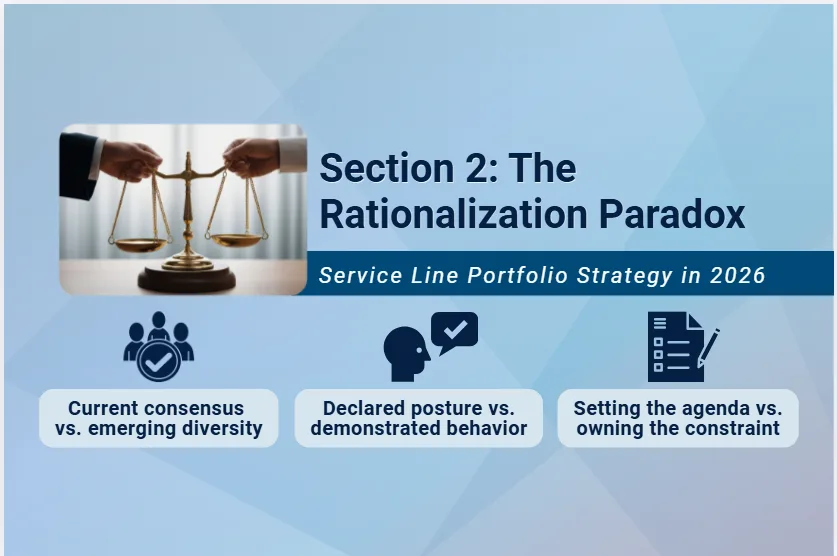
Section Summary
Health system strategy, operations, and service line leaders from across the U.S. assessed 14 service lines and evaluated each on its role in the system, margin performance, mission importance, and current strategic posture. What emerged is a consistent gap between the rationalization agenda leaders are setting and their control over the constraints that determine whether they can execute it. We call this the Rationalization Paradox.
This section is from Strategy Catalyst's report—Service Line Portfolio Strategy in 2026: Where Health Systems Are Growing; How They Are Rationalizing; and What Leaders Regret The Most. Access the report overview on the executive summary page, a breakdown of survey demographics, and Findings 1-3 in Section 1: The Valuation Paradox.
Key Section II Findings
Finding 3: Current consensus vs. emerging diversity
Among respondents, 90% report that rationalization is underway at their health system, and most expect the pace of change to accelerate over the next two years in nearly every form.
Finding 4: Declared posture vs. demonstrated behavior
53% of respondents expect their service line investments to be forward-looking in the next 1-2 years, up from 38% over the past 2-3 years. As systems shift forward, intended rationalization strategies expand beyond footprint moves.
Finding 5: Setting the agenda vs. owning the constraint
Physician alignment is the top-cited constraint to rationalization (65%), yet only 35% of respondents indicated that strategy leaders hold the authority to address it.