As patient populations diversify and competitive pressures intensify, health systems face increasing variability in how individuals seek care, evaluate providers, and engage with digital channels. Broad demographic targeting and uniform engagement strategies are no longer sufficient to drive loyalty, retention, or sustainable growth.
Consumer segmentation provides a structured, evidence-based approach to understanding that variability. By applying behavioral and psychographic insight alongside demographic and clinical data, health systems can identify distinct patterns in patient motivation, decision-making, and care-seeking behavior—and align outreach, care pathways, and resource allocation accordingly.
Strategy Catalyst’s recently published research examines how leading organizations translate segmentation from analytical insight into operating model discipline. Our central finding: segmentation creates enterprise value when it informs how care is designed, delivered, and governed—ensuring that communication, clinical delivery, and resource deployment are aligned to the realities of patient behavior.
Key Insights from Our Research
Insight #1: Behavioral and psychographic data reveal critical gaps between clinical assumptions and patient reality.
When engagement strategies rely primarily on demographic data, critical differences in patient motivation, trust orientation, and communication preferences remain hidden. These differences influence whether patients seek care, defer care, or disengage—making them central to growth, retention, and resource allocation decisions.
One system found that while clinicians estimated 80% of patients follow a "doctor knows best" mentality, only 22% actually did—meaning the remaining majority required different approaches to engagement. This gap represents material misalignment in care design, outreach investment, and capacity planning.
The value of behavioral research extends beyond attitudes toward providers:
Qualitative methods like ethnography and patient surveys clarify patient choices: which channels they trust, what barriers they face, and what motivates action.
Digital engagement analysis often challenges assumptions. Healthier patients are less likely to respond to digital notifications or proactively schedule follow-up care, demonstrating that “low risk” does not equate to “low friction.”
Behavioral segmentation surfaces these disconnects early, allowing systems to recalibrate engagement strategies and allocate resources more precisely.
Insight #2: Segmentation serves as a care delivery input, not solely as a tool for improving audience targeting.
When behavioral insights are treated as operational inputs, they inform how care is structured, delivered, and resourced. Persona research frequently reveals variation in provider preference, intervention tolerance, scheduling constraints, and desired autonomy—differences that have tangible implications for clinical delivery models.
Applying segmentation to care design surfaces opportunities that extend beyond outreach refinement:
Differentiated service offerings: preferences around visit frequency, provider interaction style, and care setting can inform tailored pathway options that improve retention and outcomes.
Precision resource allocation: segmentation enables systems to concentrate higher-touch, resource-intensive interventions where they are most needed, while extending greater flexibility based on health status—improving both capacity utilization and patient experience.
When embedded in care pathway planning, segmentation becomes a lever for operational efficiency as well as engagement effectiveness.
Insight #3: Embedding segmentation in governance, infrastructure, and multi-year strategy maximizes the ability to scale to enterprise.
Segmentation often originates within marketing or innovation teams, but scaled impact requires operationalization across clinical, IT, population health, and strategy functions. Because segmentation influences care design, digital infrastructure, and capital allocation, it requires executive sponsorship and coordinated governance.
Sustained execution depends on structural alignment:
Executive sponsorship and multi-year strategic integration that position segmentation as a core enterprise capability.
Aligned performance metrics tied to growth, loyalty, access, and retention objectives—not solely campaign performance.
Shared data infrastructure that integrates behavioral segmentation with clinical risk stratification within CRM or consumer platforms, enabling coordinated action at scale.
Without cross-functional accountability, segmentation efforts remain fragmented and episodic. With governance and infrastructure in place, segmentation becomes durable enterprise architecture—informing how growth strategies are prioritized, how resources are deployed, and how care delivery evolves over time.
Case Studies:
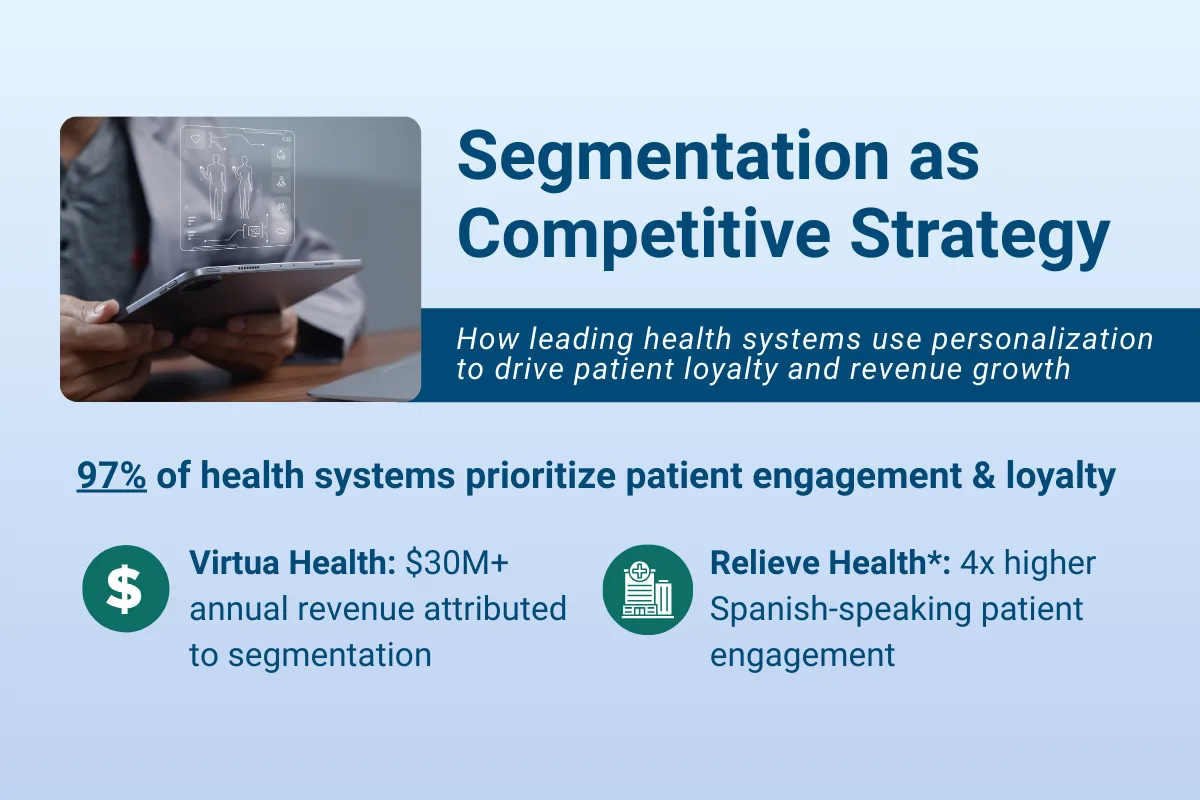
Virtua Health embedded behavioral segmentation into its multi-year strategic plan and integrated segments across nearly one million patient records. → Generated $30M+ in annual revenue attribution and sustained 30–40% campaign response rates.
Relieve Health* operationalized personas within priority service lines and deployed an AI-enabled assistant to personalize engagement. → Reduced prenatal visits by 50% for working moms and achieved 4x higher engagement among Spanish-speaking patients.
*Anonymized health system