Introduction:
TL/DR: Parental leave is a predictable, high-impact transition point; in patient-facing, shift-based teams, it’s also one of the most fragile. Our survey with The Health Management Academy surfaces practical and budget-friendly actions leaders can take right now to reduce coverage stress, enable safe re-entry, and improve retention.
Parental leave is one of life’s most profound transitions, filled with joy and exhaustion. For healthcare professionals with patient-facing responsibilities, the challenges are often amplified by shift work, unpredictable hours, physical demands, and systems that haven’t evolved as quickly as those in other industries.
For nurses, this transition is especially common: a majority are female of reproductive age, making parental leave routine in many workplaces. Amid an ongoing nursing shortage, every departure and return affects team morale, staffing, and patient care.
While research specific to nurse retention following parental leave is limited, existing data paints a concerning picture. Nearly 46% of nurses between ages 31 and 40 who are not currently working cite “family obligations” as the primary reason for leaving the workforce. And for those who stay, studies show that nurses who take parental leave experience significantly slower career progression than their childless male counterparts— even five years after the child birth.
These realities highlight the need for systems that not only accommodate parental leave but actively support nurses, protecting their well-being, careers, and workforce stability. The good news? The solutions are within reach and modest, well-designed interventions can have outsized impact.
Published by Michelle Yu, CEO, Josie
What We Heard from Nurse Leaders and Staff
In June 2025, our team at Josie conducted a survey (n = 52) with nurse leaders to better understand challenges and opportunities in supporting staff through parental leave. Participants reflected on both their leadership experiences and, where applicable, their own parental leave. Our results, including anonymized quotes, survey data, and suggested actions steps are summarized below.
Top Challenges for New Parent Nurses
Nurses revealed four common challenges, from emotional strain to logistical barriers during re-entry.
1. Emotional Toll: Many respondents shared how emotionally difficult it was to leave their child, especially after bonding during leave. One nurse said, “being a first-time mother away from family and leaving my child with a stranger was so challenging.” In the U.S., healthcare-industry paid parental leave averages far fewer weeks than many other sectors (around 7.9 weeks among top hospitals) adding to the pressure to return too soon.
Why it matters: Returning too early can erode focus and morale, increasing burnout and attrition.
2. Workload and Reentry: Nurses described the exhaustion of catching up, juggling new demands, and re-establishing routines while still adjusting to life as a parent. Nurses emphasized the importance of flexibility and a clear return plan that includes “who to call or get information on the return process [from].”
Why it matters: Without a structured re-entry plan and clear communication, nurses experience cognitive overload and frustration.
3. Administrative Burdens: Several nurses highlighted difficulties navigating HR processes and communication gaps that made returning harder. As one nurse summarized, “paperwork and leave coordination were confusing.”
Why it matters: Administrative friction erodes trust and makes a vulnerable time feel unnecessarily bureaucratic.
4. Pumping Challenges: Lactation support emerged as a key theme, and nurses described difficulty maintaining supply while managing full patient loads. One shared, “breastfeeding was tough when I had a full set of patients. Every three to four hours is so hard to do as a frontline RN.”
Why it matters: Inadequate space, accessibility, or protected time for pumping signals to staff that parent needs are secondary, undermining both equity and retention.
Top Challenges for Nurse Leaders
Nurse leaders described three key operational and personal challenges in managing parental leave transitions, often without the tools or clarity needed to do so effectively.
1. Coverage and Staffing: Leaders consistently pointed to coverage as the primary challenge. With ongoing shortages and unpredictable leave timing, even one absence can ripple through a unit. Leaders described navigating the challenge of “figuring out how to get that person covered from travelers or registry,” while “75 percent of employees want to return at a decreased FTE rate.”
Why it matters: Leaders want to show empathy, but without systemic coverage solutions, every leave becomes a balancing act between patient safety and staff well-being.
2. Return-to-Work and HR Coordination: Leaders frequently describe confusion and inconsistency around the re-entry process, especially when reinstating access, updating schedules, or completing required paperwork. Even experienced managers said they weren’t always sure which policies applied or what documentation HR needed. One nurse leader said, “getting their access reinstated and making sure they get all the HR forms correct” was a top challenge. Others mentioned not knowing exact leave and return dates was frustrating, making it difficult to plan ahead and ensure coverage.
Why it matters: Policies often exist, but they’re scattered across systems and hard to interpret. Without clear and timely communication and workflows between HR, IT, and nursing leadership, even the most supportive managers struggle to create a smooth, equitable return.
3. Balancing Team and Individual Needs: Many leaders spoke about the tension between being fair to the broader team and flexible with returning parents. One manager said, “ensuring fairness and avoiding burnout among remaining staff is the hardest part,” while another explained, “finding someone to cover if they have to leave to pump milk - as I support this, others become overwhelmed.”
Leaders also described the emotional complexity of supporting returning parents. As one noted, “many moms feel the maternity leave is too short,” and holding space for that while keeping the unit running can be difficult.
Why it matters: Leaders are navigating competing priorities without clear guidance and balancing logistics, fairness, and the emotional well-being of their staff. The result is inconsistency, stress, and compassion fatigue.
Solutions
We asked both nurse parents and nurse leaders (many of whom wear both hats) what has helped, or would help, make parental leave and return-to-work transitions smoother.
Top Solutions Cited by Nurse Parents
Nurses were clear: effective support does not require sweeping change. It requires humanity, communication, and planning.
1. Team and Leadership Support: Recent research reinforces what many nurses already know: feeling supported by leadership makes all the difference. A 2025 McKinsey report identified “feeling undervalued by leadership” as a top driver of nurse turnover, and a BMC Nursing review (Johnson et al., 2025) found supervisor support strongly influences return from leave. Our survey results echo those findings. Nurses repeatedly said that having leaders and coworkers who showed empathy, checked in, and made workloads manageable was the most helpful part of their return.
Why it matters: Trust and empathy from leaders reduce turnover and rebuild confidence, but leaders often lack the training to deliver it consistently. Targeted coaching and training can help equip leaders to show up in the right ways.
2. Pumping Support: Many nurses emphasized that something as simple as having a dedicated and accessible lactation space changed their entire return-to-work experience. One participant explained that “a dedicated place and time to pump” made it easier to manage patient care without sacrificing personal needs. Others shared how “having colleagues know I was going to need protected time to pump” helped them feel valued rather than guilty.
Why it matters: True support goes beyond compliance. A culture that normalizes and protects pumping time signals respect for working parents and strengthens retention.
3. Thoughtful Transition Plans: Respondents described how small acts of planning and flexibility eased their re-entry. One nurse recalled a manager who “sat down and went over what I missed,” while others highlighted phased schedules and proactive communication before their return.
Why it matters: Structured re-entry plans promote both safety and confidence, by helping returning nurses build their confidence and feel supported from day one.
4. Emotional and Social Support: Finally, nurses spoke about the power of peer connection and community. One participant shared that “hospital leaders and staff arranged for meals to be delivered to my home when I came home from the hospital which I thought was very thoughtful. Coworkers also talked me through filing for maternity leave and understanding my benefits.”
Why it matters: Connection combats isolation and normalizes the emotional complexity of balancing new parenthood with professional demands.
Top Solutions Cited by Nurse Leaders
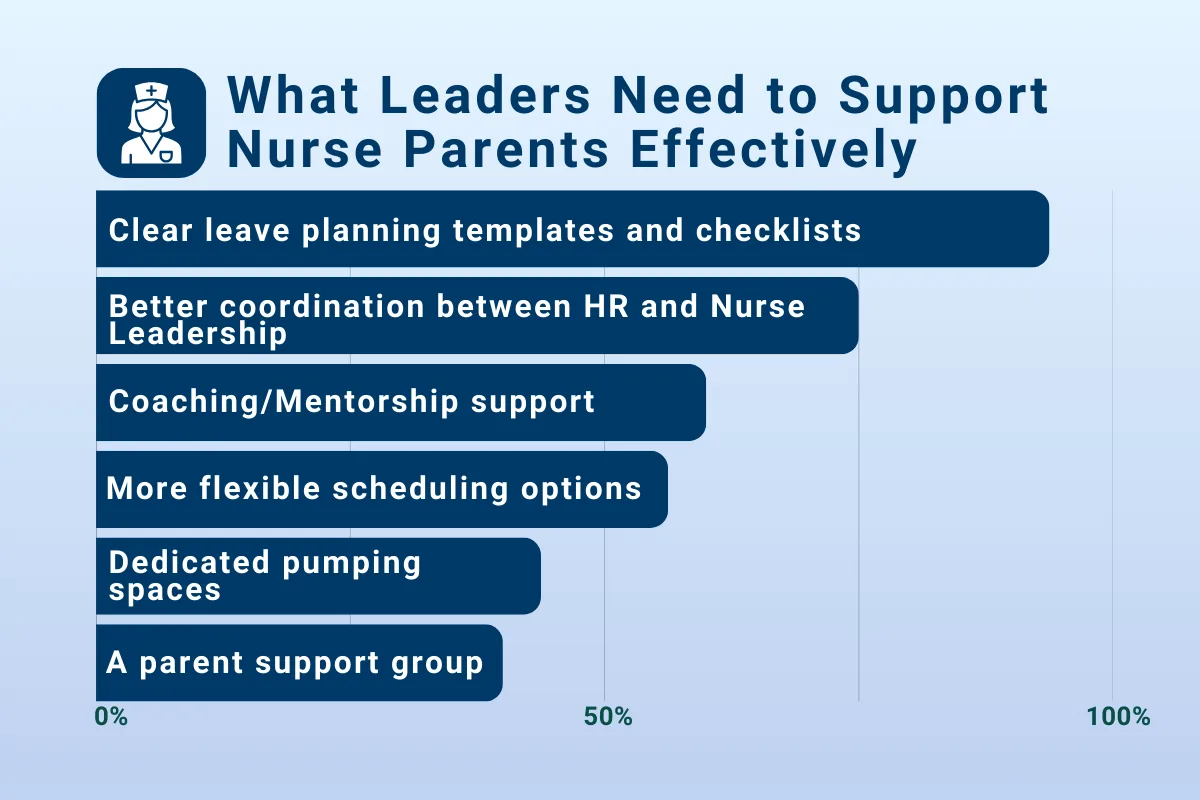
When asked what would make it easier to support nurse parents, leaders shared: they don’t need more policy, instead they need clarity and coordination.
1. Clear Leave Planning Templates and Checklists: When asked to select from a list of potential solutions to make parental leave easier to manage, the most common choice was simple but powerful: “Clear leave planning templates and checklists.” Many described wanting clear templates, timelines, and checklists that outline each step before, during, and after leave.
Why it matters: Consistency reduces anxiety for both leaders and team members. A standardized roadmap ensures nothing falls through the cracks and promotes an equitable experience across units.
2. Better Coordination Between HR and Nursing Leadership: Leaders frequently described gaps between HR processes and unit-level realities. “Better coordination between HR and nursing leadership” got the second most votes in our survey.
Why it matters: When HR and nursing operate in silos, managers are forced to improvise. Streamlined coordination saves time, reduces confusion, and builds trust between leaders and their teams.
3. More Flexible Scheduling Options and Re-boarding Time: Leaders emphasized flexibility as a key factor in retention, from phased returns and reduced hours to time for returning nurses to catch up on practice changes. They also noted that “timely approval of extra staff, i.e., contracted workers from the executive leadership team to support staffing needs during parental leaves.”
Why it matters: Flexibility and thoughtful re-boarding processes keeps experienced nurses in the workforce and signals that their needs - and their families - are valued.
4. Coaching or Mentorship Support: Several leaders said they wanted more structured development opportunities, like coaching or mentorship, to help them navigate the complexity of supporting team members through leave.
Why it matters: Many nurse managers learn through trial and error. Coaching builds leadership confidence, consistency, and a shared culture of empathy across teams.
Moving from Thought to Action
Nurse leaders don’t need more policies; they need actionable, system-level support. Here are five practical steps any organization can take to strengthen the parental-leave experience for nurses.
1. Convene a Cross-Functional Team and Publish a Standard Leave Roadmap: A simple timeline and checklist for both staff and leaders was the number one requested resource in our survey. Clear steps and points of contact for notice, coverage, and return reduce uncertainty and last-minute scrambles. One participant said that a reference guide with where to pump, who to contact, etc. would have been tremendously helpful. To support development, convene a cross-functional team, including HR, scheduling, unit leadership, and a recently returned parent, to align on a standardized process.
2. Design a Return Re-boarding Process: Offer phased schedules, re-orientation sessions, and/or a peer mentor for the first few weeks back. These strategies, along with structured manager check-ins significantly improve retention. One participant wrote that a “quick guide to practices changes” would have made a world of difference upon her return to work. Reboarding programs are common outside of healthcare and are often low-lift and budget-friendly. For example, advisory services firm Alix Partners launched a return-to-work peer mentoring program in 2022.
3. Protect Time and Space for Lactation: Ensure private rooms are close enough so employees can complete their pumping sessions within the allotted break time. Leading systems such as Mayo Clinic have standard “Lactation in the Workplace Checklist for Leaders,” that offers guidance on both logistical needs as well as how to have appropriate conversations with returning employees. UCSF Health has an entire landing page dedicated to highlighting lactation supports and other return-to-work tips for team members In many systems, this information exists but is scattered. Consolidating it into a single location improves access and clarity.
4. Normalize the Culture and Provide Manager Trainings: Say the quiet part out loud: “Leave is expected and supported here.” Train charge nurses and managers to communicate this clearly, distribute workloads fairly, and address peer resentment constructively. This is where coaching, mentorship, and training programs can equip leaders with the tools, language, and confidence to effectively lead through major life transitions such as parental leave. For example, The Washington University School of Medicine partnered with Josie to host a series of leadership trainings as part of their Faculty Development program, sharing practical yet powerful best practices to support new physician parents.
The Bottom Line
When systems make parental leave predictable, coordinated, and compassionate, they don’t just support individual nurses - they strengthen entire teams. A visible plan, aligned operations, flexible re-entry, real lactation support, and an affirming culture are not luxuries; they are retention strategies.
Parental leave isn’t just a policy; it’s a leadership moment. When organizations give nurse leaders the tools and time to support their teams, they protect both people and patient care. At Josie, we believe care for the caregiver should be the new standard. Because when nurses feel supported, everyone thrives.