In 2024, Nursing Catalyst surveyed more than 1,700 nurse managers to understand drivers of workload strain and unsustainability in frontline leadership. In 2026, we spoke with health system leaders to learn whether and how they have redesigned the nurse manager role since then. This case study highlights how one large health system partnered with an AI scheduling platform to reduce a significant source of nurse manager administrative burden. Click here to explore the full series.
Executive Summary
Ochsner Health used Nursing Catalyst’s benchmarking data and staff feedback to identify organizational sources of nurse manager burden. As a result, the system pursued a redesign of the role focused on role clarity and administrative relief.
Scheduling remained the most significant driver of nurse manager administrative burden, even after the role redesign. Nurse managers faced a system-wide problem rooted in fragmented, manual workflows that varied across Ochsner’s 40+ hospitals. To address this, Ochsner partnered with M7, a scheduling platform designed specifically for clinical workflows.
After a three-hospital pilot demonstrated meaningful time savings in scheduling and day-of-staffing, Ochsner rolled out the platform to all inpatient units across its hospitals in under five months.
How Ochsner Identified and Responded to Nurse Manager Burden
Frontline nurse managers are essential to advancing health system priorities – driving staff satisfaction, care quality, and workforce stability. Yet the role has become increasingly difficult to sustain as administrative work consumes more of managers' time.
To solve this problem, Ochsner first tackled the structural challenges of the nurse manager role. Staff feedback surfaced a clear pattern: nurses knew their own responsibilities but were unclear about what adjacent roles owned. Ochsner formed a working group that included nursing voices from every level of the organization, used that feedback to refine role scope, and communicated the changes back to team members.
Across each leadership role (from charge nurses through nurse directors), the working group defined responsibilities by daily, weekly, monthly, and quarterly cadences, distinguishing between clinical and administrative duties.
Ochsner realigned teams, making FTE and headcount decisions collaboratively, guided by the enterprise-level resources spread across the system and the unique needs of each department. Leadership cascaded messaging through one-on-one conversations to build trust and buy-in over time.
With clearer role boundaries and more structured expectations, nurse leaders were better positioned to focus on the high-value leadership work the role demands.
However, role clarity alone could not address the scheduling burden. At Ochsner, each scheduling cycle took days of manual work and required frequent manager involvement for trades, adjustments, and corrections. With 40+ hospitals across four states, scheduling workflows varied widely from facility to facility, and the lack of a unified approach meant that nurse leaders had no single view across units for day-of staffing. Staff, in turn, had limited visibility into their own schedules and available shift options.
Nursing Catalyst's benchmarking data helped confirm that these challenges were not unique to Ochsner. The external comparison points reinforced the case for investing in scheduling modernization and framed the opportunity around giving nurse managers more time for staff support and patient care.
Ochsner initially evaluated an existing vendor already in use across the system, but its provider scheduling tool was not a fit for nurse scheduling workflows. After connecting with M7’s founder at a conference, Ochsner’s team formed a partnership to address the issue.
How Ochsner Tackled Scheduling Burden with M7
M7: An AI-Powered Workforce Operations Platform for Healthcare
M7 is an AI-powered workforce operations platform built specifically for the realities of nursing workflows. Nurse-founded, the platform brings together scheduling, staffing, forecasting, and staff communication into one end-to-end system. Ochsner prioritized a tool that nurse managers would choose to use over the manual systems they were accustomed to, and M7's nurse-built design distinguished it from other options the team evaluated.
The platform supports preference-based scheduling, staff-initiated shift trades without manager approval, and house-wide supervisor visibility. M7 also tracks schedule satisfaction and other factors that impact nurse experience, giving leadership insight into how the platform is being received across units.
M7's auto-balance feature, known internally at Ochsner as "the magic button," generates a suggested schedule based on staff availability and unit needs. The feature preserves managerial autonomy by providing transparency into the decisions that drove the automated outcome, including how factors like fairness, seniority, preferences, skill mix, FTE leakage, and overtime minimization are weighted. Managers can review the reasoning and override or adjust before publishing the schedule. Acceptance rates of platform-generated schedules have increased over time as manager trust in the tool has grown.
Ochsner’s goal for the M7 partnership was to consolidate the fragmented systems that nurse managers had been working across. Ochsner integrated Workday with M7 to manage platform access and permissions. UKG remains Ochsner's source of truth for time and attendance, and M7 pulls in the relevant data and codes from UKG to support scheduling decisions. Ochsner also connected its own internally built predictive staffing model to M7, pulling in census data and historical trends so teams have the information they need to make informed staffing decisions in real time.
M7 Deployment
Ochsner launched a three-hospital pilot with M7 in April 2025 and progressed through five deployment waves, reaching full rollout across 40 facilities and 9,000+ staff by December 2025. For each site’s rollout, M7 assigned a dedicated operations lead to provide on-site presence and live call support throughout go-live.
Change management was critical to enabling successful deployment. M7's team worked with unit-level managers, ensuring they received hands-on training and had an opportunity to share feedback throughout the rollout and beyond. This process earned the trust of managers who initially pushed back. At one site, the strongest skeptics later became some of the platform’s most vocal advocates.
Central Staffing
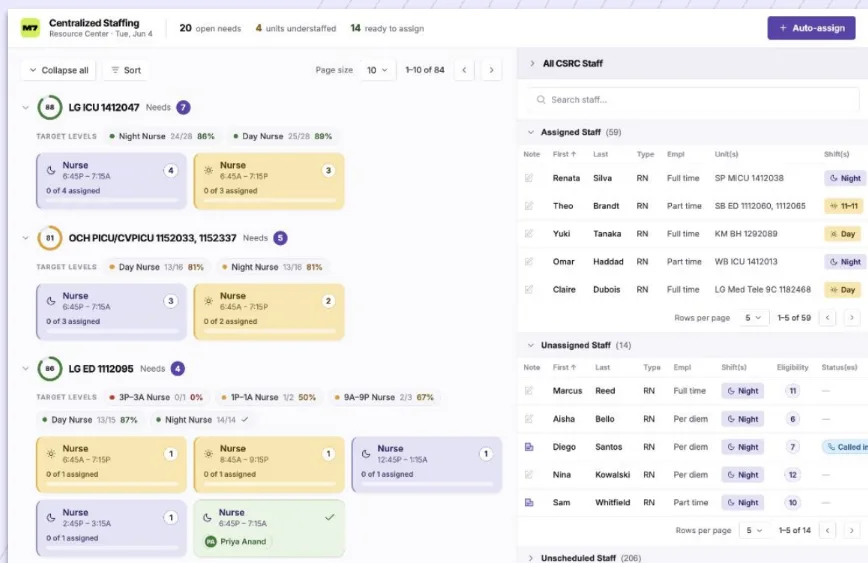
Ochsner then turned to its Central Staffing Resource Command Center, which had been managing open shift requests across its 40+ facilities through phone calls, emails, and fragmented spreadsheets. In partnership with Ochsner, M7 built a centralized staffing dashboard that gives the team a single view of open needs and available float pool staff. It now supports a float pool of more than 200 staff and redeployment of staff throughout the organization, filling over 2,000 shifts per week.

Early Outcomes and Impact
With role boundaries clarified and scheduling centralized through M7, Ochsner's early outcomes reflect what becomes possible when nurse managers spend less time on administrative work and more time leading their teams. Since the redesign began, Gallup nursing scores have improved, signaling early progress in workforce sentiment and leadership alignment.
Ochsner’s partnership with M7 has shown promising results to date across four areas:
1. Scheduling time savings: Nurse managers have seen roughly a 30% reduction in time spent building schedules each month, and an additional 25% reduction in time spent on daily staffing adjustments. Managers report using that recovered time for responsibilities such as mentorship and staff development.
2. Staff satisfaction: More than 80% of staff reported being satisfied or very satisfied with the M7 scheduling experience. Nearly half indicated that the platform factors into their decision to remain in their current role.
3. Overtime reduction: Greater visibility into staff requirements and total hours scheduled has reduced overtime built into original schedules and minimized incentive pay, limiting OT usage to filling last-minute needs.
4. Central staffing efficiency: The centralized staffing dashboard has streamlined coordinator workflows, enabling an approximately 30% reduction in staffing coordinator roles through attrition.
The M7 project won Ochsner Information Services' Project of the Year for 2025, competing against major Epic implementation projects. Ochsner attributed the recognition to the cross-functional collaboration the project required, bringing together IS teams, operational leaders, and workforce development staff. Following the system-wide nursing rollout, Ochsner and M7 are now expanding the platform to additional shift-based frontline teams, including surgical and procedural areas and other inpatient roles.
Lessons for Health System Leaders
Clarify role scope before making structural changes. Ochsner defined what each frontline leadership role should own before adjusting ratios or headcount. Nurse managers accepted the technology changes more readily because they clearly understood their responsibilities before M7 was introduced.
Select technology built for the clinical context, then invest in the rollout. Ochsner chose M7 specifically because it was designed by a nurse for nurse scheduling workflows, distinguishing it from provider-focused tools that did not translate to clinical scheduling needs. Dedicated site contacts, live call support, and on-site presence at every go-live wave were as important to adoption as the platform itself.
Plan for change management from the start. Making in-person coaching available at the unit level was more effective than virtual, asynchronous training. Skeptical managers became advocates when given time and support to build confidence and share feedback.
Acknowledgement and Implementation Rolodex
Nursing Catalyst would like to thank the team at Ochsner Health and Ilana Borkenstein at M7 for their time and generosity in sharing the outcomes of this impactful work. For more information, please reach out to:
Lauren Bergens – IS Clinical System Director, Ochsner Health, lauren.bergens@ochsner.org
Tiffany Murdock – Senior Vice President and Chief Nursing and Clinical Excellence Officer, Ochsner Health, tiffany.murdock@ochsner.org
Jordan Kahan – Manager of Nursing Strategy, Ochsner Health, jordan.kahan@ochsner.org
Deena Rome – AVP, IS Corporate Systems, Ochsner Health, deerome@ochsner.org
Bruce Weinberg – VP, Nursing Workforce Management, Ochsner Health, bruce.weinberg@ochsner.org
Ilana Borkenstein – CEO and Cofounder, M7 Health, ilana@m7health.com
About Ochsner Health
Ochsner Health is a not-for-profit health system based in the New Orleans metropolitan area of southeast Louisiana. The system encompasses 47 hospitals and 370+ health and urgent care centers across Louisiana, Mississippi, Alabama, and Texas.