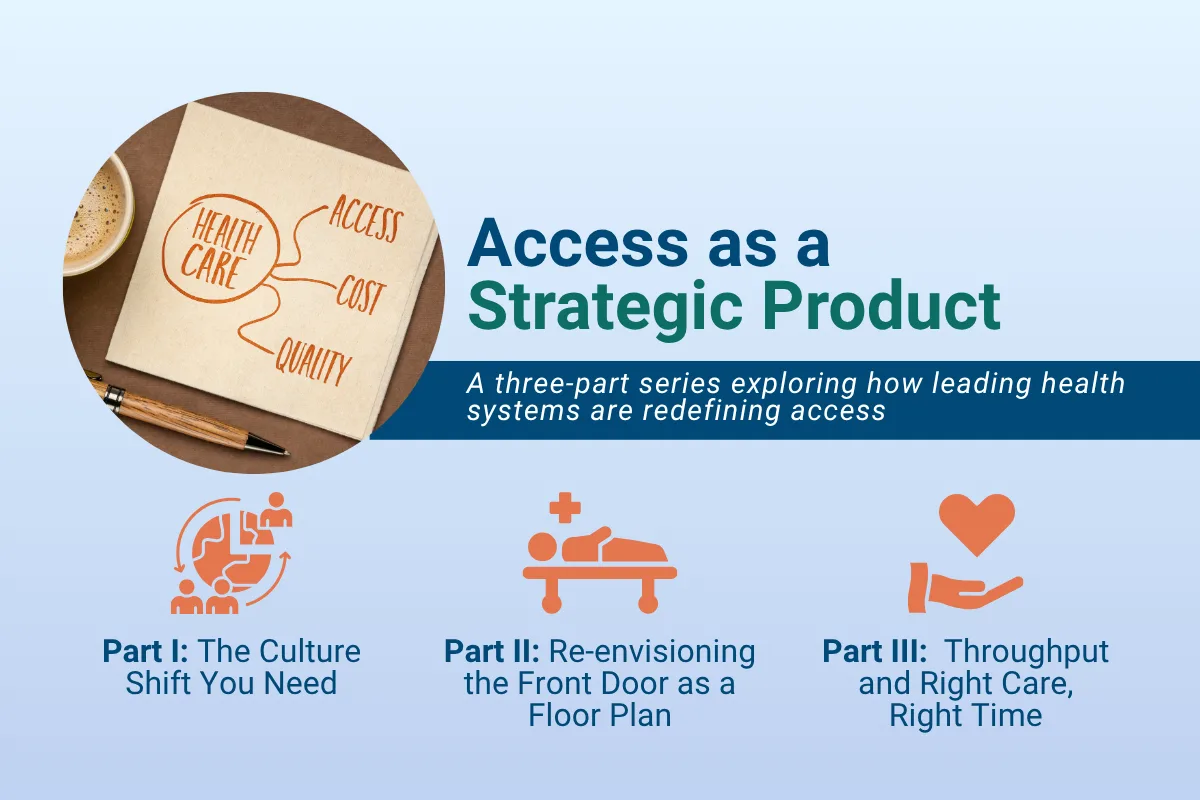
In an increasingly consumer-driven market, access has become the front line of growth, loyalty, and competitive differentiation. It determines how well demand is matched to capacity, how efficiently existing resources are used, and whether patients choose—and continue to choose—your health system.
Over the past several months, Strategy Catalyst has published a series of reports that treat access as a strategic differentiator, not a collection of fixes. We step back and examine the system conditions that make access succeed at scale: culture, standardization, governance, and redesigned care models. Rather than asking, “How did this system implement X?,” we ask, “What assumptions did they break, what structures did they change, and why did access finally improve?”
The result is a strategic playbook and discussion catalyzer for CSOs and leadership teams who want durable access improvement that fuels growth, experience, and margin—largely using the resources they already have. Our biggest takeaway is that access improves most when systems challenge assumptions.
Key Insights from our Research
Insight #1: Access transformation starts with culture. A cultural reorientation around shared enterprise responsibility catalyzes transformative change.
Transformative access improvement is fundamentally about culture, not capacity. Health systems that make progress do so by reframing access as a shared enterprise responsibility rather than a localized operational problem. When expectations, standards, and accountability vary across sites or service lines, access breaks down because the root issues are not addressed. Much of access capacity is trapped in design, standards, and flow.
Three reframes enable this cultural reorientation:
First, systems cannot hire their way out of access problems. Adding clinicians before fixing the basics scheduling logic, standardizing templates, and referral flow only allows for design inefficiencies.
Second, incremental improvement works until it doesn’t. When access gaps are large or entrenched, a time-bound reboot can reset expectations and accelerate alignment faster than pilots alone.
Third, patient experience is a leading indicator of access failure. Friction in finding, scheduling, or understanding next steps signals breakdowns well before appointment data does. Systems that treat consumer experience as a core management signal identify access failure earlier and mobilize faster around corrective action.

Insight #2: Access is as an entire floor plan of entry points, rather than a single front door, that must be designed around patient intent.
High-performing systems no longer design access around a single “front door.” Patients are not trying to enter the health system—they are trying to solve a problem as quickly and confidently as possible.
Access is an interconnected floor plan of digital, phone, referral, and in-person entry points that must feel intuitive, predictable, and aligned to intent. When systems orchestrate these touchpoints as a cohesive whole, patients move faster, capacity scales more reliably, and trust increases because the system behaves consistently.
The breakthrough is not necessarily about opening more doors but more so about making the entire floor plan easier to navigate, with every entry point reinforcing the same logic and promises.
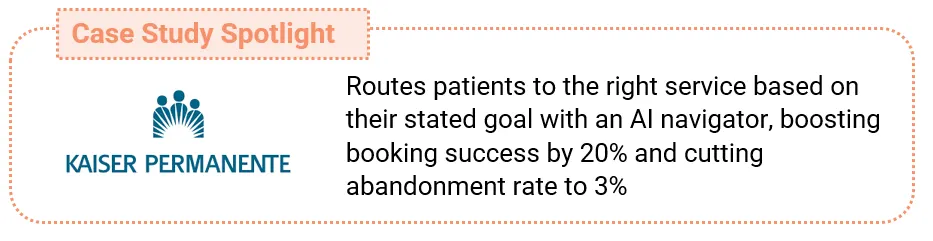
Insight #3: Executing on “right care, right time, right place” requires challenging long-standing assumptions about how access to care is designed.
Systems recognize that access constraints often persist because encounters, throughput decisions, and timelines have not been redesigned for today’s demand. Rather than optimizing within those constraints, organizations that are seeing notable improvements are redesigning the system itself—redefining what a visit looks like, who controls flow, and how early care can realistically occur.
They are delivering care earlier, more consistently, and at scale. Consider:
What if the right level of care is shared? Redesigned encounters, such as group visits, can expand capacity.
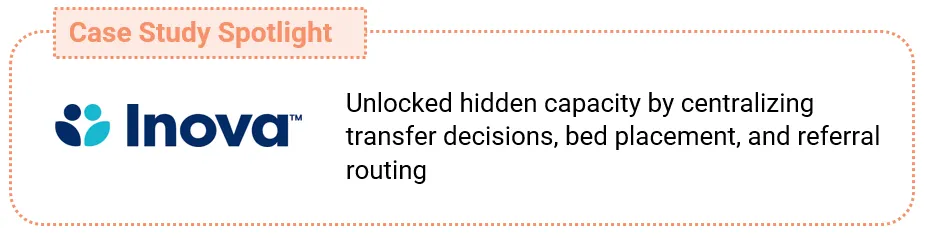
What if the right place of care is revealed through centralization? When throughput, transfers, bed placement, and referrals are managed with system-level visibility, hidden capacity emerges and downstream congestion eases.
What if the right time of care is earlier than you think is possible? Patients want to be seen sooner. Reducing scheduling, transfer, and referral friction and rethinking encounter models returns lost time to the system.
Links
This report series showcases 9 case studies of health systems that are leading the way in improving access across 3 strategic areas of focus:
Part I – The culture shift you need
Part III – Throughput and right care, right time
Featured Event
Strategy Catalyst Access Roundtable: What Leaders Must Rethink for 2026 | Register here
Join us on Wednesday, Feb. 25th at 12 pm ET for a virtual roundtable with two leaders from Cleveland Clinic and Inova Health who are questioning old assumptions about what access to care looks like and how to deliver it. What you'll hear:
What sparked their initiatives and the problems they set out to solve
How they proved value when ROI was hard to quantify or slow to materialize
The resistance they encountered and how they worked through it
How they are thinking about access investments as the landscape keeps shifting