Hospital-at-home and home-based care operator DispatchHealth is scaling back an offering that deployed advanced practice clinicians into patients' homes to help avoid emergency department visits, impacting clinical services for six health system partners. The company says it will continue to deploy paramedics and RNs to patient homes, however.
DispatchHealth provides technology, staffing, and logistics for hospital-at-home, ER avoidance, and post-discharge care, reporting more than 365,000 visits in 2025, withnearly 40 health system partners across 50 major metropolitan areas, including Cleveland Clinic, Kaiser Permanente, Mayo Clinic, and Hackensack Meridian Health.
The ED service cutback comes as part of a broader reorganization in the wake of DispatchHealth’s merger with Medically Home last year. The combined company announced plans in August to unbundle its logistics platform and remote patient monitoring equipment offerings from its clinical staffing services.
According to DispatchHealth President Erin Bartley, “The difference is that the model operates more as an enabler and an extension of a health system versus us continuing to be a full-service provider, which is how the ER alternative care model was really structured.”
So What?
1. Clinical staffing is a core competency for health systems, but technology often isn’t.
DispatchHealth’s ED-alternative offering really combined two related businesses: a technology platform and care delivery. While it has something unique to offer for the first part, the second part is something health systems already do themselves at scale across multiple service lines.
Recruiting, credentialing, and supervising APPs comes with costly overhead, and it’s possible DispatchHealth simply couldn’t cover those costs with FFS or value-based reimbursement. Replacing clinical staff with less credentialed and less costly replacements like paramedics could still help avoid some ED admissions through better triage.
At past THMA forums, CSOs have discussed the big picture question of what business health systems are in beyond simply owning hospitals (especially as that becomes less sustainable). One answer on offer here is that health systems are a clinical workforce platform in addition to being facility operators.
2. Partnerships leave health systems exposed to a vendor’s changing priorities and business model.
Clinical partnerships can help health systems expand services without building every capability internally, but they also give outside companies influence over the scope and continuity of those offerings. A merger or strategic pivot can reshape the services a vendor provides, even when the health system’s needs haven’t changed. DispatchHealth’s post-merger restructuring illustrates that exposure: partners that relied on a full-service offering may now need to assume more clinical responsibilities or find another provider.
For health systems, the takeaway is to evaluate a partner’s long-term commitment and business model alongside its current capabilities. Contracts should establish clear responsibilities and transition support if services change, while contingency plans should identify what the system could bring in-house or shift to another partner. Outsourcing care delivery still requires an internal plan for sustaining it.
3. Some health systems emphasize treating home care as part of a broader care continuum, not as a standalone product.
Health systems that opt to replace DispatchHealth’s clinical services with their own might have better opportunities to coordinate care and control the patient experience from start to finish.
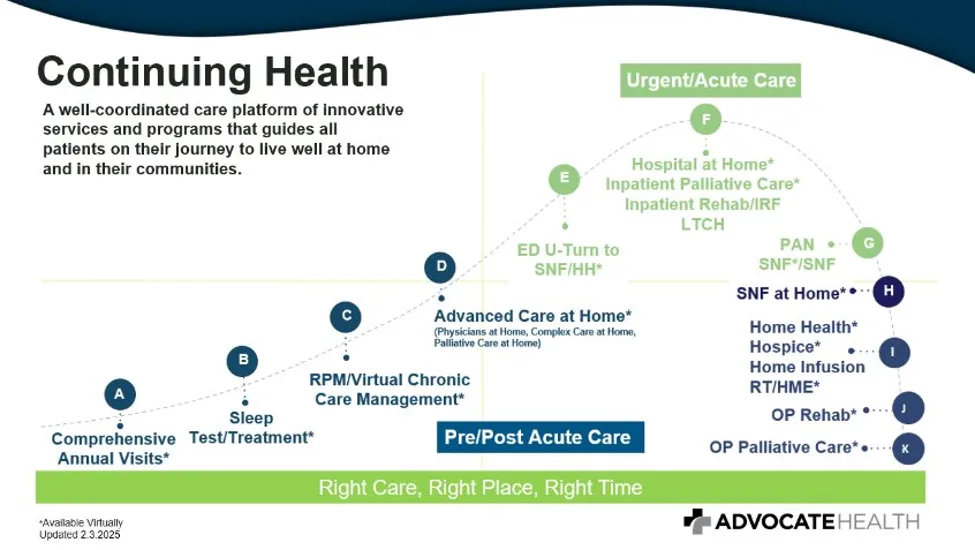
Systems with scaled H@H and home care capabilities like Advocate Health have found success by integrating a spectrum of home-based services across different acuity levels. By improving coordination across the patient journey, they maximize the use of home-based assets where it makes sense and then route the patient back through more traditional care pathways the rest of the time.